Table of Contents
- Why Locksmith License Verification Matters Before You Hire
- How to Do a Locksmith License Lookup in Your State
- How to Verify a Locksmith’s Insurance and Bonding
- Questions to Ask a Locksmith Before They Start Work
- How to Spot a Locksmith Scam and Red Flags in Advertising
- National vs. State-Level Licensing: Why Requirements Differ
- What to Do When a License or Insurance Check Falls Short
- Frequently Asked Questions
Last Updated: September 12, 2026
Why Locksmith License Verification Matters Before You Hire
A locksmith arrives at your door within minutes of your call, drills the lock, and hands you a bill that looks nothing like the quote. That scenario plays out often enough that consumer protection agencies across the country regularly warn about it. Verifying a locksmith’s credentials before you hand over your keys is the single most effective way to avoid it. This guide from BDS Locksmith walks through exactly how to verify a locksmith license and insurance, step by step, so you know who is standing at your door and who is responsible if something goes wrong.
A locksmith license is a state-issued credential confirming that a technician has met the legal requirements to perform lock and key work in that jurisdiction. Not every state issues one, which is precisely why verification trips people up.
The stakes are practical, not theoretical. An unlicensed technician may have no general liability insurance, no surety bond, and no background check on record. If that person damages your door, copies your keys, or overcharges you, you have little recourse. A licensed, bonded, and insured locksmith gives you a paper trail, a regulatory board to complain to, and a company that carries liability coverage for mistakes. BDS Locksmith operates as a licensed, bonded, and insured mobile locksmith serving the South Bay Area.
The most common mistake is hiring from the first search result without checking credentials. Emergency lockouts create pressure, and scammers count on that pressure. Spend two minutes on verification before you agree to any work.
How to Do a Locksmith License Lookup in Your State
A locksmith license lookup is the process of searching your state’s official licensing database for a technician or company’s registration number and status. The lookup takes a few minutes and requires only the company name or license number.
Start by asking the dispatcher for the company’s full legal name and license number before anyone is dispatched. A legitimate operation provides both without hesitation. If the person on the phone dodges the question or says the number is “on the truck,” treat that as a signal to call someone else.
Why There Is No National Locksmith License Search
The single biggest source of confusion is that there is no national locksmith license. Licensing is handled at the state level, and only some states require a locksmith license at all. That means there is no single federal database, no universal lookup portal, and no one website where you can type a name and see every locksmith in the country. Any site advertising a “national locksmith license lookup” is either aggregating state records (often stale) or selling leads.
This fragmentation is not a bug you can work around, it is the system. Your verification path depends entirely on which state you are standing in when the technician arrives. A license that is valid in one state may mean nothing in the next state over, and a company operating across state lines may hold credentials in one jurisdiction but not another.
Finding the Right Board for Your State
Most states that regulate locksmiths place oversight with one of three bodies:
- A dedicated locksmith licensing division (common in states with strict statutes)
- A department of consumer affairs or professional regulation
- A contractor or occupational licensing board that folds locksmiths in with other trades
Search your state’s name plus “locksmith license lookup” and look for a domain ending in .gov. That suffix matters. Third-party directory sites often scrape outdated records and present them as current, and some charge for information the state gives away free.
If your search returns nothing official, your state may not license locksmiths at all. In that case, the board does not exist, and you cannot verify a license that was never issued. Shift your entire verification effort to insurance, bonding, and business registration instead, see the next section.
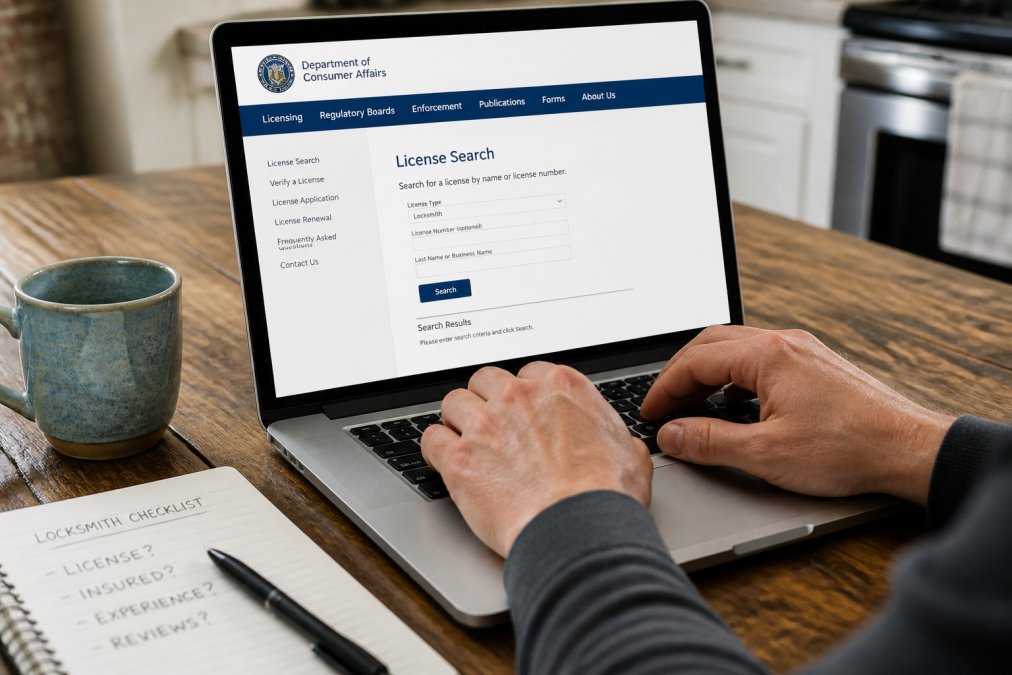
What a Real Lookup Flow Looks Like
Once you land on the official portal, the search usually accepts one of three inputs: license number, business name, or individual name. Some states allow all three; others allow only one. If you only have the technician’s first name, you may not be able to search at all, which is why you ask for the full legal business name and license number up front.
A typical result page shows the licensee’s name, the license type, the license number, the issue and expiration dates, and a status field. Some boards also publish complaint history or disciplinary actions on the same page. If your state’s portal does not show disciplinary history, look for a separate “licensee complaints” or “enforcement actions” search on the same site.
What to Check on a License Record (Registration Number, Status, Disciplinary Action)
A license record contains more than a name. Confirm four things:
- Registration number matches the number the company gave you
- Status reads active, not expired, suspended, or revoked
- Business name and address match what appears on the truck and invoice
- Disciplinary action history, which many boards publish alongside the license
That last item is the one people skip. A current license with three unresolved complaints tells a very different story than a clean record. Public search tools exist precisely so you can check this before a service call, not after.
If the license number the dispatcher gives you does not return a result, do not assume the portal is broken. Ask the company to confirm the number and the exact name it is registered under. If it still does not match, treat that as a failed verification and call someone else.
How to Verify a Locksmith’s Insurance and Bonding
Insurance and bonding verification means confirming, directly with the insurer or bond company, that coverage is active on the date of your service. A certificate alone is not proof. Certificates can be outdated, cancelled, or forged.
Ask for a certificate of insurance and a surety bond number. Then verify both independently. This is the step where scam operations fall apart, because maintaining real coverage costs money and they avoid it.
Reading a Certificate of Insurance Line by Line
A certificate of insurance (COI) is a one-page summary your locksmith’s insurer issues to show what coverage is in force. It is not the policy itself, and it is not proof the policy is still active, but it is the document you start with. Here is what each field tells you:
- Named insured, the legal business name. It should match the name on the license and the invoice. If the COI lists an individual’s name but the company is an LLC, ask why.
- Insurer name and NAIC number, the carrier issuing the policy. The NAIC number is a five-digit identifier you can look up to confirm the insurer is real and licensed in your state.
- Policy number, the identifier you will use when you call the insurer to confirm the policy is active.
- Policy effective and expiration dates, the coverage window. A certificate that expired last month proves nothing about today.
- Coverage types and limits, general liability, workers’ compensation, commercial auto, and any umbrella policy, each with a dollar limit per occurrence and in the aggregate.
- Certificate holder, sometimes the property manager or building owner, not you. That is normal; it does not reduce your protection.
General liability insurance covers property damage and injuries caused during the job (iii.org). If a technician cracks your door frame or breaks a window during an emergency service call, this is the coverage that responds. Workers’ compensation covers the technician if they are injured on your property (dol.gov). Without it, an injured worker could pursue you directly, which is a risk most homeowners never consider.
How to Confirm the Policy Is Actually Active
A COI can be issued the day coverage starts and never updated when the policy lapses. To confirm coverage is live, do three things:
- Call the insurer’s claims or verification line, not the agent named on the certificate. Use the phone number on the insurer’s own website, not the number printed on the COI, a forged certificate will list a fake number.
- Give the policy number and named insured and ask the representative to confirm the policy is in force today and the limits shown on the COI are accurate.
- Ask for the effective date and any pending cancellation. A policy can be active but already scheduled to cancel for nonpayment, which means it may not cover a job scheduled for next week.
If the locksmith cannot or will not give you the insurer’s name and policy number, that is the answer. A legitimate business carries coverage because it needs it and will share the details without friction.
Confirming a Surety Bond Directly With the Issuing Company
A surety bond is a three-party agreement among the locksmith (the principal), the bonding company (the surety), and you or the state (the obligee). If the locksmith fails to perform or violates the law, the bond company, not the locksmith, pays valid claims up to the bond amount.
Call the bonding company listed on the certificate and confirm the bond is active and the coverage amount. This takes one phone call. Ask for the bond number, the principal’s legal name, the bond amount, and the effective dates. If the company cannot or will not provide the bond company’s contact information, that is a red flag in locksmith advertising and a reason to walk away.
Photograph the license plate, company name, and any paperwork before work begins. If a dispute arises later, you have documentation that a regulatory board or insurer can act on.
A certificate of insurance is a claim, not proof. The only way to know coverage is active is to call the insurer directly using a phone number you looked up yourself, never one printed on the certificate.
Questions to Ask a Locksmith Before They Start Work
Ask for the license number, the insurance carrier, and a written estimate before any work begins. A professional answers all three without friction.
Use this checklist when you call:
- What is your full legal business name and license number?
- Can you email a certificate of insurance before you arrive?
- Is the quote on the phone the final price, or can it change on site?
- Do you charge a separate service call fee?
- Who is responsible if my door or lock is damaged during entry?
- Are you the technician who will actually arrive, or a dispatcher for someone else?
That last question matters more than most people realize. Some operations advertise locally but route calls to out-of-area subcontractors with no connection to your community. A local, licensed, bonded, and insured company can answer every one of these questions on the spot.
How to Spot a Locksmith Scam and Red Flags in Advertising
Scam operations share recognizable patterns. Learning them takes five minutes and can save you hundreds.
Watch for these warning signs:
- No physical address, only a phone number and a generic website
- Quotes far below market rate on the phone, followed by a much higher on-site charge
- Unmarked vehicles or vehicles with no company name
- Pressure to pay cash only, with no receipt offered
- Refusal to provide a license number or insurance certificate
- Drilling a lock immediately without first trying non-destructive entry methods
The Federal Trade Commission maintains consumer guidance on protecting yourself from fraudulent service providers, including locksmiths, at FTC consumer protection guidance. Reporting a scam there also helps regulators track patterns.
Legitimate companies welcome verification. They carry the credentials because they earned them, and they will happily show you. BDS Locksmith provides free estimates and documents credentials on request.
National vs. State-Level Licensing: Why Requirements Differ
There is no single national locksmith license. Requirements vary dramatically from state to state, and some states have no licensing requirement at all.
Some states mandate fingerprinting, a written examination, and a background check before issuing a license. Others require only a business permit and registration. A few have no statutory requirements whatsoever. This inconsistency is the core problem for consumers: a “licensed” locksmith in one state may hold nothing more than a business permit, while the same title in a neighboring state reflects a genuine credential verification process.
Because of this, “licensed” on a website means nothing on its own. You have to know what your state requires and confirm the technician actually meets it. When licensing is weak or absent, insurance and bonding become your primary consumer protection tools. Ask which credentials apply in your state and verify each one directly.
What to Do When a License or Insurance Check Falls Short
When a check fails, stop the job and find another provider. Do not negotiate, and do not let the technician start work “while you sort it out.”
If the license is expired or the insurance cannot be confirmed, you have three options:
- Decline the service and call a verified provider
- File a complaint with your state’s licensing board or consumer affairs office, citing the registration number and the issue
- Report suspected fraud to the FTC and your state attorney general’s consumer protection division
Document everything: names, phone numbers, quotes, and any paperwork you received. Boards act on patterns, and your report may protect the next customer.
The good news is that a verified provider is usually a phone call away. BDS Locksmith’s owner and operator, Benjamin, has helped thousands of Bay Area natives get out of tough situations regarding their lockouts, and every job starts with proof of credentials on request. The company offers 24/7 emergency service, same-day availability, mobile on-site work for automotive, residential, and commercial jobs, and a 5% military discount. You can reach the team at (408) 300-4369 or request a free estimate through the BDS Locksmith website.
Verifying credentials takes minutes, but skipping that step can cost you far more than a service call. Whether you are locked out of your home, need a car key replaced, or want a deadbolt installed, working with a licensed, bonded, and insured locksmith protects your property and your wallet. BDS Locksmith brings licensed, bonded, and insured technicians to your door with same-day availability, free estimates, and a 100% customer satisfaction commitment. Get started with BDS Locksmith and secure your home, business, or vehicle with confidence.
Frequently Asked Questions
Why is it important to hire a licensed locksmith?
A valid locksmith license shows the technician has passed a background check, fingerprinting, and any written examination your state requires. Licensing boards can discipline or revoke credentials for fraud, so a current license is your first filter against a scam. It also confirms the person has a business permit and meets statutory requirements, which matters when you are letting someone into your home or car.
How do I verify a locksmith’s insurance coverage?
Ask for a certificate of insurance before work begins. Check that general liability insurance is active, the coverage dates have not lapsed, and the business name matches the license. Then call the insurer listed on the certificate to confirm the policy is still in force. If a locksmith cannot produce a certificate or the insurer has no record, treat that as a reason to walk away.
Do all states require locksmiths to be licensed?
No. Some states have no statewide locksmith license at all, while others require registration, fingerprinting, or a written examination. That means a technician who is fully compliant in one state may hold no credentials in another. Always check your own state’s regulatory board or verification portal rather than relying on a national claim, and ask for a state-issued ID to match the record.
What are the red flags of an unlicensed locksmith?
Watch for a generic name like ’24-Hour Locksmith’ with no address, a quote far below local rates, a technician who arrives in an unmarked vehicle, and pressure to pay cash before the work is done. Refusing to show a license or insurance certificate, or giving a registration number that does not match the state lookup, are the clearest signs of an unlicensed contractor.