Table of Contents
- Average Car Key Replacement Cost in 2026: The Quick Numbers
- What Drives the Cost: Key Type, Model, and Programming
- Car Key Fob Programming Cost: What You Actually Pay For
- Lost Car Key Replacement Without a Spare: Your Options
- Dealership vs. Automotive Locksmith: Where to Get It Done
- How to Replace Car Key Fob Battery (and When You Need To)
- Emergency Replacement Services and Mobile Locksmith Fees
- How to Save Money on Car Key Replacement
- Frequently Asked Questions
Last Updated: September 11, 2026
Average Car Key Replacement Cost in 2026: The Quick Numbers
The average car key replacement cost in 2026 depends almost entirely on what kind of key you’ve lost. A traditional metal key blade is the cheapest to duplicate, while a smart proximity key with push-to-start ignition sits at the top of the range.
Here’s the honest version: there’s no single national price, because the number swings with your key type, your vehicle’s immobilizer system, and whether you go to a dealership service department or an automotive locksmith. What we can do is break the cost into its parts so you know exactly what you’re paying for.
Car key replacement is the process of cutting, programming, and pairing a new key or key fob to your vehicle’s immobilizer so the car will start and the doors will unlock.
That definition matters because the programming is often the expensive half, not the metal.
Key Replacement Cost Comparison Table
Use this table to see how the major key types compare on the factors that drive price. Exact figures vary by make and model, so treat the cost column as a relative ranking rather than a fixed quote.
| Key Type | Typical Cost Tier | Programming Needed? | Where It’s Done |
|---|---|---|---|
| Traditional metal key | Lowest | No | Hardware store or locksmith |
| Transponder chip key | Low to moderate | Yes | Locksmith or dealer |
| Remote head key | Moderate | Yes | Locksmith or dealer |
| Smart proximity key | Highest | Yes, plus synchronization | Dealer or equipped locksmith |
The jump from a basic blade to a smart key isn’t marketing. Each step adds electronics the car has to recognize.
What Drives the Cost: Key Type, Model, and Programming
Three variables set your price: the key technology, the vehicle itself, and the labor to program the key to the immobilizer system. A luxury model with a smart proximity key costs more than a base-model sedan with a transponder chip, even when both are cut by the same locksmith on the same day.
Vehicle make and model matter because the security code and programming procedure are specific to each platform. Some vehicles allow a mobile locksmith to add a key through the OBDII port in minutes. Others require a diagnostic scan tool with manufacturer authorization, which pushes the job toward a dealership service department.
- Key technology: traditional, transponder, remote head, or smart proximity
- Vehicle platform: the immobilizer system and security code requirements
- Labor: cutting the key blade, programming, and frequency synchronization
- Access: mobile service versus bringing the vehicle in
Ask any provider whether your specific year, make, and model can be programmed on-site before you agree to anything. Some platforms are dealer-only, and a good locksmith will tell you that upfront rather than after the tow.
Traditional Keys vs. Transponder, Remote, and Smart Keys
A traditional key is a cut metal blade with no electronics. A transponder chip key hides a small chip in the head that the immobilizer system reads before allowing the engine to start. A remote head key combines the blade and the lock buttons in one unit. A smart proximity key, sometimes called a push-to-start key, communicates wirelessly so the car starts with a button press.
The practical difference for your wallet: only the traditional key skips programming entirely. Every other type needs to be paired to your vehicle.
Programming Requirements for Modern Keys
Programming is the step that pairs a new key or fob to your car’s computer. It requires the correct security code or authorization for your vehicle, and it’s why a blank key bought online often can’t simply be cut and used. The immobilizer system will reject any key it doesn’t recognize.
This is where the “cheap key online” plan usually collapses. The blank may cost little, but you still need someone with the right diagnostic scan tool and the authorization to program it.
Car Key Fob Programming Cost: What You Actually Pay For
Car key fob programming cost covers labor and equipment access, not the physical key. When you pay for programming, you’re paying for the technician’s time, the diagnostic scan tool, and the authorization to write your vehicle’s security code to the new fob. That’s why the same fob can cost different amounts at different providers.
A common mistake is assuming the fob price and the programming price are the same thing. They’re separate line items. A fob you supply yourself still needs programming, and many shops charge the labor regardless of where the hardware came from. Confirm whether your quote bundles both or lists them apart.
- Fob hardware: the physical remote or smart key unit
- Programming labor: pairing the fob to the immobilizer
- Frequency synchronization: matching the fob’s signal to the receiver
- Key cutting: cutting the blade if the fob includes one
If a provider quotes you one flat number, ask what’s inside it. Transparency here separates a fair estimate from a surprise.
Lost Car Key Replacement Without a Spare: Your Options
Lost car key replacement without a spare is the most expensive scenario because there’s no original to copy. With no spare, the provider must originate a new key from your vehicle’s data rather than duplicate an existing one, which takes more time and equipment.
You have three realistic paths. A dealership service department can pull your vehicle’s key code from the manufacturer. A mobile automotive locksmith can often originate and program a key on-site using VIN verification. Or, if the vehicle is immobilized in a risky spot, you may need a tow first.
- Dealer route: reliable, usually the most expensive, may require the vehicle on-site
- Mobile locksmith route: convenient, often cheaper, depends on the platform
- Tow-then-replace route: adds towing costs on top of everything else
If you’ve lost all keys, don’t let anyone cut a key without first verifying ownership. A legitimate provider will ask for your vehicle identification number and proof you own the car. Anyone who skips that step is a risk to you and your vehicle.
Dealership vs. Automotive Locksmith: Where to Get It Done
Choosing between a dealership and an automotive locksmith comes down to cost, convenience, and whether your vehicle can be programmed outside the dealer network. Dealerships have manufacturer authorization and OEM replacement parts. Independent locksmiths offer mobile service and often lower labor, but not every platform is accessible to them.
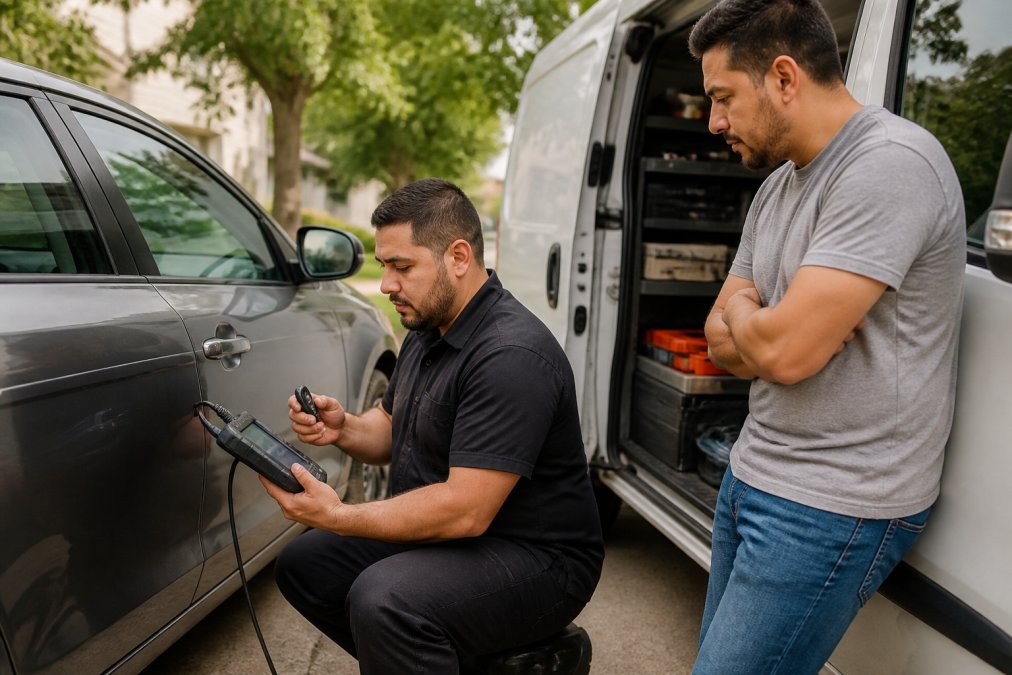
The dealership advantage is certainty. They know your platform, they carry OEM keys, and the job is done to manufacturer spec. The trade-off is price and time, since you may need an appointment and the vehicle on-site.
The locksmith advantage is speed and mobility. A mobile provider comes to your driveway, programs on-site when the platform allows, and typically charges less for labor. The catch is coverage: some newer or high-security platforms are dealer-only.
| Factor | Dealership | Automotive Locksmith |
|---|---|---|
| Cost | Usually higher | Often lower |
| Convenience | Vehicle may need to be brought in | Mobile, on-site service |
| Parts | OEM replacement | OEM or aftermarket key |
| Platform coverage | Broadest | Depends on equipment |
| Speed | Appointment-based | Same-day often possible |
Our mobile units carry diagnostic scan tools and handle most makes and models on-site, so you’re not stuck waiting on a service bay.
How to Replace Car Key Fob Battery (and When You Need To)
Replacing a car key fob battery is the cheapest fix in the entire key-replacement conversation, and it’s the first thing to rule out before you spend money on a new fob or programming. If your fob is losing range, needs multiple presses, or your push-to-start ignition complains about the key, the battery is the likely culprit, not the fob itself.
The cost gap here is enormous. A coin-cell battery is a few dollars at any drugstore or big-box retailer, while a replacement smart fob plus programming runs into the hundreds. That’s why diagnosing the battery first is the single highest-return five minutes in this whole guide.
Here’s the process:
- Pop open the fob casing along the seam using a coin or small flat tool. Many fobs have a visible notch; others hide the seam under a slide-off cover.
- Note the battery size printed on the old cell. Common sizes are CR2032, CR2025, and CR1632, the number is stamped on the metal face.
- Slide the old battery out and insert the new one with the correct polarity. The flat side (positive) usually faces up, but confirm against the old cell’s orientation.
- Snap the casing closed and test the lock, unlock, and start functions.
- If the fob still fails, the issue may be the fob itself, the vehicle’s receiver, or a lost pairing, not the battery.
Battery Fix vs. Fob Replacement: Knowing Which You Need
The decision point is simple: if a fresh battery restores full range and all buttons work, you’re done for a few dollars. If the fob still won’t sync, won’t hold a pairing, or has physical damage (cracked casing, corroded contacts, water exposure), you’re now in replacement territory, and that’s where the cost jumps from single digits to triple digits.
A few patterns worth knowing:
- Intermittent range loss that improves after a battery swap usually means the battery was the problem. No programming needed.
- A fob that works only when held against the start button often indicates a weak battery or a failing fob antenna, not a programming fault.
- A fob that stopped working after a battery swap can mean the battery was inserted backward, the contacts were bent, or the fob lost its pairing during the swap. Re-seat the battery first; if it still fails, you may need reprogramming.
- Two fobs failing at once points to the vehicle’s receiver module or a system-wide issue, not the fobs.
Buy the battery before you call anyone. If a fresh cell fixes the fob, you’ve avoided a service call, a diagnostic fee, and possibly a new fob, the three line items that make up most of a key replacement bill.
When a Battery Swap Isn’t the Answer
If the fob is dead after a confirmed-good battery, the next step is determining whether the fob needs reprogramming or replacement. Reprogramming is a labor charge; replacement is hardware plus labor. A provider should be able to tell you which one you’re facing before you authorize work, and a reputable one will test the fob’s signal rather than assume.
One more cost trap: some vehicles store the fob’s pairing in the vehicle, not the fob. Swapping a battery shouldn’t erase that pairing, but a fob that was already marginal can fail to re-establish it. If that happens, you’re paying for programming, not for the battery, and not for a new fob. Ask the provider to quote programming separately so you can see exactly what you’re buying.
Emergency Replacement Services and Mobile Locksmith Fees
Emergency replacement services cost more than scheduled work, and the reason is timing, not the key. When you’re locked out at midnight or stranded in a parking garage, you’re paying for a technician to drop everything and drive to you, often outside normal business hours. The key hardware and programming labor stay roughly the same as a scheduled job; the premium lives in the dispatch and the clock.
Understanding the fee anatomy is what lets you tell a fair emergency quote from an inflated one. A mobile locksmith bill typically stacks four components:
- Service call / dispatch fee: the base charge to send a mobile unit to your location. This is the floor of the bill and applies even if the job turns out to be a simple lockout.
- After-hours premium: an added percentage or flat surcharge for nights, weekends, and holidays. This is the single biggest swing factor in an emergency quote.
- Key hardware: the blank, transponder chip, remote head, or smart fob itself. This cost is largely fixed by your vehicle’s key type, not by the hour.
- Programming and cutting labor: pairing the key to the immobilizer and cutting the blade. Same core cost as a scheduled appointment.
A lockout, where you still have your key but it’s locked inside, is a different service from key replacement. A lockout is entry only and is usually the cheapest emergency call. Key replacement means originating or duplicating a key, which adds hardware and programming on top of the dispatch fee. Make sure the provider knows which one you actually need before they quote, because the two are priced differently.
What Actually Drives the Emergency Premium
Three variables move an emergency quote up or down:
- Time of day. A weekday afternoon call is the cheapest. Nights, weekends, and holidays carry the highest premium.
- Distance. Mobile providers price the drive. A call across town costs more than one a few miles away.
- Vehicle platform. A dealer-only platform may force a tow regardless of the hour, which stacks towing on top of the key cost.
If you can safely wait until normal business hours, you’ll almost always pay less for the same job. If you can’t, because the car is blocking traffic, in an unsafe location, or you need it immediately, a licensed mobile provider is still frequently cheaper than a tow plus a dealership appointment, especially once you factor in the dealer’s own after-hours limitations.
Before you authorize any emergency work, confirm the provider is licensed and insured, and ask for the total out-the-door price, dispatch, after-hours premium, key, and programming, in one number. A quote that only covers the service call is not a quote for the job.
Roadside Assistance and Insurance Dispatch: Who Actually Pays
This is where the emergency bill often gets smaller than drivers expect, or larger, if they assume coverage they don’t have. Two separate systems can pay for an emergency key call, and they work differently:
- Roadside assistance plans (whether bundled with a new-car warranty, a membership program, or a credit card benefit) often dispatch their own network and may cover lockout service, a tow, or a jump-start. Key replacement coverage, when it exists, is frequently capped or limited to a set number of claims per year.
- Auto insurance may include key replacement or lockout reimbursement as an optional add-on, not a standard feature. Some policies reimburse you after you pay; others require you to use an approved provider. The difference determines whether you can call the locksmith you want or must wait for the insurer’s network.
Check three things before you need them: whether your plan covers key replacement or only lockout service, whether there’s a reimbursement cap, and whether you’re required to use an approved provider. A plan that only covers lockouts won’t help if you’ve lost the key entirely, and that’s the scenario where the bill is highest.
Insurance Information Institute guide to auto policy coverage explains how optional coverages are typically structured, which helps you spot whether key replacement is included or sold separately.
The emergency premium is mostly about when you call, not what you need. If your roadside or insurance plan covers key replacement, use its network; if it only covers lockouts, price a mobile locksmith directly and confirm the total before dispatch.
How to Save Money on Car Key Replacement
The cheapest car key replacement is the one you avoid needing. A spare key kept in a safe place turns a potential emergency into a routine errand. Beyond that, a few habits consistently lower what you pay.
- Get a spare before you lose your only key. Duplicating an existing key is far cheaper than originating one from scratch.
- Compare a dealer quote against a mobile locksmith quote. The gap is often significant for the same job.
- Ask about the total, not the key. Confirm the quote includes cutting, programming, and any service call.
- Check your coverage. Some auto policies and roadside assistance plans include key replacement or lockout service.
The single biggest cost saver is having a working spare. Originating a key with no original to copy is the most expensive path, and it’s the one a spare eliminates.
Insurance and Roadside Assistance Fine Print
Insurance and roadside assistance coverage for keys is where the fine print matters most. Many drivers assume their policy covers a lost key, then discover the benefit is capped, requires a specific provider, or only applies to lockouts rather than full replacement. Read the key and lockout clauses before you need them.
Check three things: whether key replacement is covered or only lockout service, whether there’s a reimbursement cap, and whether you must use an approved provider. Some plans reimburse you after the fact; others dispatch their own network. Knowing which you have prevents a surprise bill.
Insurance Information Institute guide to auto policy coverage explains how optional coverages are typically structured, which helps you spot whether key replacement is included or sold separately.
DIY Programming Feasibility and VIN-Based Key Cutting
DIY programming is feasible for a narrow set of older vehicles and almost never for modern smart keys. Some older platforms let you program a spare fob using a sequence of in-car steps. Newer vehicles with push-to-start ignition and rolling security codes require a diagnostic scan tool and manufacturer authorization that owners don’t have.
VIN-based key cutting is the other gap most guides skip. Instead of cloning a physical key, a provider can cut a new key blade from your vehicle identification number, then program it. This matters when you have no original to copy, because cloning requires an existing key. VIN verification also confirms you own the vehicle, which is why legitimate providers ask for it.
NHTSA guidance on vehicle identification numbers outlines what a VIN contains and why it’s the standard reference for identifying a specific vehicle.
The takeaway: DIY is worth trying only on older, non-smart platforms. For anything with an immobilizer and a push-to-start button, plan on professional programming.
Frequently Asked Questions
How much should I pay for a replacement car key?
What you pay depends on the key type. A traditional metal key blade costs the least, while a transponder, remote head, or smart proximity key costs more because of the chip and programming. Dealerships and automotive locksmiths set their own prices, so request a written quote before work starts. For a current figure, check BDS Locksmith’s pricing page or call (408) 300-4369 for a free estimate.
Can a locksmith replace a smart key fob?
Yes. An automotive locksmith can supply and program smart proximity keys for most makes and models using a diagnostic scan tool that connects to the vehicle’s immobilizer system through the OBDII port. Mobile locksmiths often complete the job on site, which avoids towing costs. Confirm the locksmith carries the correct aftermarket or OEM replacement fob for your vehicle identification number before booking.
Does insurance cover lost car keys?
Standard auto insurance usually does not cover a lost key. Some policies include key replacement as an add-on, and certain roadside assistance plans reimburse lockout or key service up to a set limit. Read the fine print: many plans exclude lost keys and only cover lockouts. Renters and homeowners policies rarely apply because the key belongs to the vehicle, not the property.
Why is replacing a car key so expensive?
Modern keys contain a transponder chip that must be cut and programmed to match your vehicle’s immobilizer system. The dealer or locksmith needs a key cutting machine, a security code, and a diagnostic scan tool. Smart keys add frequency synchronization and push-to-start pairing. Labor, equipment, and the cost of the blank itself all add up, which is why a fob can cost several times more than an old metal key.
Losing your only key is stressful, and the last thing you need is a vague quote that balloons on arrival. BDS Locksmith provides mobile car key replacement and ignition repair across the area, with licensed, bonded, and insured technicians, transparent estimates before we start, and same-day availability. We offer free estimates, competitive pricing, and a 5% military discount. Call (408) 300-4369 and get your key replaced without the dealership markup.