Table of Contents
- Can You Install a Deadbolt in a Rental Apartment?
- Getting Landlord Permission to Install a Deadbolt
- Local Housing Laws and Building Code Requirements
- Checking Your Apartment Door and Frame Compatibility
- How to Install a Deadbolt on an Apartment Door
- Apartment Door Lock Rekeying as an Alternative
- Non-Destructive Security Options for Renters
- Deadbolt Installation Cost and Responsibility
- Restoring Your Apartment Before Move-Out
- Common Mistakes to Avoid When Installing a Deadbolt
- Frequently Asked Questions
Last Updated: October 5, 2026
Can You Install a Deadbolt in a Rental Apartment?
Yes, you can install a deadbolt in a rental apartment, but you need your landlord’s written permission first. Installing deadbolts in rental apartments is legal in most jurisdictions, but your lease and local housing laws determine what you’re allowed to do. The key distinction: you can’t make permanent changes to the property without consent, and a deadbolt installation typically requires drilling into the door frame.
Before you buy tools or schedule work, understand what your lease says. Some landlords allow deadbolt installation freely. Others require written approval. A few prohibit it entirely. The safest approach is always to ask in writing and get written approval back.
Your landlord’s primary concern is usually simple: will the deadbolt damage the door or frame? A professional installation causes minimal damage. Removing the lock at move-out restores the door to near-original condition. That’s what makes this conversation easier.
Getting Landlord Permission to Install a Deadbolt
Permission is not a single yes-or-no question. It is a short process with four checkpoints: the lease, the local rule, the written request, and the written approval. Work through them in order so you do not buy hardware you cannot install.
Step 1: Read the lease for the lock clause
Search the lease for the words alter, modify, improve, fixture, lock, and security. Most leases put lock changes under a general alterations clause, not a dedicated lock clause. Note three things:
- Whether alterations require prior written consent.
- Whether approved alterations must be restored at move-out.
- Whether the landlord reserves the right to retain a key to every lock.
If the lease is silent on locks, the default is usually that you still need consent before drilling. Silence is not permission.
Step 2: Confirm the local rule
State landlord-tenant statutes and local housing codes set the floor, and they vary widely. Some jurisdictions require the landlord to provide and maintain a deadbolt on exterior doors; others only require a locking doorknob. Some cities require the landlord to rekey or change locks at the start of a tenancy or on request. A few restrict who may hold keys.
Check, in this order:
- Your state’s landlord-tenant statute (often titled “Residential Landlord and Tenant Act”).
- Your city or county housing code.
- Your state or local tenant-rights handbook, which many agencies publish as a plain-language guide.
Search terms that surface official sources: “[state] residential landlord tenant act locks,” “[city] housing code deadbolt,” and “[state] tenant rights security deposit alterations.” Prefer .gov sources over forums.
Step 3: Send a written request
Email is fine and creates a timestamped record. Keep it short, specific, and easy to approve. State the unit, the exact change, who will do the work, and your restoration commitment. Attach a photo of the door and a product link or spec sheet so the landlord can see the hardware.
Step 4: Get written approval back
Approval must be in writing and should name the specific change. A verbal “sure” is hard to prove later. If the landlord approves by phone, reply by email summarizing the approval and ask them to confirm. Save the thread and a PDF export.
If your landlord requires a key, ask whether they want a copy of the new deadbolt key or prefer to keep the original lock and have you rekey it instead. Getting this in writing prevents a dispute at move-out.
Written Request Template
Dear [Landlord/Property Manager Name],
I’m writing to request written permission to install a deadbolt on the entry door of [address and unit number]. The door currently has [describe existing lock]. I plan to install a [brand/model] deadbolt with a thumb-turn interior, installed by [me / a licensed locksmith].
I will restore the door to its current condition before move-out, including filling any holes and reinstalling the original hardware. I’m happy to provide the product spec sheet, a photo of the door, and a certificate of insurance if a locksmith does the work.
Please reply to confirm whether this is approved, or let me know what you would need to approve it.
Thank you,
[Your Name]
[Your Phone Number]
[Your Email]
If the request is denied
A denial is not automatically unlawful. Whether you have recourse depends on your state and city. If the local code requires a deadbolt and the door lacks one, the landlord may be obligated to install it themselves, often at their expense. In that case, the right move is a written repair request citing the code section, not a self-install. If the code does not require it and the lease prohibits alterations, your practical options are the non-destructive alternatives covered below or negotiating a rent adjustment in exchange for the upgrade.
Do not install first and ask later. Unapproved drilling can be treated as lease damage, which puts your security deposit and, in serious cases, your tenancy at risk. Written approval protects you more than a good installation does.
State and local tenant-rights handbooks
Local Housing Laws and Building Code Requirements
Two separate rule sets govern a deadbolt: the housing or property-maintenance code that says whether a lock must exist, and the building and fire code that says what kind of lock is allowed. A lock can satisfy one and violate the other.
Housing and property-maintenance codes
These set the minimum security a landlord must provide. Depending on the jurisdiction, an exterior door may be required to have a deadbolt, a locking doorknob, or a specified minimum lock. Some codes require the landlord to rekey or change locks at the start of a tenancy or when a key is lost or a tenant requests it. Some cap how many keys the landlord may keep.
Where a deadbolt is required, the obligation usually falls on the landlord, not the tenant, and the landlord generally cannot charge the tenant for a code-required lock. That matters for your request: if the code requires it, you are asking the landlord to meet a legal duty, not asking a favor.
Fire and egress codes
Egress rules exist so occupants can leave quickly without a key, tool, or special knowledge. The practical implications for a deadbolt:
- Single-cylinder deadbolt (thumb-turn inside, key outside): the standard residential choice and the one that generally satisfies egress because you can exit by turning the thumb-turn.
- Double-cylinder deadbolt (key on both sides): requires a key to exit. Many residential codes restrict or prohibit these on egress doors because they can trap occupants during a fire or emergency, and they are especially hazardous near glass where a key could be out of reach. Avoid them on an apartment entry door.
- Exit-only and panic hardware: in some multifamily buildings, egress doors must release with a single motion. A deadbolt that requires two motions (unlock, then turn the knob) can conflict with that requirement on certain doors.
Never install a double-cylinder deadbolt on an apartment entry door. Even where it is not explicitly banned, it can obstruct emergency exit and may violate the building’s fire code. Choose a single-cylinder deadbolt with a thumb-turn interior.
Accessibility and fair-housing considerations
If the unit is subject to accessibility requirements, hardware must be operable without tight grasping, pinching, or twisting, and with limited force. A thumb-turn deadbolt generally meets this; a keyed interior side does not. In buildings with a common entry or an intercom system, adding a second lock to the unit door can also conflict with building rules about who controls access.
How to check your specific rules
- Identify your state’s landlord-tenant statute and search it for “locks,” “deadbolt,” and “security.”
- Pull your city or county housing code and search the same terms.
- Check the local fire code or ask the building manager whether the entry door is an egress door with specific hardware requirements.
- If you are in a multifamily building, ask the property manager whether the building has a master-key or access-control policy that limits what you can install.
Local housing and building code lookups
Before buying a deadbolt, confirm two things: that your local housing code does not already require the landlord to install one, and that a single-cylinder, thumb-turn deadbolt is permitted on your entry door. If either answer is unclear, ask the landlord or the local housing authority in writing.
Checking Your Apartment Door and Frame Compatibility
Not all doors accept deadbolts easily. Before you buy a lock, measure your door and check the frame condition.
Door thickness matters. Standard deadbolts fit doors 1.375 to 1.75 inches thick. Measure your door with a ruler or caliper. Place it against the edge of the closed door. If your door is thicker or thinner than this range, you’ll need a specialty lock.
Check the frame. Open your door and look at the strike plate area, the metal piece where the latch hits the frame. Is the wood solid or does it look soft or damaged? A weak frame won’t hold screws properly. If the frame is damaged, you may need to reinforce it before installing the deadbolt.
Look for existing holes. Many apartments already have a hole for a deadbolt. If one exists, installation is simpler. If not, you’ll need to drill one.
Test the door swing. Close the door and check the gap between the door and frame. It should be even. A warped door makes deadbolt alignment difficult.
If your door has issues, contact your landlord. Request they repair the frame or replace the door before you install the lock. This protects both of you.
How to Install a Deadbolt on an Apartment Door
Installing deadbolts in rental apartments is straightforward if you follow the right steps. The process takes 1-2 hours for most people.
Tools and Materials You’ll Need
Gather these items before starting:
- Deadbolt lock kit (includes bolt, cylinder, strike plate, and screws)
- Tape measure
- Pencil
- Drill with bits (typically 1-1/8″ and 2-1/8″ bits for standard deadbolts)
- Hole saw or spade bit (if drilling new holes)
- Screwdriver (Phillips and flathead)
- Chisel (for strike plate mortise)
- Sandpaper
- Shims or wood filler (for frame adjustments)
Step-by-Step Installation Process
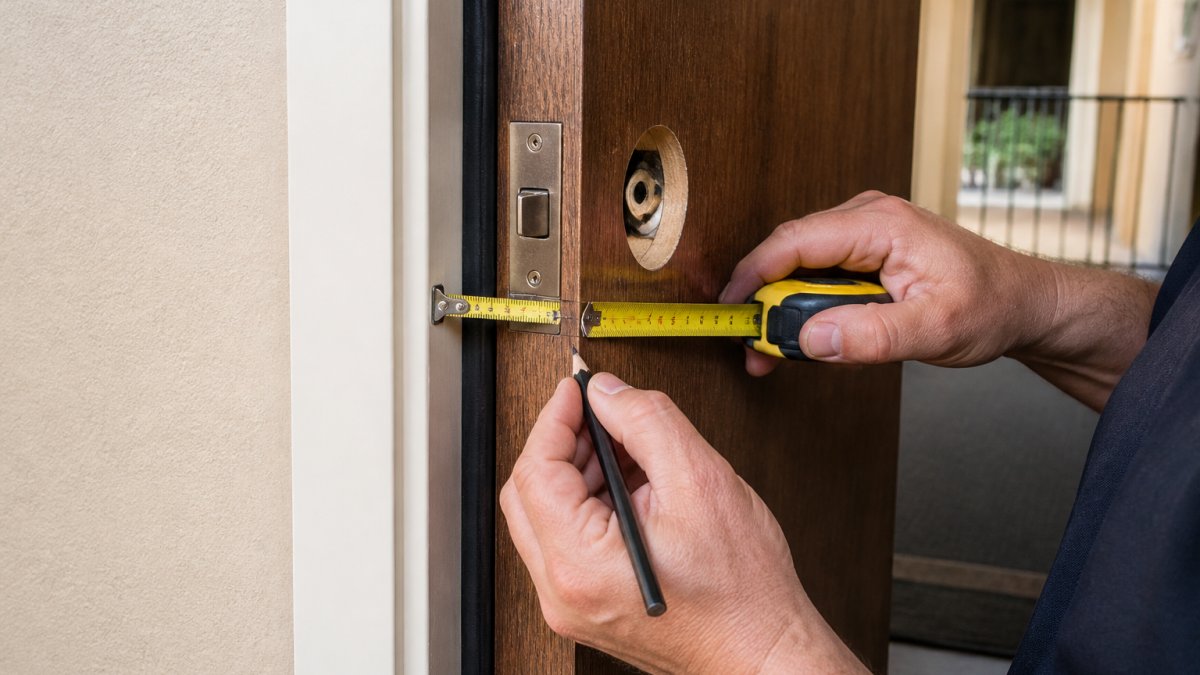
Step 1: Measure the backset. The backset is the distance from the edge of the door to the center of the hole. Standard backsets are 2.375 inches or 2.75 inches. Check your deadbolt kit, it specifies the required backset. Measure from the door edge and mark the center point with a pencil.
Step 2: Mark the hole locations. The deadbolt has two holes: one for the cylinder (front) and one for the bolt (side). Use the installation template that comes with your lock. Tape it to the door and mark both hole centers with a pencil.
Step 3: Drill the cylinder hole. Use the larger drill bit (usually 2-1/8 inches) to drill through the door. Start slowly to prevent splintering. Drill from one side until the bit tip breaks through, then finish from the other side. This prevents the exit hole from tearing.
Step 4: Drill the bolt hole. Use the smaller bit (usually 1-1/8 inches) to drill from the door edge into the cylinder hole. Drill perpendicular to the edge. This hole receives the bolt mechanism.
Step 5: Install the bolt. Insert the bolt assembly into the side hole. Align it so the bolt retracts and extends smoothly. Secure it with the provided screws.
Step 6: Install the cylinder and interior assembly. Slide the cylinder through the front hole. Attach the interior assembly on the inside. Tighten all screws firmly but don’t over-tighten, this can crack the lock body.
Step 7: Install the strike plate. Close the door and mark where the bolt hits the frame. Chisel out a shallow mortise for the strike plate. The plate should sit flush with the frame. Drill holes for the strike plate screws and secure it.
Step 8: Test the lock. Lock and unlock the deadbolt several times. The bolt should extend fully and retract smoothly. The door should close and lock without binding.
If you’re uncomfortable drilling, hire a locksmith. BDS Locksmith provides professional deadbolt installation. We ensure the lock functions smoothly and the door closes properly afterward.
Apartment Door Lock Rekeying as an Alternative
Rekeying is an option if a deadbolt already exists in your apartment. Rekeying changes the key that operates the lock without replacing the entire mechanism. This costs less than buying a new deadbolt and avoids drilling new holes.
Ask your landlord if rekeying is acceptable. Many landlords prefer this approach because it preserves the original lock hardware. You get a new key, and the landlord keeps a master key if needed.
A locksmith rekeys the lock in about 30 minutes. They remove the cylinder, replace the internal pins, and create a new key. The lock looks identical but operates with your key only.
This works best if the existing lock is in good condition. If the lock is broken or missing, rekeying isn’t possible.
Non-Destructive Security Options for Renters
If your landlord won’t approve a deadbolt, or if you want extra security without drilling, consider these alternatives:
Portable door locks. These wedge-style locks sit at the base of the door and prevent it from opening. They require no installation and leave no marks. They’re effective for apartment doors with standard frames.
Door reinforcement bars. These bars brace against the floor and door, preventing entry. They’re removable and cause no damage.
Sliding door bars. For patio or sliding doors, a bar prevents the door from sliding open. These are temporary and leave no permanent marks.
Security door braces. These mount to the door frame and lock the door in a closed position. Installation is minimal and removal is simple.
Video doorbells. A smart doorbell lets you see who’s outside before opening. This adds security without modifying the door itself.
These options work for renters who can’t modify their doors. They provide reasonable security without landlord conflict.
Deadbolt Installation Cost and Responsibility
The cost of installing deadbolts in rental apartments depends on whether you do it yourself or hire a professional.
DIY installation requires buying a deadbolt lock kit and tools. A basic deadbolt costs between $15 and $50. If you already own a drill and screwdrivers, your total cost is just the lock. If you need tools, add another $50-$100.
Professional installation through a locksmith handles everything. The locksmith measures your door, buys the appropriate lock, drills precisely, and installs the mechanism. This ensures the lock functions perfectly and the door closes properly. For pricing and availability, contact BDS Locksmith for a free estimate.
Responsibility for damage. If you drill incorrectly and damage the door, you’re typically responsible for repair. This is why professional installation protects you. A licensed locksmith’s work is covered by their insurance. If something goes wrong, they fix it.
Document the installation. Take photos of the completed work. Keep receipts. If your landlord questions the installation, you can show professional work was done.
Restoring Your Apartment Before Move-Out
When you move out, you must restore the door to its original condition. This is usually a lease requirement and a security deposit issue.
Remove the deadbolt. Unscrew the interior assembly, remove the cylinder, and pull out the bolt mechanism. Keep all original hardware.
Fill the holes. Use wood filler that matches your door color. Fill the cylinder hole and bolt hole completely. Sand smooth once dry.
Reinstall the original lock. If the door had a lock before, reinstall it. If there was no lock, leave the door with filled holes.
Paint or stain. If the door was painted, touch up the filled areas with matching paint. For stained doors, use matching stain.
Replace the strike plate. Remove your strike plate and reinstall the original. Fill any extra holes you drilled.
Taking time to restore properly prevents landlord disputes and protects your security deposit. Take photos of the completed restoration for your records.
Common Mistakes to Avoid When Installing a Deadbolt
Drilling in the wrong spot. Measure twice, drill once. A misaligned hole ruins the door and requires professional repair. Use the installation template that comes with your lock.
Using the wrong size lock. Deadbolts come in specific backset sizes. Buying the wrong size means the lock won’t align with your door. Check your door’s backset before purchasing.
Overtightening screws. Tightening screws too hard can crack the lock body or strip the holes. Tighten firmly but stop when you feel resistance.
Ignoring fire code. A deadbolt with a keyed interior side can trap people during emergencies. Buy a lock with a thumb-turn on the inside, not a keyhole.
Not getting written permission. Installing without landlord approval gives them grounds to withhold your security deposit or evict you. Always get written consent first.
Forgetting to restore the door. Leaving holes unfilled when you move out costs you your deposit. Plan restoration before move-out day.
Using cheap hardware. A $10 deadbolt may fail within months. Spend a bit more for quality. A reliable lock is worth the investment.
Not testing the lock. Test the deadbolt repeatedly before considering the job done. A lock that binds or doesn’t retract fully needs adjustment.
Installing deadbolts in rental apartments improves your security and peace of mind. The process is simple if you plan carefully and follow local rules. Get landlord permission in writing, measure your door correctly, and follow installation steps precisely. If you’d rather skip the DIY work, BDS Locksmith handles professional deadbolt installation with precision and care. Call us for a free estimate and same-day installation availability.
Frequently Asked Questions
Can I install a deadbolt in a rental apartment without landlord permission?
Most lease agreements require written permission before making alterations to the apartment. Installing a deadbolt without approval could violate your lease and result in penalties or loss of your security deposit. Check your lease and contact your landlord in writing before proceeding. Many landlords approve deadbolt installation because it improves security for the property. Getting written consent protects both you and the landlord.
What is the cost of installing a deadbolt in an apartment?
Deadbolt installation costs vary depending on whether you do it yourself or hire a professional locksmith. DIY installation typically requires a deadbolt, a hole saw, and basic tools. Professional installation through a licensed locksmith covers labor, hardware, and expertise in ensuring proper door and frame compatibility. Pricing depends on your location and the complexity of your apartment door. Contact a local locksmith for a free estimate.
Can I rekey an existing deadbolt instead of installing a new one?
Yes, rekeying is an excellent alternative for renters. If your apartment already has a deadbolt, rekeying allows you to change the lock cylinder so only your key works, without drilling new holes or altering the door. This is less invasive than installation and typically requires landlord approval. A locksmith can rekey your existing deadbolt quickly and affordably. This option is ideal if you inherit a lock from previous tenants or want to regain control of who has keys to your apartment.
What should I do if my landlord refuses to install a deadbolt?
If your landlord denies your request, review your local housing codes, many jurisdictions require deadbolts or functioning locks on apartment entry doors. Document the refusal in writing and contact your local housing authority or tenant rights organization. Some areas allow tenants to make safety-related repairs and deduct costs from rent, though this varies by state. If the existing lock is broken or missing, you may have stronger legal grounds. Consult local tenant laws or a legal advisor before taking action.