Table of Contents
- Typical Transponder Key Programming Time
- Factors That Affect How Long Transponder Key Programming Takes
- How to Program a Transponder Key: The Professional Process
- Car Key Programming Time: Locksmith vs. Dealership
- Programming a Car Key Without the Original Key
- All Keys Lost: Programming Time and What to Expect
- Transponder Key Programming Cost and Service Time
- Common Delays and Troubleshooting
- What to Prepare Before Your Programming Appointment
- Frequently Asked Questions
Last Updated: October 9, 2026
Typical Transponder Key Programming Time
Transponder key programming typically takes between 15 to 45 minutes for most vehicles. This timeframe covers the actual programming work once the locksmith or dealership begins the process. However, the total appointment time often stretches longer due to check-in, paperwork, and wait times.
The exact duration depends on several variables. A straightforward key fob replacement on a newer vehicle might take 20 minutes. An older car with a more complex security system could need 40 minutes or more. Some vehicles allow programming to happen in under 10 minutes if conditions align perfectly.
The key distinction matters because many customers confuse total appointment time with programming time alone. You might arrive, wait for the technician, then watch the actual work take 20 minutes. The full visit could be an hour or longer.
Ask your locksmith or dealership to specify the programming time separately from total appointment time. This helps you plan your day accurately and avoids frustration if you’re told “30 minutes” but the full visit takes 90 minutes.
Factors That Affect How Long Transponder Key Programming Takes
Multiple factors influence how quickly transponder key programming can be completed. Understanding these helps explain why two customers might have very different experiences at the same service provider.
Vehicle Make, Model, and Year
Different vehicles have different security systems. A 2024 Honda uses a different programming protocol than a 2010 Ford or a 2005 Toyota.
Newer vehicles often have more advanced immobilizer systems. These systems are more secure but sometimes take longer to program correctly. Older vehicles with simpler key chip technology may program faster.
The vehicle’s manufacturer matters significantly. Some automakers designed their systems to be programmed quickly. Others built in additional security steps that extend the timeline.
Key Cutting and Chip Syncing
Transponder key programming involves two separate tasks: cutting the physical key and syncing the chip to your vehicle computer.
If you need a new key cut, that adds time. A locksmith must shape the blank key to match your vehicle’s lock. This typically takes 5 to 10 minutes depending on the key type.
Chip syncing happens after cutting. The technician connects a diagnostic tool to your vehicle and programs the new key’s chip to communicate with your car. This is the core programming step.
Some keys arrive pre-cut, which saves time. If you’re replacing a key fob that doesn’t require physical cutting, the appointment moves faster.
The total time for transponder key programming includes both physical key cutting and electronic chip syncing. Skipping either step means the key won’t work.
Working Key Availability
Having a working key present speeds up the process significantly. If you have one original key that still functions, the technician can use it as a reference to program new keys faster.
Without a working key, the technician must access your vehicle’s security system through the onboard diagnostics port. This requires specialized equipment and takes longer.
If all keys are lost, the process becomes more complex. The locksmith or dealership must verify your ownership and may need to access the vehicle’s computer through alternative methods. This scenario typically adds 20 to 30 minutes to the timeline.
How to Program a Transponder Key: The Professional Process
Professional transponder key programming follows a structured sequence. Understanding the steps helps explain why each stage matters and why rushing through them creates problems.
Connecting the Diagnostic Tool
The technician begins by locating your vehicle’s onboard diagnostics port, typically found under the dashboard near the steering column. They connect a specialized programming device to this port.
This connection allows the technician to communicate directly with your vehicle’s computer. The diagnostic tool reads your vehicle’s security settings and prepares it to accept a new key.
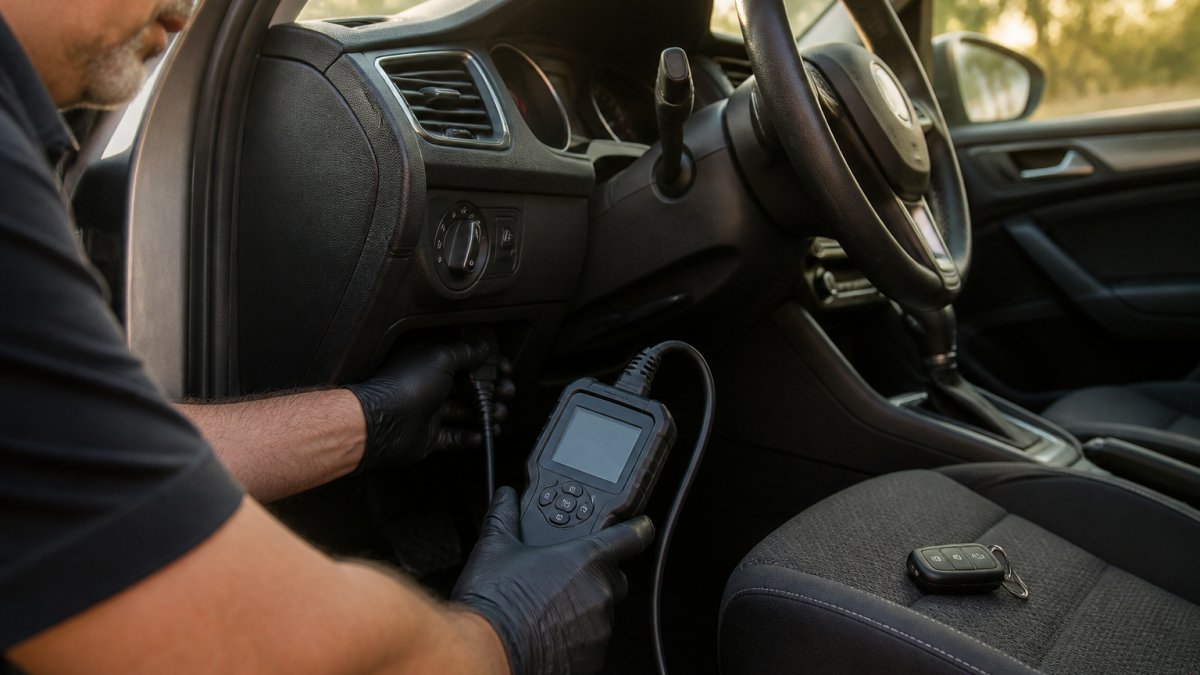
The connection process itself takes 2 to 5 minutes. Some vehicles require additional security verification before the computer allows programming to proceed.
Syncing the Key Chip to Your Vehicle Computer
Once connected, the technician initiates the programming sequence through the diagnostic tool. Your vehicle’s computer enters programming mode, which typically lasts a few minutes.
The new key blank is inserted into the ignition or held near the vehicle’s antenna. The vehicle’s computer communicates with the key’s chip, establishing a secure connection.
This syncing process usually completes in 5 to 15 minutes. The vehicle’s computer confirms the new key is recognized and will start the engine.
Multiple keys can be programmed in a single session. Each additional key typically adds only 2 to 5 minutes since the vehicle remains in programming mode.
Interrupting the programming sequence requires starting over. If the vehicle loses power or the diagnostic tool disconnects, the process must restart from the beginning, adding significant time to your appointment.
Car Key Programming Time: Locksmith vs. Dealership
Both locksmiths and dealerships program transponder keys, but the number most searchers care about, how long the whole thing takes from the moment you decide to get a key to the moment you drive away, breaks down very differently between the two. Competitors tend to quote a single range and stop there. Here is the stage-by-stage comparison.
Hands-On Programming Time
The actual bench time is nearly identical when both parties use a factory-grade tool. A mobile locksmith and a dealership technician both connect to the OBD port, put the vehicle in programming mode, and sync the chip. For most vehicles this is 15 to 45 minutes. Neither side has a meaningful speed advantage on the programming step itself.
Travel and Check-In Time
This is where the two paths diverge.
- Mobile locksmith: You stay put. Travel time is on the technician, typically 30 to 60 minutes in metro areas, longer in rural ZIP codes. There is no service-lane check-in, no shuttle, no waiting room.
- Dealership: You drive to the service department, hand over the key, and wait for a service advisor to write a repair order. Check-in alone commonly runs 10 to 20 minutes. If the service bay is backed up, your vehicle may sit for an hour or more before a technician touches it.
Parts Availability
A dealership stocks blanks and fobs for the brands it sells, so parts are usually on the shelf. An independent locksmith carries a broad inventory but may need to source an uncommon blank or a push-to-start fob for a less common model. Ask up front whether the key is in stock, a special-order blank can add a day or more, which dwarfs any programming-time difference.
Documentation and Verification
Both paths verify ownership. A dealership can pull your record from the manufacturer’s database, which is fast if you bought the car there. A locksmith will ask for your driver’s license, registration, and, in an all-keys-lost situation, the title. Budget 5 to 15 minutes for this step either way.
Realistic Total Time Windows
| Scenario | Mobile locksmith (total) | Dealership (total) |
|---|---|---|
| Spare key, working key present | 45-90 min | 60-120 min |
| Replacement key, no working key | 60-120 min | 90-180 min |
| All keys lost | 90 min-2.5 hrs | 2-4 hrs (often drop-off) |
These are total elapsed times, not programming times. The programming step inside those windows is still the same 15 to 45 minutes.
When Each Option Makes Sense
- Choose a mobile locksmith when you need same-day service, are locked out, or want to avoid a service-lane wait. Many operate evenings and weekends.
- Choose a dealership when the vehicle is under warranty, when the key is a factory-ordered item tied to a subscription feature (remote start, digital key), or when you want the work documented in the manufacturer’s service history.
When you call either provider, ask two separate questions: “How long is the programming itself?” and “How long until I’m back on the road?” The gap between those two answers is where most appointment-time surprises live.
Quality and Warranty
Programming quality is equivalent when both parties use OEM or OEM-equivalent tools. The difference is in recourse: a dealership warranty is tied to the manufacturer’s network, while a locksmith warranty is tied to that business. Ask what happens if the key fails to start a week later, a reputable provider will reprogram at no charge.
Programming a Car Key Without the Original Key
When you’ve lost your only key, transponder key programming becomes more involved. The process doesn’t change fundamentally, but it requires additional verification steps.
The technician must confirm you own the vehicle. This typically involves checking your driver’s license against the vehicle registration and title. Some locksmiths require proof of insurance as well.
Without an original key to reference, the technician accesses your vehicle’s security system through the diagnostic port and retrieves the key code from the vehicle’s computer. This code tells the programmer what settings the new key needs.
The actual programming takes the same 15 to 45 minutes as a standard replacement. The verification and code retrieval add 10 to 20 minutes to the total appointment.
If your vehicle requires a physical key cut, that step happens before programming begins. The total time for a full replacement key from scratch typically ranges from 45 minutes to 90 minutes.
All Keys Lost: Programming Time and What to Expect
Losing all keys simultaneously creates a more complex situation. Transponder key programming is still possible, but the process includes extra security measures.
When all keys are lost, the locksmith or dealership must verify ownership more thoroughly. They may require documentation like your vehicle title, registration, and a government-issued ID. This verification step can add 15 to 30 minutes.
The technician accesses your vehicle through the OBD port and retrieves the security code. This code is unique to your vehicle and stored in the vehicle’s computer.
Programming the first replacement key takes 20 to 40 minutes. Once the first key is programmed and tested, additional keys program much faster, typically 5 to 10 minutes each.
Many people program 2 or 3 replacement keys during this appointment. The total time for multiple keys ranges from 45 minutes to 2 hours depending on the vehicle and how many keys you need.
All-keys-lost situations typically require dealership service or a highly experienced mobile locksmith. BDS Locksmith handles these situations with proper documentation and verification protocols.
Transponder Key Programming Cost and Service Time
Price and time track each other closely, because most of what you pay for is labor plus the cost of the key itself. Competitors usually quote a single price range without explaining what drives it. Here is the breakdown.
What You Are Actually Paying For
A transponder key bill has three components:
- The key or fob hardware. A basic transponder chip key blank is inexpensive; a smart key or push-to-start fob with a built-in remote can cost several times more because of the electronics inside.
- Cutting labor. If the key needs to be physically cut to match your lock, that is a separate line item and a separate 5 to 10 minutes.
- Programming labor. This is the OBD-port work, the 15 to 45 minutes that the rest of this article focuses on.
When a quote sounds unusually low, ask which of the three is included. A “cheap key” that excludes programming is not a cheap key.
Typical Price Bands
Exact pricing varies by region, vehicle, and provider, but the general shape of the market is consistent:
- Spare transponder key, working key present: the lowest tier, because the vehicle is already in a known-good state and no code retrieval is needed.
- Replacement key, no working key: mid tier, adds code retrieval and ownership verification time.
- All keys lost: the highest tier, because of the extra verification, the code retrieval, and the longer programming window.
- Smart key / push-to-start fob: usually the highest hardware cost regardless of the labor scenario.
Dealerships tend to sit at the top of each band. Independent and mobile locksmiths tend to sit below them, partly because their overhead is lower and partly because they compete on convenience rather than brand.
Why Time Drives Price
A simple rule of thumb: the longer the appointment, the higher the bill. Every stage that adds minutes also adds labor cost:
- Ownership verification and code retrieval add 10 to 30 minutes and show up on the invoice.
- A dead battery that has to be charged before programming can start adds 20 to 60 minutes.
- A second or third key programmed in the same session adds only a few minutes each, which is why bundling spare keys into one appointment is almost always cheaper per key than coming back later.
Questions to Ask Before You Commit
- Is the quote for the key, the cutting, and the programming, or just one of them?
- Is the key in stock, or is there a special-order delay?
- Is there an after-hours or emergency surcharge?
- Is there a warranty, and what does it cover?
- Will the price change if the vehicle needs extra diagnostics?
A provider who can answer all five without hedging is a provider who has done the job many times on your type of vehicle.
Programming time and price are linked through labor. The fastest way to lower the bill is to have a working key present, a charged battery, and all spare keys programmed in the same visit.
Getting an Accurate Estimate
Because pricing depends on the specific year, make, model, and key type, the only reliable estimate comes from giving the provider those details up front. Have your VIN handy, it encodes the exact trim and security system, which is what determines both the key you need and the time to program it.
Common Delays and Troubleshooting
Several issues can extend transponder key programming beyond the typical timeline.
Dead vehicle battery is a common culprit. If your car’s battery is too weak, the vehicle computer cannot enter programming mode. The technician may need to charge or replace the battery first, adding 20 to 60 minutes.
Faulty diagnostic equipment occasionally causes delays. If the programming tool malfunctions, the technician must troubleshoot or use backup equipment. This adds 10 to 15 minutes.
Incompatible key blanks mean starting over with a different key. Using the wrong blank wastes time. Experienced technicians verify compatibility before beginning.
Vehicle computer issues can prevent programming from completing. If the vehicle’s security system has glitches, the technician may need to perform additional diagnostics. This extends the appointment significantly.
Worn ignition locks sometimes prevent key insertion. If the physical lock is damaged, the key won’t fit properly. The technician may need to repair the lock before programming can proceed.
Most delays are preventable with proper equipment and expertise. Professional locksmiths anticipate these issues and come prepared.
What to Prepare Before Your Programming Appointment
Preparing ahead makes your appointment faster and smoother.
Gather your vehicle documentation. Bring your driver’s license, vehicle registration, and proof of insurance. If all keys are lost, bring your vehicle title as well.
Locate your vehicle’s OBD port. It’s usually under the dashboard on the driver’s side. Knowing where it is helps the technician start immediately.
Have a working key present if possible. If you have one original key that still works, bring it. This speeds up the programming process.
Clear access to your vehicle. Make sure the technician can easily reach your car. Remove obstacles from the driveway or parking spot.
Charge your vehicle battery if it’s weak. A low battery can prevent programming from completing. A full charge eliminates this potential delay.
Know your vehicle’s year, make, and model. This information helps the technician prepare the correct programming protocol in advance.
Frequently Asked Questions
How long does it take a locksmith to program a transponder key?
Most transponder key programming takes 15 to 45 minutes for a professional locksmith, depending on your vehicle’s security system and whether you have a working key. If the key needs to be cut first, add 10 to 15 minutes. All-keys-lost situations may take 30 to 60 minutes because the locksmith must access your vehicle’s immobilizer system through the OBD port.
Can a locksmith program a transponder key without the original key?
Yes, a locksmith can program a transponder key without the original. They connect a diagnostic tool to your vehicle’s onboard diagnostics port to access the immobilizer and sync a new key chip. This process takes slightly longer than programming with an existing working key, typically 30 to 45 minutes, and requires verification of vehicle ownership.
Why can transponder key programming take longer than expected?
Several factors delay programming: older vehicles with complex immobilizer systems, key cutting that must happen first, vehicle computer requiring multiple sync attempts, or the locksmith needing to access the OBD port in tight spaces. All-keys-lost situations add time because the technician must use specialized equipment to reprogram the entire key system.
What’s the difference between locksmith and dealership transponder key programming time?
A mobile locksmith typically programs a transponder key in 15 to 45 minutes on-site. Dealerships often take longer due to scheduling, waiting times, and service bay availability, sometimes requiring a full appointment. A locksmith provides faster service without the need to tow your vehicle.
Getting locked out of your car or losing all your keys creates stress. Transponder key programming doesn’t have to add more frustration to your day. BDS Locksmith handles automotive key replacement with licensed, bonded, and insured professionals who arrive on-site quickly. We provide free estimates upfront so you know exactly what to expect. Call (408) 300-4369 for same-day service and competitive pricing. Our team prioritizes getting you back on the road safely and efficiently.