Table of Contents
- What Drives Onsite Car Key Fob Programming Cost
- Dealership vs Locksmith Key Programming: Which Costs Less?
- Step-by-Step Cost Breakdown for Onsite Programming
- Locksmith Key Programming Service Time: What to Expect
- Car Key Fob Battery Replacement Cost and When to Replace
- DIY Programming Compatibility: Can You Skip the Professional?
- Insurance Coverage for Key Replacement and Aftermarket Fob Risks
- How to Find a Reliable Mobile Locksmith for Onsite Programming
- Frequently Asked Questions
Last Updated: September 16, 2026
What Drives Onsite Car Key Fob Programming Cost
Onsite car key fob programming cost comes down to three variables: the key technology your vehicle uses, the labor and service-call fees a provider charges, and the hardware markup on the fob itself. We’ve seen two identical-looking jobs land on very different invoices because one car needed a basic transponder chip cut and the other needed a smart key synced to an immobilizer system. The fob is rarely the expensive part. The programming is.
That distinction matters because most quotes you’ll get over the phone blend hardware, labor, and travel into one number, which makes it nearly impossible to tell whether you’re being overcharged. Breaking the quote into its parts is the only way to compare providers fairly.
A key fob is a handheld remote that locks, unlocks, and often starts your vehicle by transmitting a coded signal to the car’s immobilizer system. Modern fobs contain a transponder chip that must be electronically matched to your vehicle before the engine will turn over.
Key Type, Vehicle Make, and Technology Level
The single biggest cost driver is which of the four common key types your vehicle uses. A traditional key blade with a basic remote is the cheapest to replace and program. A remote head key combines the blade and the buttons in one unit and costs more. A transponder key carries a chip that the immobilizer reads before allowing ignition, so it requires programming even though it has no buttons. A smart key with push-to-start and a proximity sensor is the most expensive, because it communicates continuously with the vehicle and often needs dealership-level software to pair.
Vehicle make matters almost as much. Luxury and European brands frequently require security codes or online authentication that only a dealership can pull, which pushes the job out of reach for many independent providers.
Service Call Fees, Labor, and Hardware Markup
A mobile provider’s invoice typically has three lines: a service call fee to cover travel to you, a labor charge for the programming time, and a markup on the fob hardware. The service call fee is usually flat within a given radius. Labor scales with how long the job takes and how specialized the equipment is. Hardware markup is where quotes diverge most, since aftermarket fobs cost far less than OEM replacement units but carry their own risks.
Ask any provider to quote the three lines separately before you commit. A single bundled number hides whether you’re paying for travel, time, or the part, and it makes it impossible to tell a fair quote from an inflated one.
Dealership vs Locksmith Key Programming: Which Costs Less?
For most drivers, a mobile locksmith costs less than a dealership for the same programming job, mainly because you’re not paying dealership labor rates or waiting for an appointment slot. The trade-off is that some vehicles, particularly newer luxury models, require manufacturer software a mobile provider may not have access to.
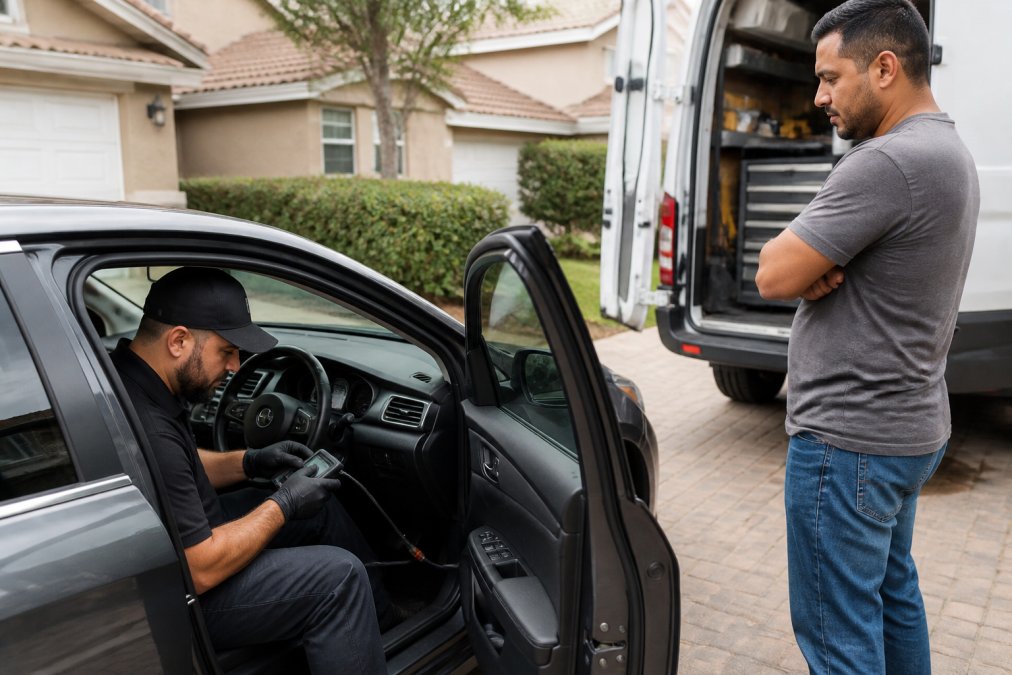
The gap widens further once you factor in towing. If your only key is lost and the car won’t start, a dealership usually requires the vehicle on-site, which means a tow. A mobile locksmith comes to the vehicle, programs a new key on the spot, and you drive away.
Dealership Service Department Pricing Model
Dealerships price key programming as a service-department line item, which means you’re paying the shop’s hourly labor rate plus full retail on OEM hardware. The advantage is guaranteed compatibility and access to manufacturer security codes. The disadvantage is scheduling: many service departments book key jobs days out, and some won’t touch a vehicle that arrives without a working key.
Mobile Locksmith Pricing Model
A mobile locksmith prices the same job as a combination of travel, labor, and hardware, and typically completes it in your driveway or parking lot. The work is done through the vehicle’s OBDII port using a diagnostic tool and programming software, followed by an ECU synchronization step that pairs the new fob to the car’s computer.
| Factor | Dealership Service Department | Mobile Locksmith |
|---|---|---|
| Where the work happens | Must bring vehicle in | Comes to your location |
| Scheduling | Often days out | Frequently same-day |
| Hardware | OEM replacement only | OEM or aftermarket options |
| Security codes | Manufacturer access | Limited on some brands |
| Towing needed if no key | Usually yes | No |
Step-by-Step Cost Breakdown for Onsite Programming
Every onsite programming invoice, regardless of provider, breaks into the same five components. Understanding each one lets you spot an inflated quote before you agree to it. The unique angle here is the split: most guides quote a single total, but the total is really three cost pools stacked on top of each other, and each pool moves for a different reason.
- Service call fee, covers the technician’s travel to your location. Often flat within a service radius, so it does not change whether the job takes 15 minutes or 90.
- VIN verification, the provider confirms your vehicle identification number to order the correct key blank and software profile. This is a labor step, not a hardware cost, but it is the step that prevents a second visit.
- Key cutting, the key blade is cut to match your ignition or door lock, if your vehicle uses a physical blade. Smart keys with no blade skip this line entirely.
- Programming and ECU synchronization, the fob is paired to the immobilizer system through the OBDII port using a programming device. This is where software licensing and subscription access show up on the provider’s side.
- Testing and immobilizer reset, the provider confirms remote entry, keyless entry, and ignition all function, and clears any error codes.
How the Money Actually Splits
Think of the invoice as three pools, not five lines:
| Cost Pool | What It Includes | What Makes It Move |
|---|---|---|
| Labor | VIN verification, key cutting, programming time, testing | Job complexity and technician time on-site |
| Software and access | Diagnostic tool licensing, manufacturer security-code access, subscription fees | Vehicle brand and whether dealer-level authentication is required |
| Hardware | The fob or key blank itself, plus any transponder chip | OEM vs. aftermarket, and whether the fob is smart or basic |
The labor pool is the most predictable. It scales with time, and time scales with how many keys need pairing and whether the immobilizer resists the new pairing. The software pool is the one drivers never see coming. A provider pays for diagnostic software subscriptions and, on some brands, per-use access to manufacturer security codes. That cost gets folded into the quote, which is why two providers can quote the same vehicle very differently depending on which software platforms they subscribe to.
The hardware pool is where aftermarket vs. OEM shows up. An aftermarket fob costs the provider less, so the markup can look attractive, but the savings are only real if the fob holds its pairing. If it fails, you pay the labor and software pools a second time.
Why the Same Job Quotes Differently
Two providers can quote the same vehicle and land hundreds of dollars apart without either one being dishonest. The difference usually sits in the software pool. A provider with a broad diagnostic subscription can program more brands in-house; a provider without it either subcontracts the job or declines it. The second difference is hardware sourcing. A provider carrying OEM fobs has a higher hardware line but a lower callback rate. A provider carrying aftermarket fobs has a lower hardware line but a higher chance of a return visit.
When you compare quotes, compare the pools, not the totals. A quote with a low hardware line and a high labor line is telling you the provider expects the job to take longer, which usually means the vehicle needs more software work. A quote with a high hardware line and a low labor line is telling you the provider is confident in the pairing and is pricing the part accordingly.
Skipping the VIN verification step is how drivers end up with a fob that won’t pair. If a provider orders hardware without confirming your VIN first, the frequency and chip type may not match your vehicle, and you’ll pay for a second attempt.
Locksmith Key Programming Service Time: What to Expect
Locksmith key programming service time usually runs 15 to 45 minutes for a straightforward fob, and longer when the vehicle needs a full immobilizer reset or the only existing key is lost. The programming itself is quick. The variables are how many keys need pairing, whether a security code must be retrieved, and whether the vehicle’s onboard computer resists the new pairing.
A common mistake is assuming a longer job means a higher bill. In practice, the labor line tracks time, but the service call fee and hardware cost stay fixed regardless of how long the technician is on-site. Ask for the time estimate up front so you can compare it against the labor charge.
Car Key Fob Battery Replacement Cost and When to Replace
Car key fob battery replacement cost is the cheapest item on this list, and it’s the one most drivers overpay for by replacing the whole fob when only the battery died. A fob that stops responding, needs to be held against the start button, or works only at close range usually has a weak battery, not a failed chip.
Replace the battery when you notice any of these signs:
- The remote entry range shrinks noticeably
- The fob works intermittently or needs repeated presses
- The keyless entry indicator on the dash stops responding
- Push-to-start requires holding the fob against the button
A common mistake is buying a replacement fob before testing the battery. Swap the battery first. If the fob still won’t pair after a fresh battery, then you’re looking at a programming job, not a hardware failure.
DIY Programming Compatibility: Can You Skip the Professional?
Some vehicles support DIY programming, but the list is narrower than most guides admit, and the deciding factor is not the brand, it is the key architecture. If your car has a simple transponder key and an onboard programming sequence, you may be able to add a spare yourself using the ignition cycle method. If it uses a smart key with push-to-start, or if you’ve lost all existing keys, DIY almost never works because the vehicle needs a security code or dealer-level software to authorize a new pairing.
Most guides stop there. The useful version is a compatibility matrix that tells you which architecture you have before you buy hardware.
DIY Compatibility Matrix by Key Architecture
| Key Architecture | DIY Feasible? | Method | What You Need |
|---|---|---|---|
| Basic transponder key, physical ignition | Yes, with one working key | Ignition cycle sequence | One working key, new key blank, cut blade |
| Remote head key, physical ignition | Sometimes | Ignition cycle or OBDII sequence | One working key, correct fob frequency |
| Smart key, push-to-start | Rarely | Dealer or professional tool | Manufacturer security access |
| Proximity fob with no working key | No | Professional only | Immobilizer reset and new pairing |
| Any vehicle with all keys lost | No | Professional only | Security code retrieval and full reset |
The pattern is consistent: DIY works when the vehicle has a physical ignition and at least one working key. It fails when the vehicle needs a security code, when the immobilizer has locked out, or when the fob communicates continuously with the car rather than only at ignition.
The Onboard Programming Sequence, Explained
Older vehicles with a basic transponder chip and a physical ignition are the best candidates. The typical method cycles the ignition on and off a set number of times with a working key present, then enters programming mode so the new key can be paired. The exact cycle count and timing vary by make and model, and getting the sequence wrong usually just exits programming mode rather than damaging anything, so it is safe to retry.
You’ll need at least one working key to start the sequence. Without one, the vehicle won’t enter programming mode at all. This is the single most common reason DIY attempts fail: the driver has already lost the only working key and is trying to program a replacement from scratch.
When DIY Fails and You Need Onsite Service
DIY fails in four common situations: you have no working key, the vehicle uses a smart key system, the immobilizer has locked out after too many failed attempts, or the fob requires online authentication. In each case, an onsite provider with a professional programming device can complete the job in a single visit.
There is also a hardware trap. Aftermarket fobs sold online are often advertised as DIY-friendly, but the frequency and chip type must match your vehicle exactly. A fob that looks identical can carry the wrong transponder chip, and no amount of ignition cycling will pair it. This is where the money gets wasted: the fob is cheap, but the failed attempt costs you the time and often a second hardware purchase.
The deciding question for DIY is simple: do you have at least one working key, and does your car use a physical ignition? If either answer is no, book an onsite provider instead of buying hardware you can’t pair. If both answers are yes, confirm your exact make, model, and year against the programming sequence before you buy a blank.
Insurance Coverage for Key Replacement and Aftermarket Fob Risks
Insurance coverage for key replacement depends entirely on your policy, and many drivers don’t discover their coverage until after they’ve paid out of pocket. Some auto policies include key replacement as an add-on, some roadside assistance programs cover lockout and key service, and some cover nothing. Check your declarations page before you assume you’re on your own. This is one of the most overlooked angles in the entire cost conversation, and it can shift your out-of-pocket number substantially.
Aftermarket fobs carry a separate risk. They cost less than OEM replacement units, but a poorly matched aftermarket fob can fail to hold its pairing, drain its battery quickly, or interfere with the immobilizer system. The savings are real, but so is the chance you’ll pay twice.
| Coverage Source | What It Typically Covers | What to Verify |
|---|---|---|
| Auto insurance add-on | Key replacement and programming | Whether OEM is required |
| Roadside assistance | Lockout and key service | Service call limits |
| Extended warranty | Key and fob replacement | Deductible and caps |
| No coverage | Nothing | Budget for full out-of-pocket |
How to Find a Reliable Mobile Locksmith for Onsite Programming
Finding a reliable mobile locksmith comes down to verification, not price alone. Ask three questions before you book: Are you licensed, bonded, and insured? Can you quote the service call, labor, and hardware separately? And do you carry the programming software for my specific make and model? A provider who answers all three clearly is worth more than the cheapest quote on the list.
Watch for the classic red flags. A quote that’s dramatically lower than everyone else usually means a bait-and-switch on arrival. A provider who won’t confirm licensing before the job is a risk you don’t need. And a technician who starts work without verifying your VIN is setting up a failed pairing.
BDS Locksmith provides free estimates, arrives on-site with the diagnostic tools needed for most makes and models, and backs every job with licensed, bonded, and insured service. Our team handles automotive, residential, and commercial work across the South Bay Area, and we offer same-day availability plus a 5% military discount.
Getting locked out or facing a dead fob is stressful enough without wondering whether the quote you got is fair. BDS Locksmith removes that uncertainty with transparent, itemized estimates, 24/7 emergency response, and mobile programming that comes to your driveway instead of sending you to a service department. Our licensed, bonded, and insured technicians handle transponder keys, smart keys, and ignition repairs on-site, and every job ends with a full function test before leaving. Call (408) 300-4369 to get a free estimate and get back on the road the same day.
Frequently Asked Questions
How much does it usually cost to get a key fob programmed?
Onsite car key fob programming cost varies based on key type, vehicle make, and whether you use a dealer or mobile locksmith. Basic transponder keys cost less to program than smart keys or push-to-start fobs. Mobile locksmiths typically charge less than dealership service departments because they skip the overhead of a brick-and-mortar location. BDS Locksmith offers free estimates and competitive pricing for onsite service in the South Bay Area.
Can you program a key fob without going to the dealership?
Yes. A licensed mobile locksmith can program most key fobs onsite using diagnostic tools and programming software that connect through the OBDII port. This works for transponder chips, remote head keys, and many smart key systems. The locksmith verifies your vehicle identification number and ownership documents before programming, then syncs the new fob to your immobilizer system. This saves you a trip to the dealership and often costs less.
Is it cheaper to program a key fob yourself or hire a professional?
DIY programming only works on certain vehicles, typically older models with simpler immobilizer systems. If your car supports it, you can save on labor. However, most modern vehicles with push-to-start and smart key technology require a professional programming device that costs more than the service itself. Attempting DIY on an incompatible vehicle can lock out your ECU and require an expensive immobilizer reset. A mobile locksmith is the safer choice for most drivers.
What factors influence the cost of mobile key fob programming?
Key factors include the type of key or fob (transponder, remote head, or smart key), your vehicle’s make and model, whether you need a new key cut or just programming, and the service call fee for onsite visits. Aftermarket fobs cost less than OEM replacement keys but may carry security risks. Battery replacement is a separate small cost. BDS Locksmith provides transparent quotes before any work begins, so you know the full price upfront.