Table of Contents
- Assess the Damage Immediately
- How to Document Property Damage Caused by the Locksmith
- Secure Your Home: Emergency Door Repair After Locksmith Damage
- Understanding Locksmith Liability Insurance
- How to File a Complaint Against a Locksmith
- Step 1: Establish liability by documenting before-and-after condition
- Step 2: Contact the locksmith company with written documentation
- Step 3: Escalate to the state licensing board if the locksmith refuses
- Step 4: File a claim with your homeowner’s insurance (if needed)
- Step 5: Consider small claims court as a last resort
- Repair Options and Cost Responsibility
- How to Prevent Damage: Choosing a Reputable Locksmith
- Frequently Asked Questions
Last Updated: October 10, 2026
Assess the Damage Immediately
When a locksmith damages your door, the first few minutes are critical. Stop and evaluate what happened before the locksmith leaves. Check both the visible damage and whether the door still functions properly.
Start by examining the door frame, lock mechanism, and door surface. Look for scratches, dents, splintered wood, bent hinges, or a misaligned frame. Test the lock by inserting your key and turning it smoothly. Open and close the door to see if it latches and swings freely without binding or dragging.
Take note of anything that wasn’t damaged before the locksmith arrived. This distinction matters later when you file a claim or complaint. If you’re unsure whether damage existed before, ask the locksmith directly. A reputable professional like BDS Locksmith will acknowledge damage they caused and discuss next steps immediately.
Document the condition right then. Take photos or video before the locksmith leaves your property. This protects you if there’s later disagreement about what happened.
How to Document Property Damage Caused by the Locksmith
Proper documentation is your strongest defense if you need to file a complaint or insurance claim. Without clear evidence, resolving what to do if a locksmith damages your door becomes much harder.
Take photographs and videos
Photograph every damaged area from multiple angles and distances. Capture close-ups showing scratches, gouges, or dents clearly. Include wide shots showing the damage in context on your door. Use natural lighting when possible so colors and details show accurately.
Record a short video walking around the damaged area. Narrate what you see: “The locksmith’s tools created this scratch on the door frame” or “The lock cylinder is now stuck and won’t turn.” Video provides context that still photos can’t.
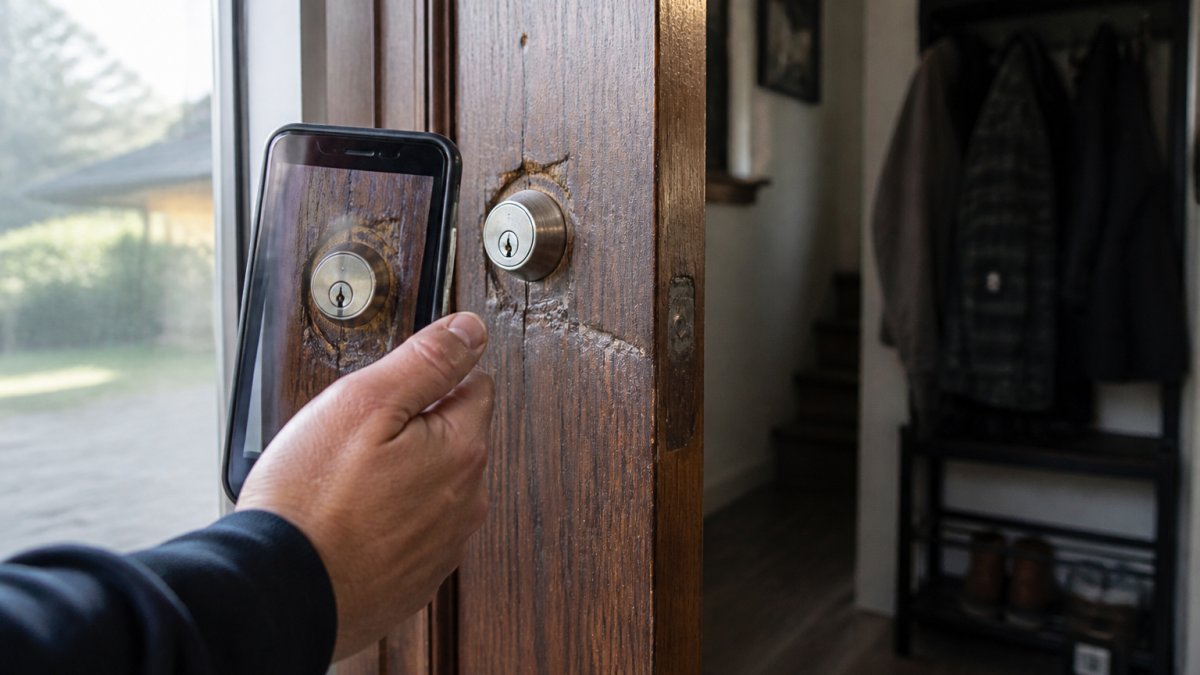
Timestamp your photos and videos if your phone does this automatically. Most modern phones embed the date and time in image files.
Keep all receipts and work orders
Collect every document related to the locksmith visit. Save the invoice, receipt, work order, and any written estimate. These papers prove when the service occurred and what was authorized.
Email yourself copies of photos and documents. Cloud storage creates a backup if your phone is lost or damaged. Write down the locksmith’s name, company, phone number, and the exact date and time of service.
Secure Your Home: Emergency Door Repair After Locksmith Damage
A damaged door compromises your home security. Even a scratched lock or bent frame can make it easier for someone to break in. Address this quickly.
Temporary fixes to prevent break-ins
If the lock no longer works properly, use a portable door lock or wedge temporarily. A door wedge or portable lock bar provides basic security until repairs are complete. These cost under $20 and require no installation.
If the door won’t close or latch, check the hinges and frame alignment. A misaligned door sometimes closes after tightening hinge screws. If that doesn’t work, wedge the door or use a temporary brace to keep it closed.
Keep your home occupied or have someone check on it daily. If you must leave, ask a trusted neighbor to monitor the property.
When to call a door repair specialist
Call a door repair professional if the damage affects the door’s structural integrity or security. Bent frames, broken locks, or splintered wood that compromises the frame all require professional repair.
Get repair estimates from at least two specialists. This gives you a baseline for repair costs to reference when discussing liability with the locksmith company. Most door repair shops provide free estimates.
Understanding Locksmith Liability Insurance
When a locksmith damages your door, determining who pays for repairs depends on insurance coverage and liability. Understanding the difference between locksmith liability insurance and your homeowner’s policy is essential before you authorize any repairs.
Locksmith liability insurance: what it covers
Most licensed locksmiths carry commercial general liability (CGL) insurance that covers accidental damage caused during their work. This insurance is designed to pay for repairs when the locksmith’s tools, techniques, or negligence cause property damage.
Liability insurance typically covers:
- Labor and materials for repairs directly caused by the locksmith’s actions
- Replacement of damaged locks, frames, or doors if repair is not feasible
- Reasonable costs for temporary security measures while repairs are pending
Liability insurance typically does not cover:
- Pre-existing damage or wear the locksmith did not cause
- Indirect costs such as your time off work, hotel stays, or lost productivity
- Damage caused by the homeowner’s negligence or failure to maintain the property
- Cosmetic damage the locksmith discloses upfront and the homeowner accepts
Homeowner’s insurance: when it applies
Your homeowner’s insurance may also cover locksmith-caused damage, but only under specific conditions. Most homeowner’s policies include coverage for accidental damage to your home’s structure and contents, but the locksmith’s liability insurance is the primary payer.
File a claim with your homeowner’s insurance only if:
- The locksmith lacks liability insurance or their coverage is insufficient
- The locksmith refuses to acknowledge responsibility
- The damage claim exceeds the locksmith’s insurance limits
Before filing with your homeowner’s insurer, contact the locksmith company first. If they accept responsibility and their insurance will cover repairs, let their insurance handle it. Filing with your own insurer may trigger a deductible (typically $500-$1,500) and could raise your premiums.
How to verify locksmith insurance and file a claim
When you contact the locksmith company about damage, ask these specific questions:
- “Do you carry commercial general liability insurance?”
- “What is your insurance company’s name and policy number?”
- “What is your coverage limit per incident?”
- “Can you provide a certificate of insurance?”
A reputable locksmith will answer immediately or provide documentation within 24 hours. If they refuse or claim they don’t carry insurance, this is a red flag, escalate to your state’s licensing board and file a claim with your homeowner’s insurance.
If the locksmith confirms coverage, request the name and contact information for their insurance adjuster. Provide the adjuster with:
- Photos and video of the damage
- Your invoice and work order from the locksmith
- Repair estimates from at least two independent contractors
- A written description of how the damage occurred
The insurance company will review your claim and either approve payment or request additional information. This process typically takes 5-15 business days.
Understanding repair cost responsibility
Once liability is established, the responsible party (locksmith’s insurance or your homeowner’s insurance) should cover the full cost of repairs. However, you may need to obtain independent estimates to support your claim.
If repair costs exceed the locksmith’s insurance limit, you may be responsible for the difference. For example, if the locksmith’s policy covers up to $5,000 per claim and your door frame replacement costs $6,000, you would need to cover the $1,000 gap, unless your homeowner’s insurance steps in.
Always get written repair estimates before authorizing work. Send these estimates to the insurance adjuster for approval before the contractor begins. This prevents disputes over what constitutes a reasonable repair cost.
How to File a Complaint Against a Locksmith
Before filing a formal complaint, establish that the damage was actually caused by the locksmith’s work and not pre-existing. This distinction is crucial, if you cannot prove the locksmith caused the damage, licensing boards and insurance companies will reject your claim.
Step 1: Establish liability by documenting before-and-after condition
The strongest complaints include clear evidence that the damage did not exist before the locksmith arrived. Use this checklist to build your case:
Before the locksmith leaves:
- Ask the locksmith directly: “Did your work cause this damage?” Document their response in writing or via email immediately after.
- Take photos of the damage with the locksmith still present, if possible. This creates a contemporaneous record.
- Ask the locksmith to note any pre-existing damage on the work order. Many work orders include a line for “pre-existing conditions.” If the locksmith refuses to document damage they caused, note this refusal in writing.
After the locksmith leaves:
- Compare your after-service photos to any before-service photos you took (or ask neighbors or family if they have photos of your door from recent weeks).
- Review the work order and invoice. Look for language like “damage noted” or “customer aware of risk.” If the locksmith claimed they warned you about damage risk but you have no record of this, note the discrepancy.
- Obtain a written repair estimate from an independent contractor. The estimate should describe the damage and confirm it is consistent with locksmith tool marks or techniques (e.g., “pry marks on frame consistent with forced entry” or “lock cylinder damaged by pick tool”).
If you cannot establish that the locksmith caused the damage, you have no valid complaint. If you can, proceed to the next step.
Step 2: Contact the locksmith company with written documentation
Do not rely on phone calls alone. Send a written complaint via email or certified mail so you have a record of your communication.
Your written complaint should include:
- The date, time, and nature of the locksmith service
- A clear description of the damage (e.g., “The lock cylinder is now stuck and will not turn. Before your visit, the lock functioned normally.”)
- Photos of the damage
- A copy of the work order and invoice
- A repair estimate showing the cost to fix the damage
- A specific request: “Please cover the cost of repairs [amount] or authorize your insurance to do so. Please respond in writing within 5 business days.”
Send this email to the locksmith company’s main office, not just the technician. If you have a company phone number, call first to get the email address of the owner or manager.
Many disputes resolve at this stage. A professional locksmith company will take responsibility and either:
- Arrange for their contractor to repair the damage at no cost to you
- Reimburse you for repairs you’ve already completed
- Provide their insurance company’s contact information so you can file a claim directly
If the locksmith responds positively, document their commitment in writing and proceed with repairs.
Step 3: Escalate to the state licensing board if the locksmith refuses
If the locksmith ignores your complaint, denies responsibility, or refuses to provide insurance information, file a formal complaint with your state’s licensing authority.
Find your state licensing board:
- Search online for “[your state] locksmith licensing board” or “[your state] Department of Consumer Affairs locksmith complaints.”
- Some states regulate locksmiths through the Department of Labor, Department of Professional Regulation, or a dedicated locksmith board.
- Contact your state’s Attorney General’s office if you cannot locate a locksmith-specific board.
File a formal complaint that includes:
- Your name, address, and phone number
- The locksmith company’s name, address, phone number, and license number (if known)
- The date of service and a detailed description of what happened
- Photos of the damage
- Copies of the work order, invoice, and your written complaint to the locksmith
- Copies of any responses (or note that the locksmith did not respond)
- A repair estimate showing the cost to fix the damage
- Your request for the licensing board to investigate and require restitution
The licensing board will investigate your complaint. If they find the locksmith acted negligently or unprofessionally, they may:
- Require the locksmith to pay for repairs
- Issue a fine or citation
- Place the locksmith on probation
- Revoke the locksmith’s license for repeated violations
This process typically takes 30-90 days. You will receive a written decision explaining the board’s findings.
Step 4: File a claim with your homeowner’s insurance (if needed)
If the locksmith’s insurance denies your claim or the locksmith lacks insurance, file a claim with your homeowner’s insurance. Provide all documentation: photos, estimates, the work order, and copies of your correspondence with the locksmith and licensing board.
Your homeowner’s insurance will investigate and either approve payment or deny the claim. If denied, you can appeal or pursue small claims court (see Step 5).
Step 5: Consider small claims court as a last resort
If the locksmith refuses to pay, their insurance denies your claim, and the licensing board cannot compel restitution, you can sue the locksmith in small claims court. Small claims court handles disputes under a set limit (typically $5,000-$10,000, depending on your state) (Understanding small claims court).
To file in small claims court:
- Contact your local district court or county courthouse for filing procedures and fees (typically $50-$200).
- Bring all documentation: photos, estimates, the work order, invoice, and copies of your written complaints and the locksmith’s responses.
- Present your case to a judge, explaining how the locksmith caused the damage and why they should pay for repairs.
- If you win, the judge will order the locksmith to pay. If the locksmith refuses, you may need to pursue collection through a collection agency or wage garnishment.
Small claims court is faster and cheaper than hiring an attorney, but it requires you to represent yourself. Many people find it worthwhile for damage claims over $500.
Repair Options and Cost Responsibility
What to do if a locksmith damages your door depends on the type and extent of damage. Repair costs range from under $50 for cosmetic fixes to several hundred dollars for frame or lock replacement.
Cosmetic repairs: scratches and dents
Scratches and dents in wood doors can often be repaired without replacing the entire door. Wood filler, sandpaper, and matching stain hide minor damage. Professional refinishing costs $100-300 depending on damage severity.
For metal doors, small dents may be left as-is or repaired by a metal specialist. Repainting a section of a metal door costs $75-200. Many homeowners accept minor cosmetic damage rather than pay for full repairs.
Lock cylinder and mechanism replacement
If the locksmith damaged the lock mechanism, replacement is usually necessary. A standard residential lock cylinder costs $50-150 including installation. High-security locks cost more but provide better protection.
The locksmith who caused the damage should pay for lock replacement as part of their liability. If they refuse, your homeowner’s insurance or the licensing board complaint may compel them to cover it.
Door frame and structural repairs
Bent or splintered door frames require professional carpentry. Repair costs range from $200-600 depending on damage extent. In severe cases, the entire door or frame must be replaced, costing $500-2000.
Document the repair estimate and send it to the locksmith company. Request they cover the full cost. If they refuse, file an insurance claim and pursue licensing board action.
How to Prevent Damage: Choosing a Reputable Locksmith
The best way to handle what to do if a locksmith damages your door is to prevent the problem from starting. Choose a qualified, licensed locksmith before an emergency forces you to take the first available option.
Verify that locksmiths are licensed and insured before hiring. Ask for proof of licensing and insurance coverage. Check online reviews and ask friends for recommendations. Licensed locksmiths carry insurance that protects you if damage occurs.
Call ahead and describe your lock or door type. Experienced locksmiths know which tools and techniques prevent damage. They’ll tell you upfront if your lock is difficult to open without risk.
Get a written estimate before work begins. Confirm what the locksmith will do, what tools they’ll use, and what you’ll pay. A clear agreement prevents misunderstandings about damage responsibility.
BDS Locksmith provides free estimates and stands behind our work. Our licensed, bonded, and insured team uses proven techniques to access your property safely. We prioritize protecting your door and lock while solving your lockout or security issue.
Damage from a locksmith visit is frustrating and stressful. The steps above help you document the problem, secure your home, and hold the locksmith accountable. Start by photographing everything and contacting the locksmith company directly. Most professionals will work with you to resolve damage fairly. For persistent issues, your state licensing board and homeowner’s insurance provide backup options.
If you need a locksmith you can trust, call BDS Locksmith at (408) 300-4369. Our team provides safe, damage-free access to your home, vehicle, or business with licensed, insured professionals and free estimates. Same-day service is available 24/7 throughout the South Bay Area.
Frequently Asked Questions
What should I do immediately if a locksmith damages my door?
Stop work immediately and ask the locksmith to stop. Assess all visible damage to the door, frame, lock cylinder, and hardware. Take photographs and videos from multiple angles before the locksmith leaves. Request a written explanation of what happened and get the locksmith’s name, company, license number, and contact information. Do not sign anything that waives your right to claim damages. Secure your home temporarily if the lock or door is compromised, and contact the locksmith company’s management within 24 hours to report the damage.
Does a locksmith have to pay for damage to a door?
Yes, a reputable locksmith with liability insurance should cover damage caused during their work. Most licensed locksmiths carry locksmith liability insurance to protect customers from accidental harm. However, responsibility depends on whether the damage was caused by the locksmith’s negligence or by a pre-existing condition. This is why documenting the door’s condition before and after work is critical. If the locksmith refuses to pay, you can file a complaint with your state’s licensing board, report the claim to their insurance company, or pursue small claims court.
How can I verify that a locksmith is insured before hiring them?
Ask the locksmith for proof of liability insurance before they begin work. Request their license number and verify it with your state’s licensing authority. A professional locksmith will provide this information without hesitation. Check their website for insurance and licensing badges, and call their company to confirm coverage details. Ask specifically whether their policy covers property damage caused during lockout or lock repair services. Licensed, bonded, and insured locksmiths are far less likely to cause damage and more likely to resolve issues fairly if something does go wrong.
Can a locksmith damage a door while opening a lock?
Yes, damage can occur even with skilled work, though non-destructive entry methods minimize this risk. Common damage includes scratches around the lock cylinder, dents or marks on the door frame, bent strike plates, and cosmetic marks on the door surface. Forced entry or lock picking can damage the lock cylinder itself, the door actuator and linkage, or the frame if excessive force is used. A qualified locksmith uses specialized tools and techniques designed to prevent damage, but accidents happen. This is why hiring a reputable, insured locksmith and documenting the door’s condition beforehand protects you.