Table of Contents
- What Locksmith Insurance Coverage for Damage Actually Pays For
- General Liability vs. Professional Liability: Where Damage Claims Land
- Locksmith General Liability Insurance Requirements: What’s Mandatory
- Coverage Types Every Mobile Locksmith Should Carry
- How to Verify Locksmith License and Insurance Before Work Starts
- How to File a Damage Claim Against a Locksmith
- Damage Scenarios Locksmith Insurance Often Excludes
- Independent Contractors vs. Employees: Who’s Covered
- Conclusion
- Frequently Asked Questions
Last Updated: September 21, 2026
What Locksmith Insurance Coverage for Damage Actually Pays For
Locksmith insurance coverage for damage pays for the repair or replacement of property you accidentally damage while performing locksmith work, plus the legal defense costs if a customer sues over that damage. At BDS Locksmith, we carry coverage precisely because a single scratched door or drilled-out lock cylinder can turn into a four-figure dispute.
Here’s the part most people get wrong: they assume all locksmith insurance is the same. It isn’t. A general liability policy responds to physical damage and bodily injury. A professional liability policy responds to claims that your work itself was faulty. Those are two different policies, and a damage claim can land under either one depending on the facts.
Locksmith insurance coverage for damage is the specific protection that responds when a technician’s tools, drilling, or handling damages a customer’s property during a job.
That distinction matters because the Insurance Information Institute’s guide to business liability coverage draws a clear line between damage you cause and damage your advice or workmanship causes.
The single most important thing to know: general liability covers accidental physical damage. Professional liability covers claims that the job was done wrong. Most locksmiths need both.
General Liability vs. Professional Liability: Where Damage Claims Land
General liability insurance covers third-party bodily injury and property damage that happens during normal business operations. If a technician drops a drill on a customer’s hardwood floor, that’s general liability.
Professional liability, sometimes called errors and omissions, covers claims that your service failed to deliver the expected result. If a customer claims your re-key left a door insecure and they were burglarized, that’s professional liability territory.
| Claim Type | Policy That Responds | Example |
|---|---|---|
| Accidental property damage | General liability | Drill slips, scratches a door panel |
| Bodily injury on site | General liability | Customer trips over a tool bag |
| Faulty workmanship claim | Professional liability | Re-key leaves a lock insecure |
| Vehicle accident en route | Commercial auto | Van hits a customer’s garage door |
| Employee injury on a job | Workers’ compensation | Technician cuts hand on a lock |
The practical implication: if you only carry one policy, you have a coverage gap. Many locksmiths discover this only after a claim is denied.
Locksmith General Liability Insurance Requirements: What’s Mandatory
Locksmith general liability insurance requirements vary by state and by client. There is no single federal mandate, but two forces drive the requirement: state licensing boards and the businesses that hire you.
Most states that license locksmiths require proof of insurance or a surety bond before issuing or renewing a license. Property managers, dealerships, and commercial clients typically demand a certificate of insurance naming them as an additional insured before they’ll let a technician on site.
For a mobile locksmith working alone, a common approach is a general liability policy with limits high enough to satisfy commercial clients, often paired with a surety bond. The exact figure depends on your state and your client mix.
Working without insurance isn’t just a licensing problem. If you damage a customer’s door and can’t pay, the customer can pursue you personally. A single uninsured claim can wipe out a small operation.
State Licensing, Bonding, and Insurance Rules
State rules differ enough that you can’t copy a neighboring state’s setup. Some states require a surety bond instead of insurance, some require both, and some have no statewide locksmith license at all, leaving the requirement to individual cities and counties.
The safest approach: check your state’s licensing authority directly and confirm the current requirement in writing. Requirements change, and a bond amount that satisfied a board two years ago may not satisfy it now. Always verify with the official source rather than a forum post.
Coverage Types Every Mobile Locksmith Should Carry
A mobile locksmith faces risks a storefront operation doesn’t. You’re driving to unfamiliar locations, working on vehicles and buildings you don’t own, and carrying thousands of dollars in tools and key-cutting equipment.
The core coverage types worth evaluating:
- General liability: third-party property damage and bodily injury
- Professional liability (errors and omissions): claims that your work was faulty
- Commercial auto: covers your service vehicle and damage it causes
- Tools and equipment coverage: replaces stolen or damaged locksmith tools
- Workers’ compensation: required in most states once you have employees
- Surety bond: often required for licensing, pays customers if you fail to perform
A business owner’s policy, or BOP, sometimes bundles general liability and commercial property at a lower combined premium. For a solo locksmith with a van full of equipment, a BOP plus commercial auto is a common starting structure.
U.S. Small Business Administration guidance on business insurance notes that the right coverage depends on your industry, location, and number of employees, which is why one-size-fits-all advice falls short.
How to Verify Locksmith License and Insurance Before Work Starts
You can verify a locksmith’s license and insurance in about five minutes by asking for the license number, the certificate of insurance, and a phone number for the insurer or agent. A legitimate technician will provide all three without hesitation.
Here’s what to check before you let anyone touch your lock:
- Ask for the state or local license number, then confirm it with the issuing authority
- Request a certificate of insurance showing general liability coverage and current dates
- Call the insurer’s listed number to confirm the policy is active, not just printed
- Confirm the technician’s name matches the license and the company on the certificate
- Get the total price in writing before work begins
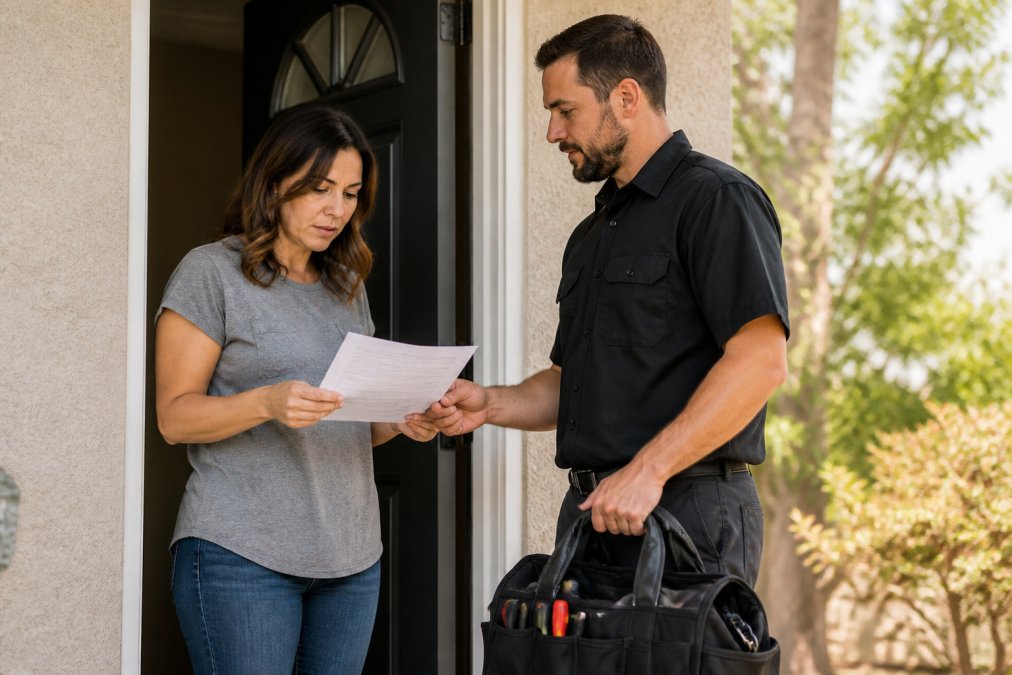
The certificate should list the policy effective dates and the insurer’s contact information. If a technician can’t produce one, that’s your answer.
Photograph the license and insurance certificate before work starts. If a dispute arises later, you have the company name, policy number, and insurer on record.
How to File a Damage Claim Against a Locksmith
Filing a damage claim against a locksmith starts with documenting the damage before the technician leaves, then submitting a written claim to the company and, if needed, to its insurer. Speed matters because evidence disappears once the technician drives away, and because most commercial general liability policies require the insured to give prompt notice of any occurrence, a delay on the company’s side can give its insurer a coverage defense that hurts your claim.
The Step-by-Step Claims Process
- Document before the technician leaves. Photograph and video the damage from multiple angles, including a wide shot that shows the damage in context (the whole door, the whole vehicle) and a close shot that shows the scratch, dent, or drilled cylinder. Include a shot with something for scale.
- Capture the technician’s identity. Write down the technician’s name, the company name, the license number if your state issues one, the vehicle make, model, color, and plate, and the job address and time.
- Get a written acknowledgment. Ask for an incident report or, at minimum, an email or text confirming the technician was on site and what happened. A text from the technician’s own phone is stronger evidence than your notes.
- Request the certificate of insurance and policy number. A legitimate company will provide both. If they refuse, that refusal is itself useful documentation.
- Get an independent repair estimate. Have a separate contractor or dealership put the repair cost in writing. Insurers move faster on a documented figure than on a description.
- Send a written demand to the company. Include the photos, the estimate, the date and location of the job, and a specific dollar amount. Send it by email and by certified mail so you have proof of delivery.
- File directly with the insurer if the company stalls. Once you have the policy number and insurer name, you can submit a third-party claim. The insurer will assign an adjuster and open a file.
- Escalate if the claim is denied or ignored. Your state’s licensing board (where locksmiths are licensed), the state attorney general’s consumer protection division, or your state’s department of insurance can all be pulled in. Small claims court is often the fastest path for smaller amounts.
How Long You Have to File
Deadlines vary by state and by the theory of the claim. A property damage claim against a business is typically governed by your state’s statute of limitations for property damage or breach of contract, which commonly runs from two to six years depending on the state and the claim type. Do not wait. Even where the deadline is years out, evidence, witnesses, and the technician’s memory degrade quickly, and insurers treat late notice as a red flag.
When the Locksmith Is Uninsured
If the company has no insurance, your options narrow but do not disappear. You can sue the company and its owner directly in small claims court (most states cap small claims at a few thousand dollars, which covers many door and lock repairs). If the company is a licensed locksmith, a complaint to the licensing board can pressure a settlement and may trigger a surety bond claim, that is exactly what the bond exists for. If the technician was an employee of a larger company, the company is generally liable for damage its employee caused in the course of the job.
What the Insurer Will Ask You
Expect the adjuster to want: the date, time, and location of the loss; a description of how the damage happened; photos; the repair estimate; proof you owned or controlled the damaged property; and any correspondence with the locksmith. If the locksmith disputes your account, the adjuster will compare your statement to the technician’s. This is why the on-scene photos and the written acknowledgment matter so much, they are the tiebreaker.
Send your demand letter within a few days of the incident, not weeks. A prompt, well-documented claim is treated very differently from one that arrives after the technician’s account has hardened.
Damage Scenarios Locksmith Insurance Often Excludes
Insurance exclusions are where most disputes actually happen. A policy that looks comprehensive on the certificate can still deny a claim if the damage falls into an excluded category. The gap between what a customer assumes is covered and what the policy actually pays is widest on high-end and electronic hardware, so those are the scenarios worth walking through.
Scenario: Scratched High-End Door Hardware
A technician uses a pick or a tension wrench on a $600 designer handle set and leaves visible scratches on the finish. The customer wants the hardware replaced, not polished. Whether this is covered depends on how the policy defines “property damage” and whether the hardware was in the technician’s care, custody, or control at the time. Many general liability policies will respond to accidental damage to a customer’s fixture, but the adjuster will scrutinize whether the scratch was caused by the technician or was pre-existing wear. This is why a pre-job photo of the hardware is worth taking on every high-end job.
Scenario: Damaged Electronic Smart Lock
Smart locks are the fastest-growing exclusion trap in the trade. A technician who damages the electronics, the motor, or the wireless module while installing or servicing a smart lock may find the claim denied under a faulty workmanship exclusion, an electrical damage exclusion, or a “damage to your own work” exclusion. Some policies also exclude damage to property that the technician installed or serviced, which can knock out the entire smart lock claim. If you regularly service smart locks, ask your agent specifically whether your policy responds to damage to the device you were working on, not just damage to the surrounding door.
Scenario: Drilled or Damaged Safe
Safe opening is a specialty service, and the damage is often intentional, drilling is the technique. A general liability policy typically excludes intentional damage, even when the intent was to open the safe, not to destroy it. The customer’s expectation is that the safe will be repaired or replaced; the policy may say otherwise. Safes are also frequently excluded as “property in the care, custody, or control” of the technician. If you do safe work, confirm in writing how your policy treats drilling damage before you take the job.
Scenario: Vehicle Entry Damage
Automotive locksmithing generates a distinct set of exclusions. Damage to a door seal, window regulator, or trim piece during a slim-jim or air-wedge entry is often treated as damage to property in your care, custody, or control, the CCC exclusion that trips up many claims. Some policies also exclude damage caused by improper towing or by tools that are not listed on the policy. Vehicle entry coverage frequently requires a specific endorsement, and not every carrier offers one.
The Exclusions That Show Up Most Often
- Wear and tear: damage to a lock or door that was already failing before the technician arrived
- Faulty workmanship over time: some general liability policies exclude damage caused by your own defective work
- Intentional damage: any damage a technician causes on purpose, including drilling
- Damage to your own work: property you installed or serviced may be excluded
- Care, custody, or control (CCC): property you are holding, transporting, or working on may be excluded
- Electrical damage: often excluded on smart locks and electronic access control
- Vehicle damage from improper towing or entry: usually needs a separate endorsement
How to Close the Gaps
The fix is almost always an endorsement or a separate policy, not a different carrier. Ask your agent three specific questions: Does my policy cover damage to the device I was working on? Does it cover drilling damage on safes? Does it cover vehicle entry damage? If the answer to any is no, price the endorsement. For high-value commercial or high-security jobs, a project-specific or excess liability endorsement may be the only way to satisfy the client’s contract requirements.
A certificate of insurance showing general liability does not tell you whether smart lock, safe, or vehicle entry damage is covered. The exclusions live in the policy form, not the certificate. Ask to see the actual policy language before you rely on it.
The three exclusions that cause the most denied locksmith claims are intentional damage (drilling), damage to your own work (smart locks and installations), and care, custody, or control (vehicles and safes). Each one can be closed with an endorsement, but only if you ask before the claim, not after.
Independent Contractors vs. Employees: Who’s Covered
Who’s covered depends on how the worker is classified, and misclassification is one of the costliest mistakes a locksmith business can make. Employees are generally covered under the company’s workers’ compensation and liability policies. Independent contractors usually are not.
If you hire subcontractors, confirm in writing that they carry their own general liability and, where required, workers’ compensation coverage. Ask for a certificate of insurance and verify it. If an uninsured subcontractor damages a customer’s property, the claim can come back to you.
For solo operators, the question flips: you are the business, so your personal coverage and your business coverage need to be clearly separated. A homeowner’s policy will not cover a commercial locksmith job.
Conclusion
The real risk in locksmith work isn’t the lock you can’t pick. It’s the door you scratch, the cylinder you drill, or the claim that lands months later. Coverage gaps show up at the worst possible moment, and by then it’s too late to close them.
BDS Locksmith is licensed, bonded, and insured, and we provide proof before work starts. Our mobile service covers automotive, residential, and commercial jobs across the South Bay, backed by same-day availability, free estimates, and a 5% military discount. If you want a locksmith who can show you the certificate instead of just claiming one, call (408) 300-4369 and get started with BDS Locksmith.
Frequently Asked Questions
Does professional locksmith insurance cover accidental property damage?
General liability policies typically cover accidental damage a locksmith causes to your property during a job, such as a scratched door frame, cracked glass, or a damaged ignition. Coverage applies when the damage is unintentional and the technician was working within the scope of the job. Deliberate damage, faulty workmanship, and wear-related failures usually fall outside the policy. Ask to see the certificate of insurance before work begins and confirm the policy is active on the date of service.
How can I verify that a locksmith is properly insured before they start work?
Ask for a certificate of insurance and check three things: the policyholder name matches the business, the effective dates cover your service day, and the liability limit is listed. Then call the insurance carrier’s number on the certificate to confirm the policy is active. In states that license locksmiths, you can also check the state licensing board’s online lookup. A legitimate locksmith will provide this without hesitation. If a provider stalls or says the certificate is at the office, that is a warning sign.
What should I do if a locksmith damages my door or ignition during a service?
Stop and document everything before the technician leaves. Photograph the damage from multiple angles, note the date, time, and technician name, and get a written incident report if the company offers one. Then file a claim with the locksmith’s insurance carrier, not your own, since the claim should go against their liability policy. Keep your invoice and any text or email communication. If the company refuses to cooperate, your state’s consumer protection office or licensing board can help mediate.
Are locksmiths required to carry insurance to operate legally?
It varies by state. Some states require locksmiths to hold a license, post a surety bond, and carry a minimum amount of general liability coverage before they can operate. Others have no statewide licensing requirement at all. Even where insurance is not legally mandated, most reputable locksmiths carry it because commercial clients, property managers, and dealerships require proof of coverage before allowing work on their premises. Always ask for proof regardless of what your state requires.