Table of Contents
- Is Emergency Locksmith Covered by Insurance?
- Does Homeowners Insurance Cover Locksmith Services?
- Renters Insurance and Locksmith Coverage
- Auto Insurance and Emergency Locksmith Services
- Emergency Locksmith Cost and Deductibles
- Locksmith Coverage After a Break-In: What You Need to Know
- How to File a Locksmith Insurance Claim
- Step 1: Confirm the Loss Is a Covered Peril Before You File
- Step 2: Gather the Documentation the Adjuster Will Actually Ask For
- Step 3: Submit the Claim and Track It
- Step 4: Understand How the Deductible and Limits Affect Your Payout
- Step 5: Know the Common Reasons Claims Get Denied
- A Note on Choosing the Locksmith You Hire
- What’s Not Covered: Common Exclusions and Limits
- Avoiding Locksmith Scams and Protecting Your Coverage
- Frequently Asked Questions
Last Updated: October 12, 2026
Is Emergency Locksmith Covered by Insurance?
When you’re locked out of your home or car, calling an emergency locksmith feels urgent. But after the service is done, you might wonder: who actually pays for it? The answer depends on what type of insurance you have and what caused the lockout in the first place.
Understanding your coverage before an emergency happens saves time, stress, and money.
The truth is, is emergency locksmith covered by insurance depends on several factors. Your homeowners policy, renters insurance, auto insurance, or roadside assistance plan might cover it. But each policy has different rules, limits, and exclusions. Let’s break down what you need to know.
Does Homeowners Insurance Cover Locksmith Services?
Most standard homeowners insurance policies do not automatically cover emergency locksmith services for simple lockouts. However, coverage exists in specific situations.
When homeowners insurance might cover locksmith costs:
Your homeowners insurance may pay if the lockout resulted from a covered loss. A break-in, fire, or theft that damaged your locks qualifies. If someone broke into your home and damaged the lock during entry, your policy’s property damage coverage may reimburse you for lock repair or replacement.
The key word is “damage.” If you’re simply locked out with an intact lock, your policy likely won’t cover the locksmith bill. But if the lock itself was damaged, whether by a break-in, weather, or accident, you may have a claim.
Coverage for Lockouts and Access Issues
A standard lockout without property damage typically falls outside homeowners insurance coverage. Your policy protects against covered perils like theft, fire, and vandalism. Being locked out of your own home isn’t a covered peril.
However, some homeowners policies include additional coverage options. A few insurers offer “service line coverage” or “home service coverage” that includes locksmith services. These are optional add-ons you purchase separately. Check your policy documents or call your agent to see if you have this coverage.
Many people assume their homeowners insurance covers lockouts because they pay for so much else. The reality: homeowners insurance is designed to protect against major losses, not service calls. Emergency locksmith costs are usually your responsibility unless property damage occurred.
Coverage After a Break-In or Forced Entry
This is where homeowners insurance becomes valuable. If someone broke into your home and damaged your locks, your policy should cover the repair or replacement.
What typically qualifies:
- A burglar forced open a door or window, damaging the lock
- Vandalism damaged your locks
- A fire or weather event damaged locks
- Theft of your keys led to lock replacement for security
In these cases, file a claim with your homeowners insurance. Document the damage with photos. Get an itemized invoice from your locksmith. Your insurer will review the claim and either approve reimbursement or deny it based on your policy wording.
The coverage limit matters too. Your homeowners policy has a deductible (often $500 or $1,000). You pay that amount out of pocket. Your insurer covers the rest, up to your policy’s limit. If lock replacement costs $800 and your deductible is $500, you pay $500 and insurance covers $300.
Renters Insurance and Locksmith Coverage
Renters insurance works differently than homeowners insurance. You don’t own the building, so your policy focuses on your personal belongings and liability.
Standard renters insurance does not cover locksmith services. Your policy protects your furniture, electronics, and clothes, not the landlord’s locks.
However, if you caused damage that requires a locksmith to fix, your renters liability coverage might help. For example, if you accidentally damaged the lock and the landlord demands reimbursement, your liability coverage could pay (up to your policy limit).
Some renters policies include optional service line coverage, similar to homeowners policies. This add-on covers emergency locksmith calls. If you rent and want this protection, ask your insurer about adding it to your policy.
Your landlord’s responsibility: In most cases, your landlord is responsible for maintaining the locks on the property. If you’re locked out due to a lock malfunction, contact your landlord first. They should pay for the locksmith. Only call a locksmith yourself if the landlord is unreachable and you need emergency access.
Auto Insurance and Emergency Locksmith Services
Auto insurance and roadside assistance are two different products, and the distinction matters when you’re locked out of your car. A standard personal auto policy, liability, collision, comprehensive, uninsured/underinsured motorist, is built to pay for crashes, theft, and injuries. It is not built to pay a locksmith to pop a door. Roadside assistance, whether sold as an add-on to your auto policy or as a standalone membership, is the product that actually dispatches help.
What a Standard Auto Policy Does and Doesn’t Pay For
| Coverage on your auto policy | Does it pay a locksmith for a car lockout? |
|---|---|
| Liability (bodily injury / property damage) | No, pays others you injure or damage |
| Collision | No, pays to repair your car after a crash |
| Comprehensive | Usually no, pays for theft, fire, hail, vandalism; a lockout is not a covered peril |
| Medical payments / PIP | No, pays medical bills after a crash |
| Uninsured/underinsured motorist | No, pays when a hit-and-run or uninsured driver injures you |
| Roadside assistance (add-on) | Yes, this is the coverage that dispatches a locksmith |
One narrow exception: if your keys were stolen during a covered theft and the thief damaged the ignition or door cylinder, comprehensive coverage may pay to repair that damage. The lockout itself is still not the covered event, the theft and resulting damage are.
Roadside Assistance: The Coverage That Actually Helps
Roadside assistance is the practical answer for car lockouts. It is sold three ways:
- As an add-on to your auto policy. Many insurers offer it for a few dollars a month. It typically appears on your declarations page as “Roadside Assistance” or “Towing and Labor.”
- As a standalone membership. Motor clubs and some retailers sell annual memberships that include lockout service.
- Bundled with a credit card or new-car warranty. Many credit cards and new-vehicle warranties include a roadside benefit, check the card’s guide to benefits or the warranty booklet before paying out of pocket.
What roadside assistance typically covers for a lockout:
- Dispatching a locksmith or a service technician to unlock the vehicle
- A per-incident dollar cap (commonly in the $50-$100 range, but it varies widely by plan)
- A per-year call limit (often three to five service calls)
- Sometimes reimbursement if you pay the provider directly and submit a receipt
What it usually does not cover:
- Replacing keys or fobs (that is a separate key-replacement benefit, if you have one)
- Damage to the door or window caused by a non-professional unlock attempt
- Lockouts at your home or business (that is a homeowners or renters question, not an auto one)
How to Actually Use the Benefit
- Find the number before you need it. Roadside assistance phone numbers are usually on your insurance ID card, your membership card, or in your insurer’s app. Save it in your phone.
- Call the dispatch line, not a random locksmith. If you call a locksmith directly and then try to claim reimbursement, many plans will only reimburse up to the per-incident cap, and some will deny the claim entirely if you didn’t use their network.
- Confirm the cap and any out-of-pocket before the truck rolls. Ask: “What is my per-incident limit, and will I owe anything out of pocket?”
- Keep the dispatch confirmation and the receipt. If the provider bills you directly, you’ll need the itemized receipt to submit for reimbursement.
If you have both an auto-policy roadside add-on and a credit-card roadside benefit, you generally cannot double-dip on the same incident. Pick the one with the higher per-incident cap, and save the other for a future call.
The Bottom Line for Car Lockouts
A standard auto policy will not pay a locksmith for a simple car lockout. Roadside assistance, whether on your policy, on a membership card, or bundled with a credit card, is the coverage that does. Check which one you have before you’re standing in a parking lot at 11 p.m., and confirm the per-incident cap so you know what you’ll owe.
Emergency Locksmith Cost and Deductibles
Understanding locksmith pricing and how deductibles work helps you plan financially.
Typical emergency locksmith costs vary by situation:
- Residential lockout: pricing depends on time of day, location, and lock type
- Car lockout: varies based on vehicle make and model
- Lock replacement after a break-in: depends on lock quality and complexity
Emergency calls (nights, weekends, holidays) usually cost more than daytime service. BDS Locksmith offers free estimates so you know the cost before work begins.
How deductibles affect reimbursement:
If your insurance covers the locksmith bill, your deductible applies. You pay the deductible first. Insurance covers costs above that amount, up to your policy limit.
Example: Locksmith bill is $600. Your deductible is $500. You pay $500. Insurance reimburses $100.
This is why a small lockout call might not be worth claiming. If the bill is $300 and your deductible is $500, you pay the full $300 out of pocket anyway. Filing a claim won’t help.
Locksmith Coverage After a Break-In: What You Need to Know
A break-in is one situation where is emergency locksmith covered by insurance clearly applies. Your homeowners or renters policy should cover lock repair or replacement if a burglar damaged your locks.
Steps after a break-in:
- Call police and file a report
- Get a locksmith to secure your home immediately
- Document all damage with photos and video
- Get itemized invoices from the locksmith
- File an insurance claim with your agent
Your insurer will want proof of the break-in. A police report is essential. Photos of the damaged lock are helpful. The locksmith’s invoice should itemize what was repaired or replaced.
Important: Some policies require you to use specific contractors or get approval before paying for repairs. Check your policy or call your agent before hiring a locksmith. If you don’t follow the process, your insurer might deny the claim.
BDS Locksmith provides detailed invoices. We’re licensed and insured.
How to File a Locksmith Insurance Claim
Most guides stop at “call your insurer and submit your invoice.” That is not enough to actually get reimbursed. The gap between a claim that pays and one that gets denied usually comes down to three things: whether the loss is a covered peril, whether your documentation proves it, and whether the payout clears your deductible. This section walks through the mechanics.
Step 1: Confirm the Loss Is a Covered Peril Before You File
Before you call your insurer, answer this question: what caused the lockout?
- Break-in, vandalism, fire, or storm damage to the lock, likely a covered peril under homeowners or renters property coverage.
- Simple lockout with an intact lock, not a covered peril. Filing will not produce a payout.
- Lost keys with no damage, typically not covered; rekeying for security is a maintenance choice, not a loss.
- Wear and tear or a mechanical failure, excluded as maintenance.
If you are unsure, call your agent and describe the cause before you file. A quick phone call prevents a denied claim from appearing on your loss history.
Step 2: Gather the Documentation the Adjuster Will Actually Ask For
A claims adjuster is trying to answer three questions: did a covered loss happen, what did it damage, and what did it cost to fix? Your paperwork should answer all three.
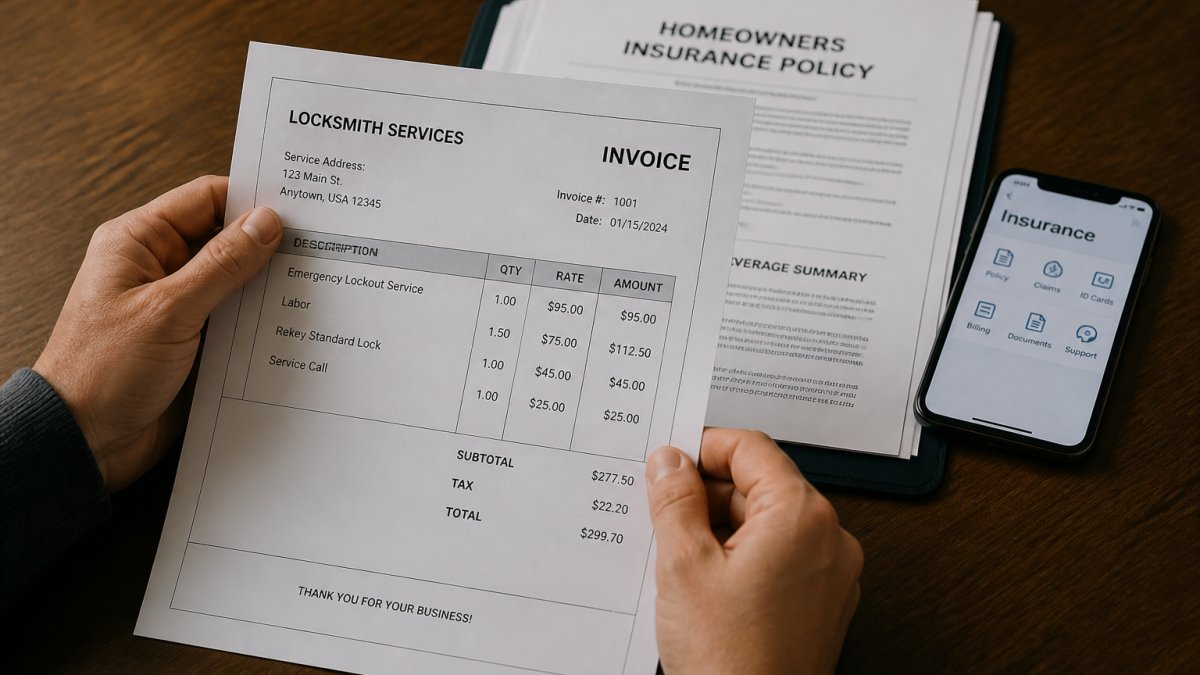
- Itemized locksmith invoice. Not “locksmith service, $450.” The invoice should list each line: “front door cylinder replacement,” “deadbolt rekey,” “labor,” “after-hours callout.” Vague invoices get kicked back.
- Photos and video of the damage. Shoot the damaged cylinder, the forced door frame, the broken glass, before the locksmith starts work if possible, and after if not.
- Police report number. For a break-in, theft, or vandalism, the report number is often required. File the report the same day.
- Proof of payment. Receipt, credit-card statement, or canceled check showing you paid the locksmith.
- Your declarations page. This shows your deductible and your coverage limits, the adjuster will reference it, and so should you.
- Any correspondence with the locksmith. Texts, emails, or written estimates that show the scope of work.
Some policies require you to notify the insurer before you hire a contractor, or to use an in-network provider. If you hire first and ask later, the insurer can reduce or deny the claim. Read the “Duties After Loss” section of your policy, or call your agent before the locksmith starts.
Step 3: Submit the Claim and Track It
- Report the loss. Use your insurer’s app, website, or claims phone line. Have your policy number and the date of loss ready.
- Upload documentation. Most insurers accept photos and PDFs through the app or portal. Keep the originals.
- Answer the adjuster’s questions. Be consistent with your police report and your locksmith invoice. Inconsistencies trigger scrutiny.
- Wait for the decision. Simple property claims are often decided within a few business days; complex ones can take longer.
- Review the settlement letter. It will show the covered amount, your deductible, and any depreciation. If something looks wrong, ask for a written explanation.
Step 4: Understand How the Deductible and Limits Affect Your Payout
This is where most people are surprised. Even a covered claim may pay nothing if the loss is smaller than your deductible.
- Deductible. If your homeowners deductible is $1,000 and the locksmith bill is $600, the claim pays $0, and you have still filed a claim, which some insurers count against your loss history.
- Coverage limit. Property coverage has a maximum. If the lock replacement is $2,000 and your sublimit for the category is $1,500, you pay the difference.
- Depreciation (actual cash value policies). If your policy pays actual cash value rather than replacement cost, the payout is reduced by the age of the lock. A 15-year-old deadbolt is worth far less than a new one.
- Reimbursement caps on service add-ons. If you have an optional service-line or home-service endorsement, it usually has its own per-incident cap, often a few hundred dollars, separate from your main deductible.
Run the math before you file. If the locksmith bill is close to or below your deductible, paying out of pocket usually costs less in the long run than a claim on your loss history.
Step 5: Know the Common Reasons Claims Get Denied
- The loss was a simple lockout, not a covered peril.
- The invoice was not itemized.
- No police report was filed for a break-in.
- The work was done before the insurer was notified, in violation of the policy’s duties-after-loss clause.
- The damage was pre-existing or the result of wear and tear.
- The claim was filed after the policy’s notice deadline.
If your claim is denied, you can ask for the specific policy language relied on, request a supervisor review, and, in many states, file a complaint with the state department of insurance. That last step is free and often prompts a second look.
A Note on Choosing the Locksmith You Hire
Your insurer may reimburse the bill, but it will not vouch for the locksmith. Hire a licensed, insured provider who gives a written estimate and an itemized invoice. That protects your wallet and gives your claim the clean paper trail an adjuster needs to approve it.
What’s Not Covered: Common Exclusions and Limits
Understanding what your insurance won’t cover prevents disappointment later.
Standard exclusions:
- Simple lockouts: Being locked out without property damage is usually not covered
- Wear and tear: Normal lock degradation isn’t a covered loss
- Lost or misplaced keys: This is your responsibility, not the insurer’s
- Locks damaged by you: If you accidentally broke the lock, it may not be covered
- Landlord’s locks: For renters, the landlord is responsible for building locks
- High deductibles: A small bill might not exceed your deductible
Coverage limits matter too. Your homeowners policy has a maximum it will pay. If lock replacement costs $2,000 and your policy limit for personal property is $1,500, you pay the difference.
Read your policy carefully. Call your agent if anything is unclear. Knowing your exclusions before an emergency prevents surprises.
Avoiding Locksmith Scams and Protecting Your Coverage
Not all locksmiths are legitimate. Scams can cost you money and potentially void your insurance claim.
Red flags to watch for:
- Quotes given over the phone without seeing the lock
- Pressure to pay cash only
- Refusal to provide a written estimate
- Claims to be “affiliated with” your insurance company
- Excessive charges or hidden fees
- No business license or insurance information
Protect your coverage:
Always hire a licensed locksmith. Ask for proof of licensing and insurance before work begins. Get a written estimate. Request an itemized invoice after the job.
BDS Locksmith is licensed, bonded, and insured. We provide free estimates so you know the cost upfront. Our invoices are detailed and insurance-friendly. When you call us, you’re getting a professional service that insurers trust.
Scam artists often target people in emergency situations. You’re stressed, locked out, and willing to pay anything. Scammers exploit this. Taking time to verify credentials protects both your wallet and your insurance claim.
Being locked out is frustrating, but understanding your insurance coverage makes it manageable. Most simple lockouts are your responsibility. But if property damage occurred, whether from a break-in, weather, or accident, your homeowners or renters insurance may cover the cost. Roadside assistance on your auto policy can cover car lockouts.
When you need an emergency locksmith, call BDS Locksmith. We’re licensed and insured, provide free estimates, and deliver competitive pricing with same-day service. Our detailed invoices are available, and our 5% military discount rewards those who serve. Call (408) 300-4369 for immediate help, we’re available 24/7.
Frequently Asked Questions
Does homeowners insurance cover an emergency locksmith call?
Coverage depends on your specific policy and the reason for the lockout. If the lockout resulted from a covered loss (such as a break-in or fire), homeowners insurance may reimburse locksmith costs. However, if you’re simply locked out due to a lost key, most standard policies do not cover this as it’s considered a maintenance issue rather than a covered loss. Check your policy wording or contact your insurer to confirm what’s included in your coverage.
What documentation do I need to submit a locksmith insurance claim?
Keep an itemized invoice from the licensed locksmith showing the service date, type of service performed, and charges. Include photographs of any damage caused during the lockout or break-in. Provide a written statement explaining the circumstances (lockout, break-in, etc.). Your insurance certificate and policy details are also required. Contact your insurance company before paying the full bill.
Will my insurance cover locksmith costs after a break-in?
Yes, if a break-in damaged your locks, homeowners insurance typically covers the cost to repair or replace them as part of property damage coverage. This includes emergency locksmith services to secure your home immediately after the break-in. File a claim with your insurer and provide the police report number, photographs of damage, and the locksmith’s itemized invoice. Your deductible will apply, so you’ll pay that amount out-of-pocket before insurance reimburses the rest.
What’s the difference between homeowners, renters, and auto insurance coverage for locksmith services?
Homeowners insurance covers locksmith costs related to covered losses at your residence. Renters insurance typically does not cover locksmith services for the rental unit itself, since the landlord is responsible for locks. Auto insurance may cover roadside assistance lockout services if you have that add-on, though many policies exclude lockouts entirely. Roadside assistance programs often provide the most reliable coverage for emergency lockouts. Review your specific policy to understand which locksmith scenarios are covered.