Table of Contents
- Why Apartments Need a Different Deadbolt Plan
- Getting Landlord Permission for Lock Changes
- Deadbolt Installation Tools You Actually Need
- Measuring Backset, Door Thickness, and Lock Placement
- Deadbolt Installation Steps: From Marking to Testing
- Deadbolt Alignment Troubleshooting: Latch, Strike, and Door Sag
- When to Call a Locksmith or Property Management
- Frequently Asked Questions
Last Updated: October 12, 2026
Why Apartments Need a Different Deadbolt Plan
Installing a deadbolt on an apartment door is not the same job as securing a house. Renters face lease rules, fire codes, and door frames they do not own, so the plan has to change before the drill comes out.
The lock itself is rarely the hard part. Permission and compatibility are.
A deadbolt is a locking mechanism that throws a solid metal bolt into the door frame, rather than a spring latch that retracts with a credit card. That solid bolt is what makes it harder to kick in.
Here is the core tension most guides ignore: the security upgrade you want may conflict with the lease you signed. Get the order right and the job takes an afternoon. Get it wrong and you are patching drywall and explaining yourself to a property manager.
Below, we break down the rules, the measurements, and the steps, plus the no-drill options that keep renters out of trouble.
Drilling a new hole in a door you do not own can cost you your security deposit, and in some leases it counts as a lease violation. Always get written permission before you cut anything.
Lease Rules, Fire Codes, and Egress
Lease terms usually control whether you can change a lock at all. Many rental agreements require written approval, and some require the landlord to keep a copy of the new key.
Fire safety matters just as much. A deadbolt must never block egress, which is your ability to get out fast in an emergency. The U.S. Fire Administration home fire safety guidance stresses that doors must open freely from the inside without a key.
That means a double-cylinder deadbolt, which needs a key on both sides, is a bad idea on an apartment door. It can trap you inside during a fire.
Door and Frame Compatibility Checks
Apartment doors are often thinner and lighter than house doors. Many are hollow-core or steel-wrapped, and the frames may be metal rather than solid wood.
Check these before buying anything:
- Door thickness, which affects the bolt length
- Backset, the distance from the door edge to the center of the hole
- Frame material, since steel needs different prep than wood
- Existing holes, which may limit your lock choices
If the frame is thin metal, a standard strike plate may not hold under force. That is a real limitation, and it is worth knowing before you spend money.
Getting Landlord Permission for Lock Changes
Landlord permission for lock changes is the step renters skip, and it is the one that causes the most problems. A quick email or written request protects your deposit and keeps you compliant.
Ask for approval in writing, and be specific. Name the lock type, the door, and who will do the work. Offer to provide a key to management if the lease requires it.
Here is a simple request template you can copy:
Subject: Request to install a deadbolt on my apartment door
Hi [Manager name],
I would like to upgrade the lock on my apartment door at [address] for added security. I plan to install a single-cylinder deadbolt with a thumb turn on the inside, so it never blocks emergency exit.
I will use a licensed locksmith and can provide a copy of the key if required by my lease. Please let me know if you approve, and if there are any building rules I should follow.
Thank you,
[Your name] and [unit number]
Keep the reply. If a dispute ever comes up, that email is your proof.
Ask your property manager which lock brands the building already uses. Matching the existing system can make approval easier and avoids key conflicts with maintenance staff.
Deadbolt Installation Tools You Actually Need
Deadbolt installation tools are simple, and you probably own most of them. The full list is short, but each item earns its place.
- Tape measure for backset and thickness
- Pencil for marking
- Power drill with a hole saw and drill bits
- Chisel and hammer for recessing the latch and strike plate
- Screwdriver for mounting screws
- Template that comes with most deadbolt kits
- Safety glasses to keep wood and metal chips out of your eyes
A hole saw sized to your lock is the one item people forget. Check the kit instructions for the exact diameter before you buy.
No-Drill and Renter-Friendly Alternatives
No-drill options let renters add security without touching the door. These are the safest choices when a lease forbids permanent changes.
- Door reinforcement plates that screw into the existing strike area
- Portable travel locks that add a second barrier from the inside
- Smart locks that replace an existing deadbolt without new holes
- Window and patio sensors that alert you to entry attempts
A portable lock is not as strong as a properly installed deadbolt. But it adds real resistance, and it comes off when you move out.
If you want a permanent fix, a professional install is the cleaner path. Our team can handle a single apartment door without damaging the frame.
Measuring Backset, Door Thickness, and Lock Placement
Measure before you buy, or you will make a second trip. Two numbers decide which deadbolt fits: backset and door thickness.
Backset is the distance from the edge of the door to the center of the existing hole. Most doors use either 2-3/8 inches or 2-3/4 inches. Get this wrong and the bolt will not line up with the strike plate.
Door thickness is usually 1-3/8 inches or 1-3/4 inches. The lock kit is built for a specific range, so check the box.
| Measurement | Common Size | Why It Matters |
|---|---|---|
| Backset | 2-3/8 in or 2-3/4 in | Aligns bolt with strike plate |
| Door thickness | 1-3/8 in or 1-3/4 in | Fits the bolt and screws |
| Face bore hole | 2-1/8 in | Houses the lock body |
| Edge bore hole | 1 in | Holds the latch and bolt |
Write your numbers down. Then match them to the lock before you leave the store.
Deadbolt Installation Steps: From Marking to Testing
Deadbolt installation steps follow a set order, and skipping ahead causes misaligned holes. Work slowly, and test after each stage.
Total time: about 45 to 60 minutes
Difficulty: moderate
Step 1: Mark the Door Face and Edge
Mark the door face and edge using your template and measurements. This sets the position for both bore holes.
- Tape the template to the door at your measured backset height
- Mark the center point for the face bore
- Mark the center point on the door edge for the edge bore
- Double-check both marks against your measurements
A common mistake is measuring from the wrong reference point. Always measure from the door edge, not the frame.
Step 2: Drill the Face Bore and Edge Bore
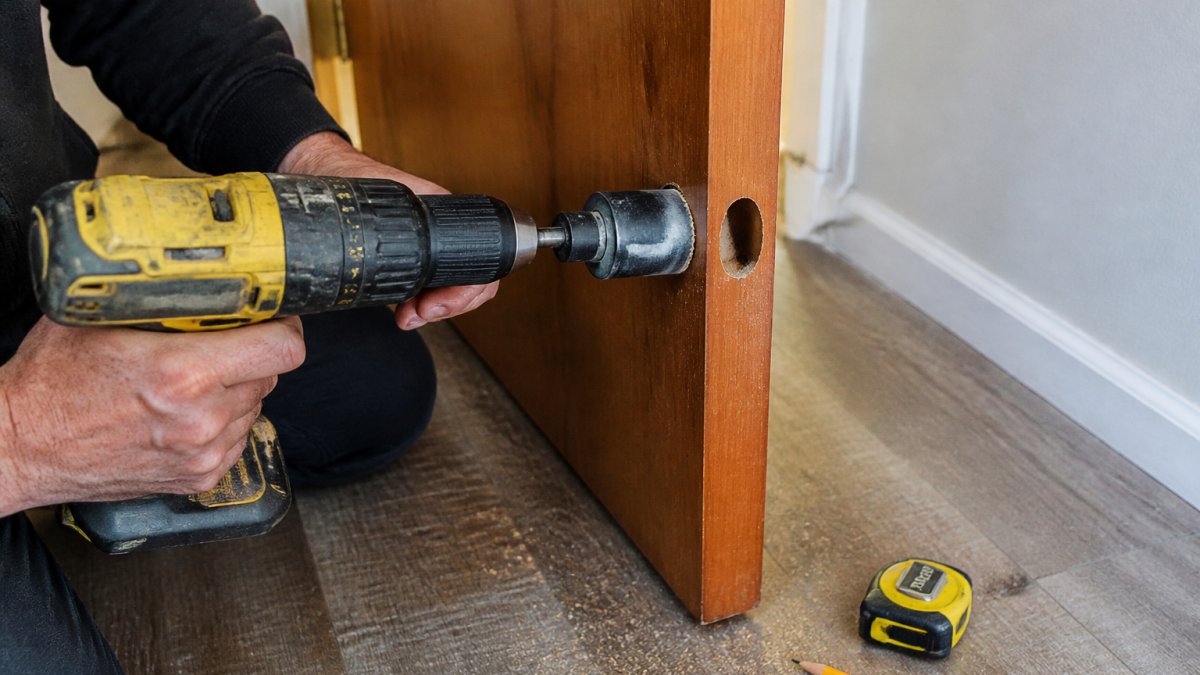
Drill the face bore first, then the edge bore. The face bore is the large hole on the door face. The edge bore is the smaller hole on the door edge.
- Use the hole saw for the face bore, and keep the drill level
- Drill halfway through, then finish from the other side
- Use the smaller bit for the edge bore
- Clear the chips as you go
Drilling from both sides prevents splintering and keeps the holes aligned. If the holes do not meet cleanly, the bolt will bind.
Step 3: Chisel the Latch and Strike Plate Recesses
Chisel the recesses so the latch and strike plate sit flush with the wood. A flush plate looks better and holds better.
- Trace the outline of the latch plate on the door edge
- Score the outline with a sharp chisel
- Remove wood to the depth of the plate
- Repeat on the frame for the strike plate
- Test the fit before you screw anything in
Take thin cuts. You can always remove more wood, but you cannot put it back.
The two numbers that decide everything are backset and door thickness. Measure both before you buy, and the rest of the install goes smoothly.
Deadbolt Alignment Troubleshooting: Latch, Strike, and Door Sag
Deadbolt alignment troubleshooting usually comes down to one of three problems: a latch that binds, a strike plate that misses, or a door that has sagged.
Start with the simplest fix. Open the door and work the bolt by hand. If it moves freely, the lock is fine and the frame is the issue.
| Problem | Likely Cause | Fix |
|---|---|---|
| Bolt binds in the hole | Misaligned bore holes | Re-drill or file the hole slightly |
| Bolt misses the strike | Strike plate set wrong | Enlarge or shift the strike plate |
| Door rubs the frame | Sagging hinges | Tighten or replace hinge screws |
| Bolt sticks when turned | Debris or tight fit | Clean and lubricate the bolt |
Door sag is the one people misdiagnose. If the door has dropped, no amount of lock adjustment will fix it. Tighten the top hinge screws first, then retest.
A strike plate that is set too shallow is another common miss. The bolt hits the plate instead of sliding into the frame. Chisel a little deeper and retest.
When to Call a Locksmith or Property Management
Call a locksmith when the door is steel, the frame is metal, or the holes are already misaligned. These jobs need the right tools and a steady hand.
Call property management when your lease forbids changes, when the frame is failing, or when the building uses a master key system. A master key system lets one key open many doors, and a random new lock can break that setup.
We recommend a professional install when any of these apply:
- The door is steel or metal-wrapped
- The existing holes are damaged or oversized
- You need a key that matches a building system
- You want a high-security lock with reinforced hardware
Our licensed and insured team handles apartment lock installs across the South Bay, and we offer free estimates so you know the scope before we start. We also offer a 5% military discount.
If you are renting and just need one deadbolt, we take those jobs too. Small work is still work worth doing right.
Apartment security does not have to mean fighting your lease or damaging a door you do not own. It means measuring first, getting permission in writing, and choosing the right lock for the frame you have.
When the job needs a professional hand, BDS Locksmith brings mobile service to your door, same-day availability, and licensed, insured technicians who install without damage. We provide free estimates and competitive pricing, so there are no surprises.
Call (408) 300-4369 to schedule your deadbolt installation and secure your apartment the right way.
Frequently Asked Questions
Do I need my landlord’s permission to install a deadbolt on my apartment door?
Yes, in most cases. Your lease likely prohibits permanent modifications without written approval. Ask your landlord or property manager first, and get permission in writing. Some landlords will allow a deadbolt if you provide them a key or agree to restore the door when you move out. If they refuse, renter-friendly options like no-drill deadbolts or door reinforcement bars can add security without violating your lease.
What tools do I need to install a deadbolt on an apartment door?
You will need a power drill, a hole saw sized for your deadbolt (usually 2-1/8 inches for the face bore), a 1-inch spade bit for the edge bore, a chisel, a hammer, a screwdriver, a tape measure, and a pencil. Most deadbolt kits include a paper template and mounting screws. A lock installation kit that combines the hole saw and alignment guide can save time and reduce the risk of drilling in the wrong spot.
Why do I have to lift my door to lock the deadbolt?
A door that needs lifting to lock usually has sagging hinges or a misaligned strike plate. The deadbolt enters the strike plate at a slight angle instead of straight on. Tighten the hinge screws first. If that does not fix it, file the strike plate opening slightly larger or move the strike plate up or down a few millimeters. In older apartment buildings, humidity and settling can shift the frame, so check the gap between the door and jamb before drilling any new holes.
How can I secure an apartment door without drilling?
Several no-drill options exist for renters. A door reinforcement bar that wedges under the doorknob adds kick-in resistance without any tools. Portable travel locks and door wedges work for temporary security. For a permanent solution that respects your lease, ask your landlord about a re-key or a deadbolt installation done by a licensed locksmith.