Last Updated: November 4, 2026
Quick Summary
To choose a locksmith for lock installation, define the job first, then verify the license, insurance, and bonding before you book. Get an itemized written estimate, confirm the lock grade and door measurements, and inspect the finished work before the technician leaves.
- Write down the door type, lock type, job scope, and deadline before calling any shop.
- Ask for the license number, insurance certificate, and bond number, then verify each one.
- Confirm the backset, bore hole diameter, and door thickness before accepting a quote.
- Compare quotes on the itemized total, not the headline number.
- Test the lock yourself and get the warranty terms in writing before the technician leaves.
Table of Contents
- Step 1: Define the Job Before You Call Anyone
- Step 2: Learn How to Verify Locksmith Credentials
- Step 3: Check Reputation Through Reviews, Referrals, and Local Presence
- Step 4: Match the Locksmith’s Skills to Your Door and Lock Type
- Step 5: Understand Locksmith Installation Cost Before Work Begins
- Step 6: Get a Written Estimate and Ask About Extra Fees
- Step 7: How to Secure Garage Side Doors as Part of the Install
- Step 8: Inspect the Finished Work and Confirm the Warranty
- Frequently Asked Questions
Step 1: Define the Job Before You Call Anyone
The best way to choose a locksmith for lock installation starts with knowing exactly what you need before the phone ever rings. A vague request invites a vague quote. A precise one gets you a fair price and the right technician.
Write down four things first:
- The door type: wood, steel, fiberglass, or glass
- The lock type: deadbolt, knob, lever, or smart lock
- The job scope: new install, replacement, or re-key
- Your deadline: emergency, same day, or scheduled
This matters because a residential locksmith quoting a standard deadbolt faces a different job than one installing a commercial-grade mortise lock. Mixing the two wastes everyone’s time.
A common mistake is calling five shops and describing the job differently each time. You end up comparing prices for different work. Define the job once, then use the same description everywhere.
Photographing the door edge, the existing lock, and the door frame before you call can help you describe the job accurately.
Step 2: Learn How to Verify Locksmith Credentials
Verifying a locksmith means confirming three separate things: a valid license where your state requires one, active insurance, and bonding. Each protects you in a different way, and a legitimate shop will hand over proof without hesitation.
Licensing rules vary by state and sometimes by city. Check your state’s consumer protection or business licensing office to see what applies where you live. If a license is required and the technician cannot produce a number, walk away.
License, Bonding, and Insurance: What Each One Covers
These three get used interchangeably, but they are not the same:
- License: proves the locksmith met state or local requirements to operate
- Insurance: covers damage to your door, lock, or property during the work
- Bonding: protects you financially if the technician commits theft or fraud
Ask for a certificate of insurance and a bond number. A real business keeps these on hand and sends them without a fuss.
How to Check Credentials Before You Book
Do this before you agree to anything:
- Ask for the license number and verify it with the issuing agency
- Request the insurance certificate and confirm the policy is current
- Check the business name on the documents matches the company you called
- Look up the business in your state’s registry
For a deeper walkthrough of exactly what to check, see our guide on what to check for locksmith credentials.
Watch out: some unlicensed operators use a real company’s license number. Confirm the name on the license matches the name on the van, the invoice, and the phone greeting.
Step 3: Check Reputation Through Reviews, Referrals, and Local Presence
Reputation checking is where most people do the least work and regret it most. A locksmith with a real local presence has a verifiable business address, a working phone number, and a trail of customer reviews that go back years.
Start with these signals:
- A physical business address, not just a phone number
- Consistent reviews across Google, Yelp, and the Better Business Bureau
- Referrals from neighbors, property managers, or your real estate agent
- A local phone number with a real area code
Be skeptical of a shop with a large number of five-star reviews posted in a single week. Also watch for the opposite: a business that answers the phone with a generic greeting and cannot name its own address.
A good test is to ask a simple question: “Where are you based?” A legitimate local locksmith answers in one sentence. A call-center operation stalls.
Step 4: Match the Locksmith’s Skills to Your Door and Lock Type
Skill matching is the step most guides skip. A technician who installs basic knob locks all day may not be the right person for a high-security deadbolt or a smart lock system. Ask what they install most often and whether they have done your specific setup.
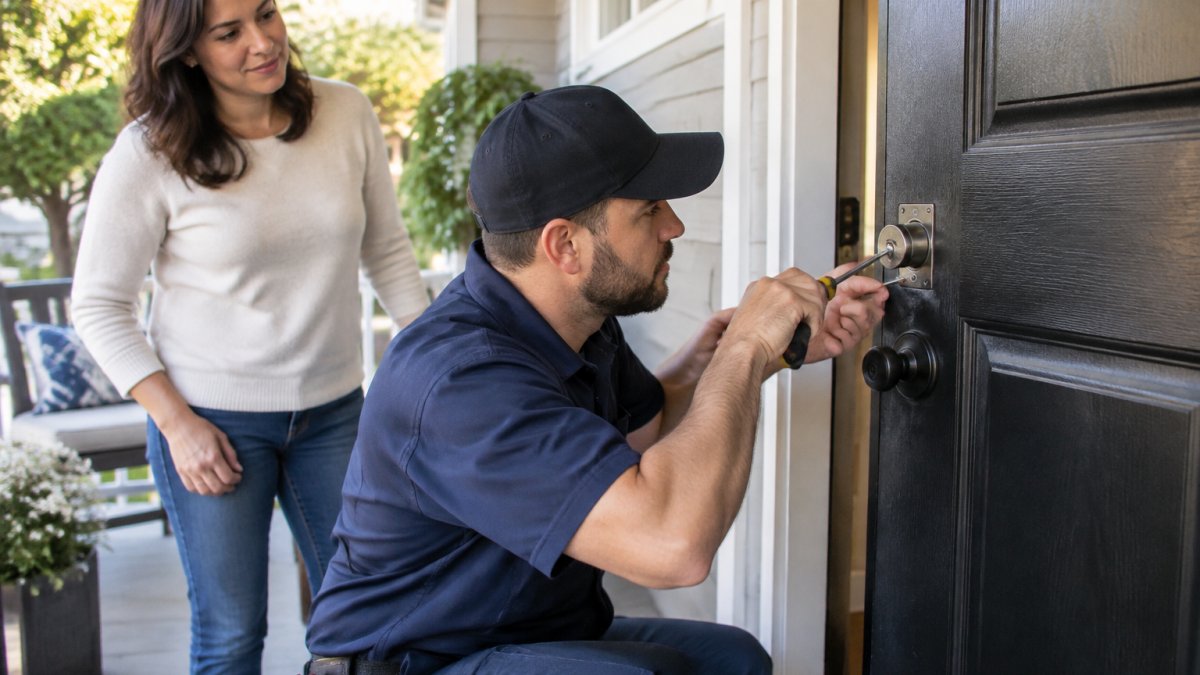
The fastest way to test skill is to make the technician explain their recommendation in terms of your door, not their inventory. A prepared installer will ask about door material, thickness, backset, and bore hole size before quoting. If the answer is a brand name with no reference to your door, you are talking to a salesperson.
Lock Grades and Certifications That Signal Real Security
Lock grades give you a measurable way to judge security instead of guessing. Residential lock grades give you a measurable way to judge security instead of guessing, and the grade indicates how much force and abuse a lock is built to survive.
- Grade 1: highest residential security, built for heavy use
- Grade 2: solid middle ground for most homes
- Grade 3: basic builder-grade, lowest security
Ask the locksmith which grade they recommend for your door and why. A technician who can explain the difference is a technician who knows the hardware.
Grade is only half the story. The other half is whether the lock fits the door. A Grade 1 deadbolt installed in a door with a thin face bore and no reinforcement is weaker than a Grade 2 deadbolt backed by a reinforced strike plate and a solid frame. A competent installer will talk about both the lock and the door preparation, and will tell you when the door, not the lock, is the limiting factor.
Door Type and Hardware Compatibility
Door material changes the installation. Wood doors accept standard boring and mortise work. Steel doors often need specific hardware and may already have reinforced edges. Fiberglass doors can be hollow or foam-filled and may not hold a heavy deadbolt without a backing plate. Glass and full-lite doors usually require a different hardware family entirely.
Ask the installer to confirm three measurements before quoting:
- Backset: the distance from the door edge to the center of the lock bore, commonly 2-3/8 inches or 2-3/4 inches
- Bore hole diameter: standard cylindrical locks use a 2-1/8 inch cross bore
- Door thickness: most residential doors are 1-3/4 inches, but older and specialty doors vary
If the technician cannot state these numbers or asks you to measure them after the quote, the quote is a guess.
Smart Locks and Electronic Access Systems
Smart locks add a layer of complexity. They need correct door prep, solid Wi-Fi or Bluetooth pairing, and a technician who understands the electronics, not just the metal.
Ask three questions before booking:
- Have you installed this brand before?
- Can you program it and walk me through the app?
- What happens if the electronics fail?
If the answer to any of these is shaky, find a different installer.
Go one level deeper on compatibility. Ask whether the smart lock replaces the entire deadbolt or retrofits over an existing cylinder, whether it needs a specific hub or bridge for remote access, and whether it keeps a mechanical key override. A lock with no key override can leave you locked out when the battery dies or the app fails. Confirm the backup method in writing before installation.
The Installation Consultation Checklist
Before you approve any quote, run this list with the technician:
- What lock model and grade are you installing, and why is it right for this door?
- Does the door need re-boring, reinforcement, or a new strike plate?
- Will you reuse existing holes or drill new ones?
- Is the deadbolt keyed to match existing keys, and can you re-key on site?
- What is the warranty on the hardware and on your labor?
- What is your policy if the lock does not fit or the door needs repair?
A technician who answers these without hedging is showing you the depth of their installation experience. A technician who deflects is showing you the limits of it.
Step 5: Understand Locksmith Installation Cost Before Work Begins
Locksmith installation cost depends on the lock type, door condition, and labor, so a flat number usually requires asking questions first. For current pricing or a quote, contact BDS Locksmith directly. Expect the price to break into parts: the lock itself, labor, and any service-call fee.
Locksmith installation costs are commonly structured in parts, and BDS Locksmith provides an itemized quote on request. Here is how the cost is generally organized:
| Cost Component | What It Covers | What to Ask |
|---|---|---|
| Lock hardware | The deadbolt or lock unit | Is the lock included or do I supply it? |
| Labor | Time to install and test | Is labor billed flat or hourly? |
| Service call | Trip to your location | Is it waived if I book the install? |
| Extra parts | Strikes, plates, door prep | What triggers an added charge? |
If you are weighing a high-security upgrade, our guide on estimating the cost of high-security locks breaks down what drives the price up or down.
Get the all-in number in writing before anyone touches the door.
Service-Call Fees, After-Hours Rates, and Deposits
A service-call fee is a line item to clarify before booking. It typically covers the trip, and you should ask whether it is credited toward the installation. Ask directly: “Is the service call included in the installation price, or is it added on top?” Get the answer in writing.
After-hours and emergency rates are a separate tier. Ask whether after-hours or weekend work is priced differently from standard appointments. If your job can wait for a standard appointment window, say so and ask for the standard rate. If it cannot, ask for the after-hours rate up front rather than discovering it on the invoice.
Some shops ask for a deposit on special-order hardware. If a deposit is requested, it should be documented, refundable under stated conditions, and applied to the final bill. Avoid paying a full installation price before the work is done.
How to Compare Quotes Fairly
Comparing quotes is where most homeowners go wrong. They compare the headline number and pick the lowest one, then pay more when the extras appear. Compare the itemized total instead.
Put each quote side by side and check four things:
- Same lock model and grade in every quote, or the comparison is meaningless
- Same scope: installation only, or installation plus door prep and reinforcement
- Same fee structure: service call, after-hours, and disposal fees listed separately
- Same warranty terms: hardware and labor coverage stated in writing
A quote that is dramatically lower than every other bid usually means the price will climb once the technician is at your door. A quote that is higher but itemized and complete is often the cheaper job in the end.
What Can Legitimately Raise the Price
A straight answer to “What could make this cost more?” names specific conditions. Common ones include:
- Door damage or rot around the existing lock that needs repair before installation
- Unusual door thickness or a non-standard backset that requires extra prep
- A switch from a cylindrical lock to a mortise lock, which is a different installation
- Reinforcement hardware, such as a heavy-duty strike plate or a door wrap
- Re-keying or keying to match existing keys
An evasive answer, or a promise that the price will never change, is a red flag. No honest installer can guarantee a fixed price before seeing the door.
Step 6: Get a Written Estimate and Ask About Extra Fees
A written estimate is your protection against the classic bait-and-switch. The phone quote is not the price. The signed estimate is.
Ask for these in writing:
- Total cost, itemized by part and labor
- Any service-call or after-hours fee
- The exact lock model being installed
- The warranty terms
Then ask the question that saves the most money: “What could make this cost more?” A straight answer names door damage, unusual door thickness, or a lock that needs extra prep. A evasive answer is a red flag.
Watch out: a quote that is dramatically lower than every other bid usually means the price will climb once the technician is at your door. Compare quotes on the itemized total, not the headline number.
Step 7: How to Secure Garage Side Doors as Part of the Install
Garage side doors are the weak point most homeowners forget. They are often flimsier than the front door and easier to kick in. A good installation visit is the moment to fix that.
Ask the locksmith to check:
- Whether the side door has a deadbolt or only a knob lock
- Whether the door frame and strike plate are reinforced
- Whether the door is solid or hollow-core
A hollow-core side door with a basic knob lock is an open invitation. Upgrading to a solid door with a Grade 1 or Grade 2 deadbolt and a reinforced strike plate closes the gap. Our full guide on how to secure garage side doors covers the hardware and reinforcement steps in detail.
If your installation appointment includes the garage, say so when you book. It changes the parts list and the time estimate.
Step 8: Inspect the Finished Work and Confirm the Warranty
Inspection is the last step, and skipping it costs people money. Test the lock yourself before the technician leaves.
Run through this checklist:
- Lock turns smoothly with the key, no sticking
- Deadbolt extends fully into the strike plate
- Door closes and latches without force
- No damage to the door, frame, or trim
- All keys work, and spares are accounted for
- Warranty terms are in writing
Ask for the warranty in writing and confirm what it covers: the hardware, the labor, or both. A workmanship guarantee should state how long it lasts and how to make a claim.
If something is wrong, raise it before the technician leaves. If damage happens during the work, know your options. Our article on what to do if a locksmith damages your door walks through the steps to document it and get it resolved.
Choosing a locksmith for lock installation comes down to doing the boring checks: verify the credentials, confirm the insurance, get the estimate in writing, and inspect the work. Most people skip half of these and pay for it later.
At BDS Locksmith, we handle residential and commercial lock installation across the South Bay Area as a licensed, bonded, and insured mobile service. We offer free estimates, same-day availability, and a 5% military discount. Call (408) 300-4369 or visit our locksmith service page to book your installation.
Frequently Asked Questions
How much does a locksmith charge to install a lock?
Locksmith installation cost depends on the lock type, door material, and whether hardware is supplied. A standard deadbolt install usually runs less than a high-security or smart lock that needs programming. Ask for a written estimate that separates the service call fee, labor, and hardware so you can compare quotes fairly. BDS Locksmith offers free estimates, and current pricing is available on its website.
How do I know if a locksmith is reputable?
Check three things: a verifiable license and insurance, a local business address and phone number, and recent customer reviews that mention installation work specifically. Ask whether the technician is bonded and whether the company provides a written estimate and warranty. A reputable locksmith will answer these questions without hesitation and let you inspect identification on arrival.
Should I hire a locksmith or install door locks myself?
A basic knob swap is a reasonable DIY job if your door is already drilled correctly. Hire a professional when you are installing a deadbolt on a new door, upgrading to high-security hardware, fitting a smart lock, or securing a garage side door, since these require precise boring, alignment, and sometimes door reinforcement. Poor installation is the most common reason locks fail or doors get damaged.
Is it cheaper to rekey existing locks or install new ones?
Rekeying is usually cheaper because the locksmith changes the pins rather than supplying new hardware, and it makes sense when the existing locks are in good condition and meet your security needs. Install new locks when the hardware is worn, the grade is too low, or you want keypad or smart access. Ask the locksmith to quote both options for the same door before you decide.