Last Updated: November 5, 2026
Quick Summary
To learn how to report an unlicensed locksmith in your state, start with the agency that issues locksmith licenses, then file a parallel complaint with your state attorney general’s consumer protection division if billing fraud is involved. Confirm the agency actually regulates locksmiths before you upload evidence, because a complaint sent to the wrong board is closed without action.
- Ask for the license number and confirm it yourself on your state’s licensing database before hiring.
- Gather the invoice, photos, screenshots, written quote, and a dated timeline before you file.
- Filing with the wrong agency is the most common reason a complaint gets closed without action.
- Anonymous reports are accepted in most states but carry less weight than named complaints.
- You can still sue the operator in small claims court regardless of what the board decides.
Table of Contents
- Why Reporting an Unlicensed Locksmith Matters
- How to Verify Locksmith License and Insurance Before You Hire
- Risks of Hiring an Unlicensed Locksmith and Fraud Warning Signs
- Evidence Collection Checklist for Your Complaint
- Locksmith Scam Reporting Procedures: Where to Send Your Complaint
- How to File a Formal Complaint Step by Step
- How to Report an Unlicensed Business Anonymously
- What Happens After You File: Enforcement and Penalties
- Choosing a Licensed Locksmith for Your Next Lockout
- Frequently Asked Questions
Why Reporting an Unlicensed Locksmith Matters
Reporting an unlicensed locksmith is the act of filing a formal complaint with a state licensing board or consumer protection agency against someone who performs lock work without the required credential. Homeowners who skip this step leave the same bad actors free to keep working the same neighborhoods.
The stakes are higher than a bad door job. An unlicensed operator has no bond, no insurance, and no regulator watching their work. If they damage your door or lock, you have little legal recourse. That is why how to report an unlicensed locksmith in your state matters for every homeowner, not just the person who got burned.
Reporting also protects public safety. A person who picks locks for a living without a license has never passed a background check. A complaint puts that person on the radar of an enforcement agency.
A single complaint rarely shuts down a scam operation, but a documented pattern of complaints gives regulators the evidence they need to open an investigation.
How to Verify Locksmith License and Insurance Before You Hire
Verifying a locksmith’s license and insurance is the fastest way to avoid ever needing to file a complaint. Ask for the license number before you agree to any work, then confirm it yourself.
Here is the process we recommend:
- Ask for the license number and the name of the issuing board.
- Search that number on your state’s licensing database.
- Confirm the name on the license matches the technician and the company.
- Ask for a certificate of insurance and call the insurer to confirm it is active.
- Get a written estimate before any work starts.
Do not accept a photo of a license card as proof. Look up the number yourself. A common mistake is trusting the number printed on a van or a business card, which anyone can print.
For a full walkthrough of the checks, see our guide on how to verify a locksmith license and insurance. If you want a printable list of what to ask for, our locksmith credential checklist covers each item to confirm.
One more thing: confirm the business registration too. A license tied to a company that does not legally exist is a red flag.
Risks of Hiring an Unlicensed Locksmith and Fraud Warning Signs
The biggest risk of hiring an unlicensed locksmith is that you have no legal recourse when something goes wrong. No bond means no claim. No insurance means no payout for a damaged door.
Fraud warning signs tend to cluster. Watch for these:
- Generic van markings with no company name or license number
- A quote that changes once the lock is already drilled
- Cash-only demands with no invoice offered
- Pressure to drill a lock that a skilled tech could pick
- No physical business address on the website or paperwork
- A phone number that routes to a call center, not a local shop
Misrepresentation is the core of most locksmith scams. The operator claims to be local and licensed, then charges far more than quoted. Our article on why generic van markings signal a scam breaks down the red flags in more detail.
If you are already in a dispute, do not pay under pressure. Ask for a written invoice first. A legitimate business will provide one.
Evidence Collection Checklist for Your Complaint
Strong evidence is what turns a complaint into an investigation. Regulators receive many reports; the ones with documentation get acted on.
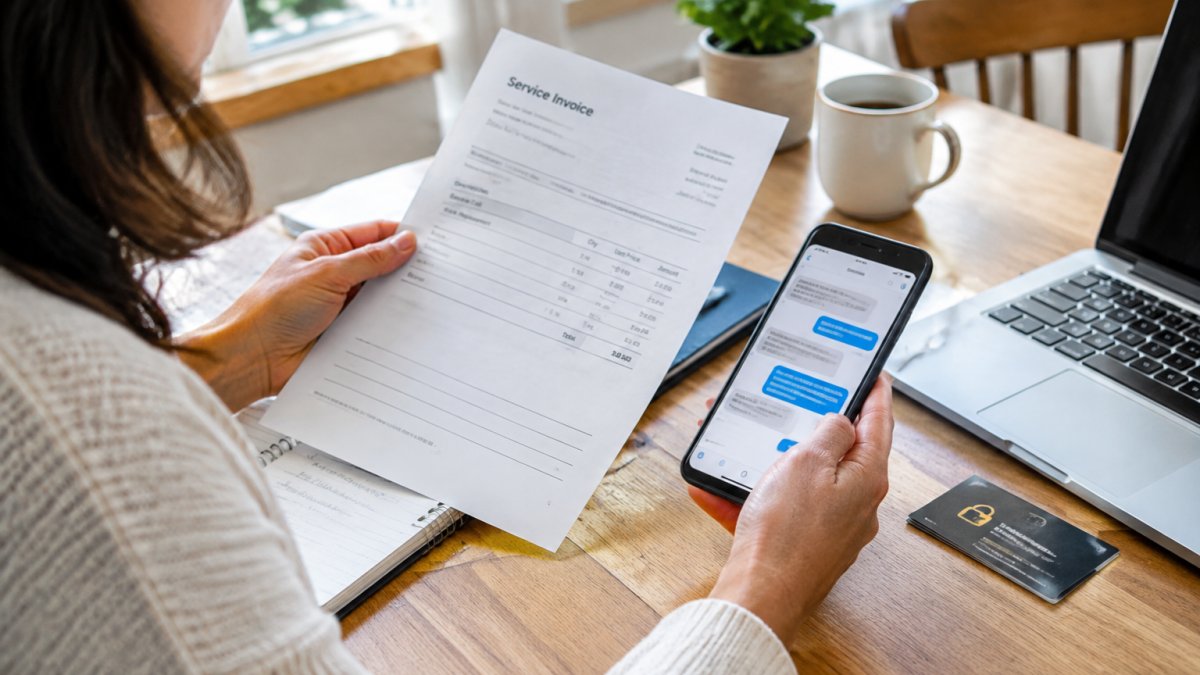
Gather these items before you file:
- The service invoice or receipt, even a handwritten one
- Photos of the work performed and any damage
- Screenshots of text messages and call logs
- The quote you were given, in writing if possible
- The technician’s name, and any license number they gave
- The vehicle description, including any markings
- Payment records: card statement, check copy, or cash receipt
- A dated timeline of what happened
Write your timeline the same day. Memory fades fast, and specific dates and times carry weight in an administrative hearing.
Keep copies of everything. Do not send originals to any agency.
Locksmith Scam Reporting Procedures: Where to Send Your Complaint
Knowing where to send a locksmith scam report is half the battle. Oversight is often split between a licensing board and a consumer affairs office, so you may need to file in two places. The problem is that no two states organize this the same way, and filing with the wrong agency is the single most common reason a complaint gets closed without action.
Start with the agency that issues locksmith licenses in your state, then consider a parallel complaint with your state attorney general’s consumer protection division.
Here is a quick reference for the typical path:
| Where to file | What it handles | What to include |
|---|---|---|
| State licensing board | Unlicensed activity, credential violations | License number, invoice, timeline |
| Consumer affairs office | Fraudulent business practices, billing disputes | Receipts, screenshots, written quote |
| State attorney general | Patterns of fraud, prosecution referrals | All evidence, list of other victims |
| Local police (non-emergency) | Theft, fraud, property damage | Police report number, photos |
How to Find Your State’s Correct Agency
Because the agency name changes at every border, use a lookup sequence rather than guessing. Work through these in order:
- Search your state’s official licensing portal for the term “locksmith license.” The result that returns a license search or application page is the issuing board.
- If no locksmith-specific result appears, search for “security alarm” or “private security” licensing. Several states fold locksmith oversight into a broader security or investigative bureau.
- If the license is issued at the county or municipal level in your area, the state board will usually redirect you; call its main line and ask for the correct jurisdiction before you file.
- Confirm the agency accepts locksmith complaints by phone or by reading its complaint intake page. A board that does not regulate locksmiths will close your file without review.
State-by-State Resource Directory
Use the categories below to locate the right office in your state. Agency names shift, but the structure is consistent enough to navigate.
- States with a dedicated locksmith licensing board or bureau: the board handles unlicensed activity and credential violations directly. File here first, then send a copy to the attorney general if billing fraud is involved.
- States that regulate locksmiths under a broader security or alarm bureau: the same office that licenses alarm and security contractors usually accepts locksmith complaints. Ask for the complaint intake unit, not the licensing help desk.
- States with local (county or city) licensing: file with the local licensing authority that issued the credential, and send a parallel report to the state consumer affairs office for the business-practice side.
- States with no statewide locksmith license: oversight falls to consumer protection and the attorney general. File a deceptive-trade-practices complaint and a non-emergency police report if money was taken by fraud.
For official complaint forms and current contact details, check the USA.gov state consumer protection directory to find your state’s consumer affairs office. The Federal Trade Commission complaint portal also accepts reports on fraudulent business practices, though licensing enforcement stays at the state level. The FTC’s Consumer Sentinel database shares reports with state and local enforcement, so a federal filing is not wasted even when the license itself is a state matter (the FTC).
File with every agency that applies. Duplicate reports are not a problem; missing one is. Keep a simple log of each agency, the date filed, and the confirmation number so you can follow up without re-reading your own paperwork.
Watch out: a complaint sent to a board that does not license locksmiths will be closed without action, so confirm jurisdiction before you spend time uploading evidence.
How to File a Formal Complaint Step by Step
Filing a formal complaint takes about 30 minutes once your evidence is organized. Follow these steps in order.
- Find the right agency. Search your state’s licensing board website for the locksmith complaint form.
- Download the complaint form. Most states offer an online portal and a printable PDF.
- Fill in your details and the business details. Use the exact name on the invoice.
- Write a factual narrative. Stick to dates, times, and what was said. Skip the emotion.
- Attach your evidence. Upload the invoice, photos, and screenshots as separate files.
- State what you want. A refund, an investigation, or both.
- Submit and save the confirmation number. You will need it to follow up.
- Send a copy to the attorney general’s office if the board does not cover billing fraud.
Keep your narrative under one page. Investigators read hundreds of these. A clear, dated summary gets read closely; a long rant gets skimmed.
Watch out: filing with the wrong agency is the most common mistake. A complaint sent to a board that does not license locksmiths will be closed without action. Confirm jurisdiction first.
How to Report an Unlicensed Business Anonymously
You can report an unlicensed business anonymously in most states, though anonymous reports carry less weight. Regulators prioritize complaints where they can contact the complainant for follow-up.
Here is how to report an unlicensed locksmith in your state without giving your name:
- Use the online complaint portal and leave the contact fields blank if the form allows it
- Ask the agency directly whether anonymous submissions are accepted
- File through a consumer advocacy group that forwards reports
- Submit a tip to the attorney general’s consumer hotline
The trade-off is real. An anonymous report with strong documentation still gets reviewed, but investigators cannot ask you clarifying questions. If you can safely include your name, do it.
If you fear retaliation, note that most states treat complaint records as confidential during an active investigation. Ask the intake officer how your information will be handled before you submit.
What Happens After You File: Enforcement and Penalties
After you file, the agency reviews your complaint and decides whether it falls under its authority. You will usually get an acknowledgment within a few weeks.
From there, the process follows a common path:
- Intake review: staff check jurisdiction and evidence quality
- Investigation: an investigator contacts you and the business
- Notice to the business: the operator gets a chance to respond
- Administrative hearing: serious cases go before a hearing officer
- Disciplinary action: fines, license suspension, or a cease-and-desist order
Penalties for unlicensed activity vary by state. The licensing board can also refer a case to the attorney general for prosecution.
Civil liability is separate. You can still sue the operator in small claims court for a refund or damages, regardless of what the board decides. Confirm the small claims limits and filing fees for your county before you file.
Timelines stretch. A simple case may close in a few months; a pattern-of-fraud case can take much longer. Follow up with your confirmation number every few weeks.
Escalation Paths When a Complaint Is Ignored or Dismissed
A closed file is not always the end of the road. A dismissal can mean the agency lacked jurisdiction, evidence, or staffing, not that the conduct was lawful. Work through these escalation steps in order:
- Ask for the dismissal reason in writing. A short email to the intake unit requesting the basis for closure often reveals whether the file went to the wrong agency or lacked a specific document.
- Re-file with the correct agency. If the closure was jurisdictional, refile with the office named in the response and reference the original confirmation number so the new agency sees the prior attempt.
- Escalate within the agency. Ask to speak with the complaint supervisor or the enforcement division chief. A polite written request for supervisory review, with your evidence attached again, moves a file that stalled at intake.
- File with the attorney general’s consumer protection division. A pattern of complaints, even individually dismissed, can support a broader deceptive-practices investigation. Send your timeline and evidence, and note any other victims you know of.
- Contact your state legislator’s constituent services office. These offices routinely make inquiries to state agencies on a constituent’s behalf and can prompt a status update that a lone complainant cannot.
- File a FTC report and a non-emergency police report. These create a federal and local record that can support a later civil case even when the licensing board takes no action.
- Pursue civil remedies. Small claims court for a refund or damages, or a demand letter through a consumer law attorney, can resolve the money side when enforcement does not.
Keep every acknowledgment, closure letter, and confirmation number. An escalation is far stronger when you can show the paper trail of what you already tried and what each agency said.
Watch out: repeated identical filings with the same agency can be logged as duplicate complaints and slow the review, so escalate to a new channel or a supervisor rather than resubmitting the same form.
Choosing a Licensed Locksmith for Your Next Lockout
The best way to avoid the complaint process is to hire right the first time. A licensed, insured locksmith gives you a paper trail, a bond, and a regulator to call if something goes wrong.
BDS Locksmith is licensed, bonded, and insured. We offer free locksmith estimates, mobile service that comes to you, same-day availability, and a 5% military discount.
When you are locked out and stressed, it is hard to vet a stranger at the door. Do it anyway. Ask for the license number, confirm the estimate in writing, and check that the invoice matches the quote.
For more on picking a trustworthy provider under pressure, read our guide on choosing a reliable emergency locksmith. If you need help finding someone who answers around the clock, our tips on finding reliable 24/7 locksmiths walk through what to confirm before you call.
Frequently Asked Questions
How do I verify if a locksmith is licensed in my state?
Ask for the license number and the name of the issuing agency, then check it yourself. Most states with locksmith licensing publish a searchable database through the regulatory board or consumer affairs office. Confirm the name on the license matches the company on the invoice, and ask for a certificate of insurance. A legitimate locksmith will provide both without hesitation. If the number cannot be found or the names do not match, do not hire them and consider filing a report.
What evidence do I need to report an unlicensed locksmith?
Collect the service invoice, any written estimate or text messages, the company name and phone number, photos of the vehicle or van, and the technician’s name if given. Note the date, time, and address of the job. Keep payment records such as a card receipt or check copy. If the price changed on arrival, write down the original quote and the final charge. This documentation helps the enforcement agency connect the complaint to a specific business and build a case.
Can I report an unlicensed locksmith anonymously?
Many state agencies accept anonymous tips, but the complaint may carry less weight because investigators cannot follow up with you for details. You can usually file anonymously through the attorney general’s consumer complaint form or a local non-emergency line. If you want the agency to act on your specific case, provide contact information and ask about confidentiality. Weigh the tradeoff: anonymity protects you, but named complaints often move faster.
Which state agency handles complaints against locksmiths?
It depends on your state. Common contacts include the state attorney general’s consumer protection division, a dedicated licensing board or bureau of security, and the state consumer affairs office. Some states delegate to county or city business licensing departments. Start with your state’s licensing board if locksmiths are regulated there; otherwise file with the attorney general. If unsure, call your local consumer affairs office and ask which agency has jurisdiction over unlicensed locksmith activity.
A lockout is stressful enough without wondering whether the person at your door is legitimate. BDS Locksmith takes that worry off the table: we are licensed, bonded, and insured, we show proof on request, and we give free estimates before any work begins. Our mobile team serves the South Bay with same-day availability, and we offer a 5% military discount. Get started with BDS Locksmith and get your door open with a provider you can verify.