Table of Contents
- Why High Security Deadbolts Matter More Than Standard Locks
- Resistance to Forced Entry and Drill Attacks
- How High Security Deadbolts Stop Unauthorized Key Duplication
- How to Prevent Lock Bumping and Lock Picking
- ANSI Grade 1 Deadbolt Requirements Explained
- Durability, Materials, and Long-Term Lock Performance
- Mechanical vs. Electronic Deadbolts: Which Fits Your Home
- How to Secure Garage Side Doors with High Security Hardware
- Do High Security Deadbolts Lower Home Insurance Premiums?
- Smart Home Integration Risks with High Security Deadbolts
- Maintenance and Longevity: Keeping Deadbolts Working for Years
- Cost-Benefit Analysis: Are High Security Deadbolts Worth It?
- High Security Deadbolts vs. Standard Deadbolts: A Side-by-Side Look
- Frequently Asked Questions
Last Updated: September 13, 2026
Why High Security Deadbolts Matter More Than Standard Locks
A deadbolt is only as strong as the weakest part of the assembly it belongs to, and that assembly includes the cylinder, the bolt, the strike plate, and the door frame itself. High security deadbolts matter because they harden every one of those points instead of just one.
The benefits of high security deadbolts come down to one idea: they remove the shortcuts an intruder relies on. A standard residential lock assumes the person at the door is either authorized or honest. A high security deadbolt assumes neither.
Here is what that actually changes in practice:
- Forced entry gets harder. Hardened bolts and reinforced strike plates resist the kick, pry, and wrench attacks that defeat cheap hardware.
- Key duplication gets controlled. Restricted keyways mean a key cannot be copied at a hardware store without authorization.
- Manipulation gets blocked. Anti-pick and anti-bump pins defeat the fastest covert entry methods.
- The frame stops being the weak link. Security hardware only works when the frame and strike are reinforced to match.
Most homeowners upgrade the lock and ignore the frame. That is a common mistake.
Resistance to Forced Entry and Drill Attacks
The answer to “how do high security deadbolts stop forced entry” is straightforward: they use harder materials, longer bolt throws, and reinforced strike hardware so the door gives out before the lock does. A standard deadbolt with a one-inch bolt and a thin brass strike can split a softwood frame with a single well-placed kick (ansi.org). A high security deadbolt with a hardened steel bolt and a reinforced strike plate distributes that force across a much larger area.
Drill resistance works differently. Attackers target the cylinder, hoping to drill out the pins and turn the mechanism. High security cylinders use anti-drill pins made of hardened material, often paired with a rotating outer ring that spins when a drill bit touches it. The bit skates instead of biting.
What most guides miss is that forced entry is rarely a lock problem alone. It is a door frame integrity problem. A deadbolt rated for heavy-duty use still fails if it is mounted into a hollow frame with a two-screw strike plate. The fix is a reinforced strike with long structural screws that anchor into the wall stud, not just the trim.
Installing a high-security deadbolt into an unreinforced frame is a common installation error. The lock survives the attack, but the frame splinters and the door swings open anyway. Always reinforce the strike plate and jamb at the same time.
How High Security Deadbolts Stop Unauthorized Key Duplication
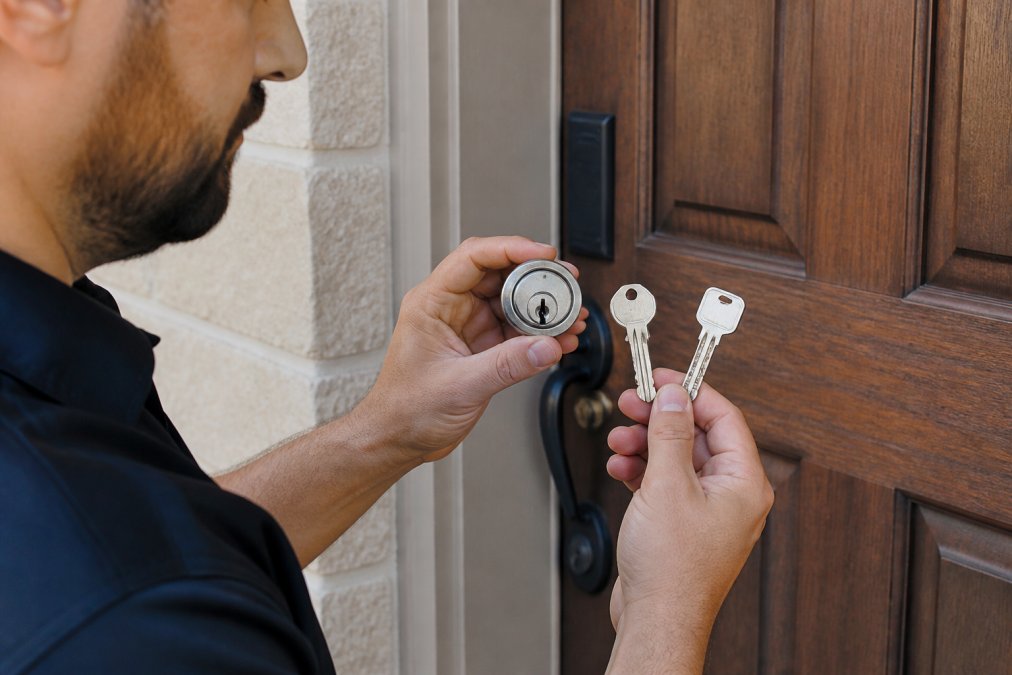
Unauthorized key duplication is blocked by a restricted keyway profile, which requires a patented key blank that only the lock manufacturer or an authorized dealer can supply. You cannot walk into a general hardware store and copy a restricted key, because the store does not stock the blank. That single supply-chain restriction is what makes key control possible.
The practical benefit shows up in three situations:
- Rental turnover. A landlord can re-key without replacing the whole lock, and a former tenant cannot copy the key beforehand.
- Contractor and service access. You hand over a key knowing it cannot be duplicated on a whim.
- Lost keys. A registered key can be flagged, and the cylinder re-keyed without swapping hardware.
A common mistake is assuming any “do not duplicate” stamp provides protection. It does not. A stamp is a request; a restricted keyway is a physical control. Only the second one actually stops unauthorized key duplication.
How to Prevent Lock Bumping and Lock Picking
To prevent lock bumping, you need a cylinder that resists the technique at the mechanical level, not a cover or a guard. Bumping works by inserting a specially cut key and striking it while applying turning pressure, which causes the pins to jump and align. Anti-bump pins and paracentric keyways defeat that alignment. Picking works by manipulating pins one at a time, and pick resistance comes from tight tolerances, security pins, and keyway shapes that make tension and feel unreliable.
The three covert methods to defend against:
- Bumping: defeated by anti-bump pins and restricted keyways.
- Picking: defeated by security pins and precision tolerances.
- Lock manipulation and impressioning: defeated by restricted blanks that are hard to source and shape.
A high security deadbolt does not make these attacks impossible. It makes them slow, noisy, and unreliable, which is the realistic goal of any residential security upgrade. An intruder who cannot get in quietly usually leaves.
ANSI Grade 1 Deadbolt Requirements Explained
ANSI Grade 1 deadbolt requirements describe the highest durability and security rating a residential deadbolt can earn under the American National Standards Institute grading system, verified through standardized cycle, impact, and force testing. Grade 1 locks are tested to withstand far more operating cycles and greater physical force than Grade 2 or Grade 3 hardware. Grade 3 is the minimum builders typically install; Grade 1 is the top of the residential scale.
The grading covers several performance areas:
- Cycle testing for long-term mechanical reliability
- Impact resistance against blunt force
- Pull and torque resistance on the cylinder and bolt
- Bolt strength under direct load
For anyone shopping, the label matters more than the marketing copy. A lock advertised as “heavy duty” without a Grade 1 rating is a claim, not a certification. When we specify ANSI Grade 1 deadbolt requirements for a client, we are choosing hardware that has been independently tested, not just described as strong.
ANSI/BHMA standards for deadbolt hardware outlines how these grades are structured and tested.
What the Grades Actually Separate
The three residential grades are not marketing tiers; they are different test thresholds applied to the same categories of abuse. The practical differences that matter at the door:
- Cycle count. Grade 1 hardware is tested to a substantially higher number of open/close cycles than Grade 2, and Grade 2 well above Grade 3. This is the number that predicts whether the lock still feels tight after a decade of daily use.
- Impact and strike force. Grade 1 deadbolts are tested against a heavier impact load than lower grades, which is the test that maps most directly to kick resistance.
- Cylinder pull and torque. The cylinder must resist being wrenched or pulled out of the housing. This is where cheap cast housings fail first.
- Bolt end-load and saw resistance. The extended bolt is loaded and attacked directly. A hardened bolt with a hardened insert resists cutting; a soft bolt does not.
A lock can pass Grade 1 on the cycle test and still be paired with a strike plate that fails the first kick. The grade rates the lock, not the installation. That gap is where most real-world failures happen.
How to Read the Label Before You Buy
You do not need a lab to verify a claim. You need the packaging or the spec sheet, and you need to know what to look for.
- Find the grade marking. It appears on the box, on the lock body, or in the manufacturer’s published specification. Look for the ANSI/BHMA grade number, not a phrase like “commercial grade” or “heavy duty.”
- Confirm it is the deadbolt being graded. Some packaging grades the whole lockset family; confirm the deadbolt itself carries the rating.
- Check the cylinder listing separately. A Grade 1 deadbolt can ship with a cylinder that carries its own listing, such as a UL 437 designation for key locks. The two ratings cover different things, the deadbolt’s durability and the cylinder’s resistance to picking, bumping, and drilling.
- Match the strike to the grade. If the lock is Grade 1 and the strike is a thin plate with two short screws, the assembly is not Grade 1 in practice.
The Grade 1 vs. UL 437 Distinction
These two ratings get conflated constantly, and they answer different questions.
- ANSI/BHMA Grade 1 is a durability and physical-strength rating for the deadbolt assembly. It tells you the hardware survives cycles, impact, and load.
- UL 437 is a listing applied to key locks and covers resistance to covert and surreptitious entry techniques, picking, impressioning, and related manipulation, plus some physical attack resistance.
A lock can be Grade 1 and not carry UL 437. A lock can carry UL 437 and be Grade 2. The strongest residential choice is a Grade 1 deadbolt paired with a UL 437 listed cylinder, installed into a reinforced strike and jamb. That combination is what the ratings are actually for, and it is the combination worth asking a supplier to confirm in writing before you buy.
Durability, Materials, and Long-Term Lock Performance
Durability comes down to materials and construction, and the differences are visible once you know what to look for. A high security deadbolt typically uses a solid hardened steel bolt, a reinforced cylinder housing, and a strike plate thick enough to resist deformation. Cheaper locks use cast metal and thin plating that wears through at the points of friction.
Lock durability shows up in the details:
- Bolt material. Hardened steel resists cutting and sawing; soft cast metal does not.
- Cylinder housing. A reinforced collar resists wrenching and pull attacks.
- Strike plate thickness. A heavy gauge plate spreads impact force instead of bending.
- Finish quality. Better coatings resist corrosion at the door edge, where weather hits hardest.
What most people never consider is that a lock is a wear item. Every turn of the key wears the pins and the keyway. A Grade 1 lock with quality materials simply takes far longer to reach the point where it needs service. In practice, that means fewer emergency calls and a lock that still feels tight after years of daily use.
Mechanical vs. Electronic Deadbolts: Which Fits Your Home
The choice between mechanical and electronic deadbolts comes down to how you want to manage access. A mechanical high security deadbolt relies entirely on a physical key and hardened internal components. An electronic deadbolt adds keypad, remote access, or biometric security on top of the mechanical lock. Neither is universally better; they solve different problems.
| Feature | Mechanical High Security | Electronic Deadbolt |
|---|---|---|
| Access method | Physical key only | Keypad, fob, app, biometric |
| Power dependency | None | Batteries or wired power |
| Key duplication control | Restricted keyway | Code management |
| Best for | Rentals, low-tech households | Frequent guest access |
| Failure mode | Wears gradually | Dead battery, firmware issues |
A mechanical lock never runs out of power. That is its core advantage, and it is why many security-minded homeowners still prefer one on the primary entry door. An electronic lock offers remote access and easy code changes for guests, contractors, or short-term rentals, but it introduces a new set of dependencies.
For the main entry door, a mechanical Grade 1 deadbolt paired with a separate smart lock on a secondary door can offer the best of both. This allows for a lock that works without batteries where it matters most.
How to Secure Garage Side Doors with High Security Hardware
A garage side door is one of the most overlooked entry points on a property, and securing it means treating it like any other exterior door rather than a utility afterthought. These doors are often hollow-core, hung on a light frame, and fitted with a basic knob lock. That combination is a soft target, and intruders know it.
Here is how to secure garage side doors properly:
- Replace the knob lock with a Grade 1 deadbolt. The knob lock stays for convenience; the deadbolt does the actual work.
- Reinforce the strike and jamb. Long structural screws into the stud, plus a heavy strike plate.
- Add a door reinforcer or wrap plate. This ties the lock and the frame together against splitting.
- Hinge-side protection. Security hinges or hinge bolts stop the door being popped off its pins.
- Consider a solid-core or metal door. A hollow door defeats good hardware.
The order matters. Upgrading the deadbolt without reinforcing the frame is money half spent. When handling a garage side door, the hardware and the reinforcement should go in together, because one without the other leaves the same gap an intruder already knows how to exploit.
Do High Security Deadbolts Lower Home Insurance Premiums?
High security deadbolts can contribute to an insurance premium reduction, but the effect depends entirely on your insurer and how your policy defines a qualifying security upgrade. Some carriers offer discounts for specific, verifiable security features; others do not adjust rates for locks at all. There is no universal rule, and no lock upgrade guarantees a lower bill.
What actually moves the needle with insurers:
- A documented, qualifying lock that meets a recognized security rating, such as ANSI/BHMA Grade 1 or a UL 437 listing on the cylinder
- A monitored alarm system, which most carriers weight more heavily than locks
- Proof of installation, such as a receipt or a locksmith’s documentation
- A bundled security package, rather than a single component
The honest advice: call your insurer before you buy, ask what specific features qualify for a discount, and get it in writing. Then choose hardware that meets that definition. Buying a premium lock and assuming a discount will follow is backwards. A high security deadbolt is worth installing for the security itself; any premium reduction is a bonus, not the reason.
How the ROI Math Actually Works
Most guides stop at “ask your insurer.” The useful version is a break-even calculation, and you can run it in about five minutes.
- Get your current annual premium off the declarations page.
- Ask the carrier for the exact discount percentage tied to a qualifying deadbolt, and whether it stacks with an alarm discount.
- Multiply premium by discount percentage to get annual savings.
- Divide the installed cost of the upgrade (hardware plus professional installation) by that annual savings figure.
The result is your payback period in years. A common pattern is that a single-door upgrade pays back over several years on premium savings alone, and that ignores the deductible, the claim history hit, and the property loss a break-in would cause, which are the larger numbers. If your carrier offers no lock discount, the payback period is effectively infinite on insurance grounds, and the case for the upgrade rests entirely on loss prevention. That is still a legitimate case; it just is not an insurance case.
Treat the insurance discount as a tiebreaker between two locks you already want, not as the reason to buy. Run the break-even math so you know which it is for your policy.
What Carriers Actually Ask For
When a discount is available, verification is usually documentary, not physical. Expect to provide:
- A receipt or invoice showing the lock model and installation date
- The manufacturer’s specification sheet showing the ANSI/BHMA grade or UL listing
- Sometimes a locksmith’s signed statement confirming the strike plate and jamb were reinforced at the same time
That last item matters more than most homeowners expect. A carrier that discounts for “security deadbolts” is often discounting for the whole reinforced assembly, not the cylinder alone. If you installed a Grade 1 lock into an unreinforced frame, you may not qualify, and you also have not actually improved your security. The documentation and the physical work point the same direction.
Where the Discount Is Smallest
Discounts cluster where risk is already low. A home in a low-property-crime area with a monitored alarm, motion lighting, and a fenced yard may see a token reduction or none at all, because the lock is not the marginal risk factor. The same lock in a higher-risk area, on a home with no alarm, is more likely to be the feature the underwriter credits. This is counterintuitive but consistent: insurers discount the feature that changes their loss expectation, not the feature that is most impressive.
Smart Home Integration Risks with High Security Deadbolts
Smart home integration risks with high security deadbolts come from adding a wireless layer to a mechanical device that was never designed to be networked. The mechanical lock is the strong part. The connectivity is where the new vulnerabilities live.
The risks worth understanding:
- Battery failure. An electronic deadbolt with a dead battery is a locked door you cannot open from outside without a backup.
- Firmware and app dependencies. A discontinued app or an unpatched device can leave you locked out or exposed.
- Wireless interception. Poorly secured smart locks can be targeted over their wireless protocols.
- Cloud account compromise. If access is tied to an account, the account becomes a key.
- Physical bypass of the electronics. Some electronic locks have a mechanical override that is weaker than the deadbolt itself.
A high security deadbolt with a mechanical core and an electronic convenience layer handles this best. Keep a physical key as the fallback, keep the firmware updated, and never rely solely on an app to get into your own home. Access control should degrade gracefully, not fail completely when the battery dies.
Maintenance and Longevity: Keeping Deadbolts Working for Years
Maintenance is the difference between a lock that lasts a decade and one that seizes in three years, and it takes minutes per door. Most people never service a deadbolt until it fails, which is exactly when it costs the most to fix.
A simple annual routine:
- Lubricate the cylinder with a dry graphite or PTFE lubricant. Never use oil; it collects grit and gums up the pins.
- Check the bolt throw. The bolt should extend fully and smoothly into the strike.
- Tighten the strike and jamb screws. Seasonal movement loosens them.
- Test the keyway. A key that sticks is an early warning.
- Inspect the finish at the door edge for corrosion.
A common mistake is spraying WD-40 into a lock. It feels better for a week, then attracts dust and makes the problem worse. Use a dry lubricant made for locks.
If a key starts to feel gritty, do not force it. Gritty resistance usually means worn pins or a dirty cylinder. Cleaning and re-lubricating with a dry product now costs far less than a lockout later.
Cost-Benefit Analysis: Are High Security Deadbolts Worth It?
High security deadbolts are worth it when the value of what they protect and the likelihood of an attempt justify the upgrade, and for most homeowners the math favors doing it on at least the primary entry points. The cost of the hardware and professional installation is a one-time expense. The cost of a break-in is not just the stolen property; it is the door repair, the insurance claim, the deductible, and the disruption.
The honest cost-benefit picture:
- Where it clearly pays off: primary entry doors, garage side doors, and any door hidden from the street.
- Where it is optional: interior doors, or secondary doors already protected by an alarm and lighting.
- Where it is a waste: upgrading the lock while leaving a hollow door or a rotten frame in place.
A high security deadbolt is not a guarantee. It is a filter. It raises the effort required to get in, and effort is the one thing a casual intruder will not spend. Pair the hardware with lighting, an alarm, and a reinforced frame, and you have a layered defense that is genuinely hard to beat.
FBI crime data on property crime trends is a useful reference for understanding how burglary risk has shifted over time.
High Security Deadbolts vs. Standard Deadbolts: A Side-by-Side Look
The gap between a high security deadbolt and a standard deadbolt is not one feature; it is a stack of differences that compound. Standard locks are built to a price for a builder. High security locks are built to a rating for a homeowner who intends to stay secure.
| Feature | Standard Deadbolt | High Security Deadbolt |
|---|---|---|
| Bolt material | Cast or soft metal | Hardened steel |
| Key duplication | Open, any hardware store | Restricted keyway |
| Drill resistance | Minimal | Anti-drill pins |
| Bump and pick resistance | Low | Security pins, tight tolerances |
| Strike plate | Thin, short screws | Reinforced, long screws |
| Security rating | Often Grade 3 | Typically Grade 1 |
The takeaway is not that every door needs the top tier. It is that the primary entry points deserve hardware that actually resists the methods intruders use, and a standard builder lock does not. If you are choosing where to spend, spend it on the doors someone would actually try.
A break-in rarely announces itself, and the lock is the last line that has to hold. BDS Locksmith installs and services high security deadbolts, reinforced strike plates, and full residential security hardware on site, with same-day availability and 24/7 emergency service. Every job starts with a free estimate, our team is licensed, bonded, and insured, and we carry a 5% military discount for those who serve. Get started with BDS Locksmith by calling (408) 300-4369 and secure your home with hardware that holds when it counts.
Frequently Asked Questions
What makes a deadbolt considered high security?
A high security deadbolt combines hardened steel construction, anti-drill pins, a restricted keyway, and often UL 437 certification. These features resist forced entry, lock bumping, and unauthorized key duplication. ANSI Grade 1 rating is the top durability standard, tested for 250,000 cycles. For homeowners, the key differences are drill resistance, pick resistance, and key control that prevents anyone from copying your key without authorization.
Do high security deadbolts prevent lock bumping and picking?
Yes, most high security deadbolts are specifically engineered to stop lock bumping. They use security pins, shallow keyway profiles, and restricted key blanks that make bump keys ineffective. Pick resistance improves because the internal pin stack includes spool or serrated pins that bind during manipulation. No lock is 100% bump-proof, but a UL 437-rated deadbolt raises the skill and time required beyond what most intruders will attempt.
Can a burglar open a deadbolt lock?
A standard deadbolt can be defeated through bumping, picking, drilling, or forcing the door frame. A high security deadbolt makes each of those methods significantly harder. Drill resistance comes from hardened steel inserts and anti-drill pins. Frame integrity improves with a reinforced strike plate and longer screws. The bolt throw on a quality deadbolt is typically 1 inch, which resists shimming and prying far better than shorter bolts.
What locks do police recommend for doors?
Law enforcement and security professionals generally recommend ANSI Grade 1 deadbolts with a minimum 1-inch bolt throw, a reinforced strike plate, and hardened steel construction. They also emphasize door frame integrity, since a strong lock on a weak frame still fails. Adding a UL 437-rated cylinder with key control gives you drill resistance, pick resistance, and protection against unauthorized key duplication.
Is a Grade 3 security deadbolt good or bad?
Grade 3 is the lowest ANSI rating, tested for 100,000 cycles and minimal force resistance. It meets basic residential codes but offers limited drill resistance and weaker materials. Grade 2 is a step up for light commercial use. Grade 1 is the highest, tested for 250,000 cycles and the strongest strike and bolt performance. For exterior doors, Grade 1 high security deadbolts provide the best protection.
Are high security deadbolts worth the investment for homeowners?
For most homeowners, yes. A high security deadbolt costs more than a standard one, but it delivers drill resistance, bump resistance, key control, and often qualifies for insurance premium reductions. When you factor in the cost of a break-in, replacing stolen items, and repairing a damaged door, the upgrade pays for itself. BDS Locksmith offers free estimates so you can compare options before committing.
How do I secure a garage side door?
Garage side doors are a common weak point because they are often hollow-core or have a single standard lock. Install an ANSI Grade 1 deadbolt with a reinforced strike plate and 3-inch screws that reach the stud. Add a heavy-duty latch guard to prevent prying. For extra security, use a high security cylinder with key control so no one can duplicate the key without authorization. BDS Locksmith can assess and reinforce the full door assembly.
Do high security deadbolts affect home insurance premiums?
Many insurers offer premium reductions when you install ANSI Grade 1 deadbolts and other approved security hardware. The exact discount varies by provider and policy. Document your installation with receipts and photos, then ask your agent about available credits. Even a small reduction adds up over years, and the added residential protection is the bigger return on investment.