Table of Contents
- Can You Program a Car Key Without the Dealership?
- Transponder Key vs. Key Fob: What You’re Actually Programming
- What You’ll Need: Transponder Key Programming Tools and Equipment
- Step-by-Step: How to Program a Car Key Without Dealership
- Which Vehicles Allow DIY Key Programming?
- How to Replace Car Key Fob Battery (and Why It Matters for Programming)
- Automotive Locksmith Key Programming Cost vs. Dealership vs. DIY
- VIN-Based Key Cutting vs. OBDII Programming: What’s the Difference?
- When to Call a Professional (and What to Avoid)
- Frequently Asked Questions
Last Updated: September 25, 2026
Can You Program a Car Key Without the Dealership?
Yes, you can program car key without dealership involvement in many cases. The process ranges from a simple button sequence to using an OBDII scanner. At BDS Locksmith, we handle these jobs across the South Bay Area, and the first question is always the same: what kind of key do you have?
The answer depends on your vehicle’s year, make, and model. Older cars often allow manual programming. Newer vehicles with push-to-start and immobilizer systems usually need a diagnostic tool.
Below, we’ll show you exactly which category your car falls into. We’ll also cover the tools, the steps, and when it’s smarter to call a pro.
Transponder Key vs. Key Fob: What You’re Actually Programming
A transponder key is a metal key with a small chip inside the head. The chip sends a signal to your car’s immobilizer system before the engine will start.
A key fob is the remote part that locks and unlocks your doors. It handles keyless entry and remote entry functions.
Here’s the distinction most guides miss: you might be programming one, the other, or both.
- Remote only: The fob buttons don’t work, but the car starts fine
- Chip only: The car cranks but won’t start, or the security light flashes
- Both: You have a brand-new key that needs full setup
The immobilizer system is the security layer. It reads the chip’s frequency and checks the security pin code. If the code doesn’t match, the car won’t start, no matter how well the key is cut.
What You’ll Need: Transponder Key Programming Tools and Equipment
The right tools depend on your vehicle. Basic remote pairing needs nothing but your hands. Chip programming needs a diagnostic scanner or programming tool.
OBDII Scanners and Programming Devices
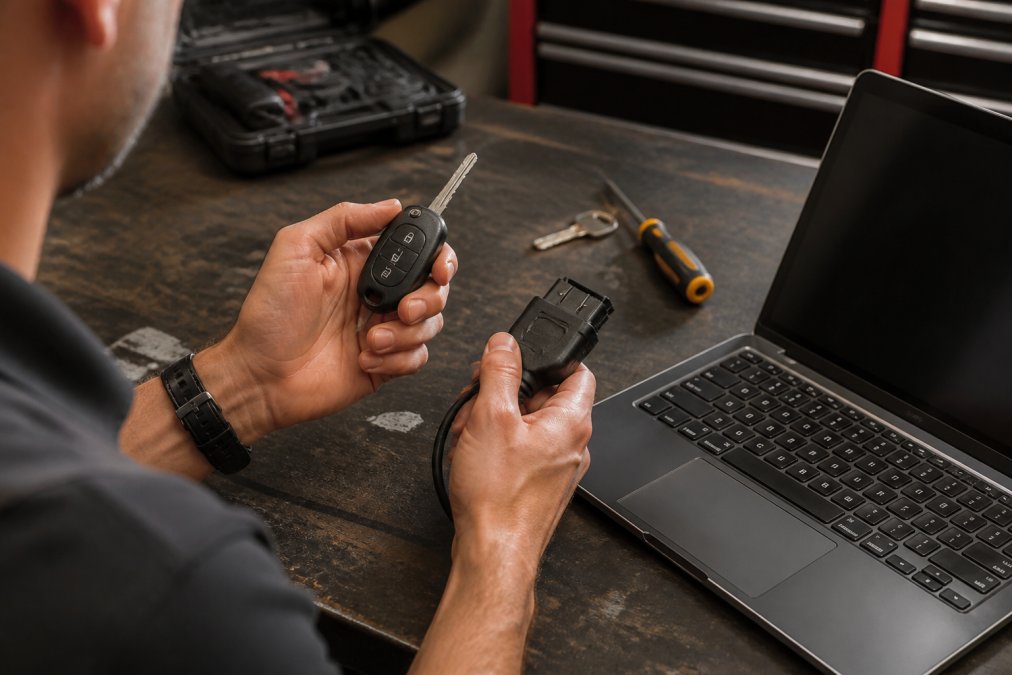
The OBDII port is a connector under your dashboard. A programming tool plugs in here to talk to your car’s computer.
There are two main types:
- Dealer diagnostic tool: Factory-level access, expensive, usually not sold to the public
- Aftermarket programmer: Made by third parties, works on many models, costs less
Not every aftermarket tool works on every car. Compatibility is the number one reason DIY attempts fail.
OBDII Programmer vs. Manual Button Sequence: Which Does Your Car Need?
This is the fork in the road most guides skip. Before you buy anything, figure out which of two programming paths your vehicle uses.
Manual button sequence (no tool required). The car’s body control module listens for a specific pattern of ignition turns and fob button presses. Common on many domestic trucks and SUVs from the late 1990s through the mid-2010s, and on a number of economy sedans with remote head keys. You need the working key (or a valet key), the new fob, and about five minutes.
OBDII programmer required. The immobilizer module will not accept a new chip without an authenticated session over the diagnostic port. This is the norm for most push-to-start and smart key systems, nearly all luxury brands, and an increasing share of mainstream models built after roughly 2015. You need a compatible programmer, a charged laptop or the tool’s own screen, and often a security pin code retrieved from the manufacturer or a locksmith database.
A practical way to tell which camp you’re in: check your owner’s manual’s index for “key fob programming” or “remote programming.” If the manual walks you through an ignition-turn sequence, you’re in the manual camp. If it says “see your dealer,” you’re almost certainly in the OBDII camp.
Key Cutting vs. Chip Programming
These are two separate jobs, and mixing them up wastes time.
Key cutting shapes the metal blade to match your lock. Chip programming pairs the electronics to your car’s computer.
A key can be cut perfectly and still not start your car. That’s the chip.
A common mistake is buying a cut key online and assuming it will work. If the chip isn’t programmed to your immobilizer system, the engine will not start, even with a perfect blade.
The Hidden Risks of Cheap Aftermarket Programmers
Price is the reason most people reach for a third-party tool, but the failure modes are real and expensive.
- ECU and immobilizer bricking. A programmer that drops its session mid-write, or that sends a malformed seed-key exchange, can leave the immobilizer module in a locked state. Recovery usually means a dealer visit and a module replacement, not a re-flash.
- Key wipe. Some low-quality tools overwrite the entire key table instead of appending a new slot. If your only working key is in that table, you can lose it in the same operation.
- Counterfeit firmware. Tools sold far below the typical street price for their class often ship with cloned firmware that misreports vehicle coverage. The tool claims support, the vehicle disagrees.
- No recovery path. Reputable tool makers publish coverage lists, firmware update logs, and support channels. If a seller can’t tell you which immobilizer families the tool supports, treat that as a no.
A reasonable rule: if the tool costs less than a single dealer programming visit for your model, assume it will not handle a dealer-locked immobilizer. It may still be fine for a manual-sequence remote.
Warranty and Insurance Implications
This is the question new-car owners ask first, and most guides ignore it.
Under the Magnuson-Moss Warranty Act, a manufacturer cannot void your entire vehicle warranty simply because you or an independent shop performed a repair or installed an aftermarket part. But the manufacturer can deny a specific warranty claim if it can show the aftermarket part or the DIY procedure caused the failure. In practice, that means a botched immobilizer write that damages the module is likely to be treated as a customer-caused failure, and the repair bill lands on you.
A few practical guardrails:
- Keep records. Save the tool’s receipt, the key blank’s part number, and any screenshots of the programming session. If a related claim is ever questioned, documentation is your defense.
- Check your policy. Some insurers ask about aftermarket electronics at renewal. A dealer-installed or locksmith-installed key is rarely an issue; a self-programmed ECU-adjacent change is worth a phone call to your agent.
- Leased vehicles. Lease contracts often require dealer-approved parts and service for anything touching the immobilizer. Read the wear-and-tear clause before you plug anything in.
DIY programming is cheapest when it works and most expensive when it bricks a module. Match the tool to your vehicle’s actual programming path before you spend a dollar.
Step-by-Step: How to Program a Car Key Without Dealership
The process to program car key without dealership has two parts: verifying compatibility, then running the programming sequence. Skipping the first part is where most people get stuck.
Step 1: Gather Your Tools and Verify Vehicle Compatibility
Check three things before you start:
- Your vehicle identification number (VIN)
- Your existing working key, if you have one
- The FCC ID printed on your old fob
The FCC ID tells you the exact frequency your remote uses. Match it to your replacement.
Next, confirm your car allows DIY programming. Some brands lock this behind dealer-only software.
Step 2: Program the Remote and Transponder Chip
For the remote entry portion, most cars use a manual sequence:
- Sit in the driver’s seat with all doors closed
- Turn the ignition to “On” without starting the engine
- Press the lock or unlock button on the fob
- Turn the ignition off, then repeat the cycle
- Listen for a chime or watch for a flash to confirm
For the transponder chip, you’ll need a programming tool plugged into the OBDII port. Follow the on-screen steps. The tool handles ECU synchronization and authentication for you.
Expected result: The car starts, and the security light stops flashing.
If you’re programming a second key, keep your original working key nearby. Many systems need one already-paired key to authorize a new one. Lose all your keys, and the job gets much harder.
Which Vehicles Allow DIY Key Programming?
Many older vehicles and some newer ones allow DIY programming. The dividing line is usually the immobilizer system and how tightly the maker locks its software.
Vehicles That Typically Allow Manual DIY Programming
These are the cases where a button sequence or a simple fob-pairing routine usually works without a diagnostic tool:
- Older cars with basic remote head keys, many models from the late 1990s through the mid-2000s where the remote and the key share a head
- Many domestic trucks and SUVs, full-size pickups and body-on-frame SUVs from the 2000s and 2010s frequently publish an ignition-cycle sequence in the owner’s manual
- Vehicles with a published manual sequence, if the owner’s manual has a numbered list of ignition turns and button presses, that’s your green light
- Second-key additions on cars that already have one working key, many systems will accept a new fob as long as an authorized key is present
Vehicles That Typically Require an OBDII Programmer or Dealer Tool
- Push-to-start and smart key systems, the immobilizer expects an authenticated diagnostic session, not a button dance
- Luxury brands with dealer-locked software, the seed-key exchange is gated behind factory credentials
- Cars needing a security pin code you can’t retrieve yourself, without the pin, the tool can’t open a programming session
- Most models built after roughly 2015, the trend has been toward tighter immobilizer gating across all price tiers
- Vehicles where all keys are lost, even DIY-friendly models often require a dealer or locksmith once the key table is empty
How to Confirm Your Specific Vehicle
Three checks, in order:
- Owner’s manual index. Search for “key fob programming,” “remote programming,” or “transponder.” A published sequence means manual DIY is on the table.
- FCC ID on the existing fob. The ID printed on the back identifies the exact radio frequency and protocol. Any replacement must match it.
- Model-specific forums and tool coverage lists. Reputable programmer makers publish which immobilizer families their tools support. Cross-check your model year against that list before buying.
When in doubt, check your owner’s manual or a model-specific forum before buying any tool.
Proof of Ownership: What You’ll Be Asked to Show
Whether you buy a key blank online, walk into a locksmith, or order through a dealer parts counter, expect to prove the key is for a car you actually own. This is an anti-theft requirement, not a customer-service inconvenience.
Commonly requested documents:
- Vehicle registration or title showing your name
- Government-issued photo ID matching the registration
- Vehicle identification number (VIN), usually verified against the registration and the car itself
- Proof of insurance in some cases, particularly for dealer-ordered keys
Online sellers of key blanks and programmers vary widely in how strictly they enforce this. A seller that asks for nothing is a seller that has no anti-fraud process, which is worth weighing against the small savings.
If you’re programming a second key, keep your original working key nearby. Many systems need one already-paired key to authorize a new one. Lose all your keys, and the job gets much harder.
How to Replace Car Key Fob Battery (and Why It Matters for Programming)
A dead battery is the most common reason a fob “stops working.” Before you assume the key needs programming, swap the battery.
Here’s the simple process:
- Pry open the fob case with a small flat tool
- Note the battery size, often a coin cell
- Remove the old battery without touching the contacts
- Insert the new one with the correct side facing up
- Snap the case closed and test the buttons
Why it matters for programming: a weak battery can cause pairing to fail mid-sequence. A fresh cell gives you a clean signal. If the fob still won’t pair after a new battery, the problem is the programming, not the power.
Automotive Locksmith Key Programming Cost vs. Dealership vs. DIY
Cost is where DIY looks best on paper, but the full picture is more complicated. Pricing depends on your vehicle, key type, and location, so always confirm current rates before you commit.
| Option | What You Pay For | Best For | Main Drawback |
|---|---|---|---|
| DIY | Tool cost plus key blank | Simple remotes, older cars | Tool may not work on your model |
| Dealership | Parts plus labor, often highest | Newer, dealer-locked cars | Highest cost, slow turnaround |
| Automotive locksmith | Mobile service, one visit | Most vehicles, all key types | Need a trusted local pro |
For automotive locksmith key programming cost, the total usually beats a dealership because you skip the tow and the dealer labor rate. BDS Locksmith offers free estimates so you know the number before we arrive.
The cheapest option isn’t always DIY. If you buy a tool that doesn’t work on your car, you’ve paid twice: once for the tool and again for a pro.
VIN-Based Key Cutting vs. OBDII Programming: What’s the Difference?
These are two different jobs that people constantly confuse. Understanding both saves you money and frustration.
VIN-based key cutting uses your vehicle identification number to cut the metal blade to factory specs. A machine reads your VIN, pulls the correct pattern, and cuts a key blank. This gives you a blade that physically turns the lock.
OBDII programming handles the electronics. A tool plugs into the OBDII port and pairs the transponder chip or smart key to your car’s computer.
You need both for a fully working new key. A cut key without programming won’t start the car. A programmed chip on a bad blade won’t turn the ignition.
A security risk with cheap aftermarket programmers is that some can overwrite or wipe existing keys. If a tool mishandles the immobilizer reset, you could lose your working key too. Buy from reputable sellers and check reviews for your exact model.
When to Call a Professional (and What to Avoid)
Some jobs are worth handing off. If your car is push-to-start, uses a smart key, or needs a security pin code, a pro with the right dealer diagnostic tool will finish faster and safer than a DIY attempt.
Call a professional when:
- You’ve lost all your keys
- Your car is dealer-locked
- The DIY sequence fails twice
- You need key cutting and programming together
BDS Locksmith is licensed, bonded, and insured, and we come to you. No towing, no dealership wait.
Common Mistakes to Avoid
- Buying a tool before checking your car’s compatibility
- Forgetting the FCC ID and frequency match
- Skipping the battery swap on a “dead” fob
- Attempting an immobilizer reset with a cheap tool
- Losing your only working key before making a spare
Make a spare key while you still have a working one. Programming a copy is far easier and cheaper than replacing all keys after a total loss.
Frequently Asked Questions
Can you program a key without going to the dealership?
Yes, for many vehicles you can program a key without the dealership. Older models (pre-2010) often use simple manual sequences like turning the ignition and pressing buttons. Newer cars with immobilizer systems may require an OBDII programming tool or a locksmith. Always check your owner’s manual for specific instructions. If your car uses a push-to-start system or requires a security pin code, a professional automotive locksmith is your best bet.
What tools are needed to program a modern transponder key?
To program a modern transponder key, you’ll need a diagnostic scanner or dedicated key programming tool that supports your vehicle’s make and model. These tools connect to the OBDII port and can read the immobilizer system. You’ll also need a compatible key blank, a key cutting machine if the key is not pre-cut, and sometimes a security pin code from the dealer. Basic remote programming may only require the key fob and a manual sequence.
Is it possible to program a key fob without the original?
Programming a key fob without the original is possible, but it depends on your vehicle. Some cars allow you to add a new fob using a working key and a manual sequence. If you have lost all keys, you will likely need a locksmith or dealer to reset the immobilizer system and program new keys. This often requires a security pin code and specialized equipment. Attempting without proper tools can lock you out entirely.
How does automotive locksmith key programming cost compare to the dealership?
Automotive locksmith key programming cost can be competitive with dealership prices. Locksmiths can often come to you, which can be a convenience. Dealerships may charge higher rates and require you to bring the vehicle in. However, prices vary by vehicle make, key type, and location. For an accurate quote, check with a local locksmith like BDS Locksmith, which offers competitive pricing and mobile service.
Losing a key or facing a dead fob is stressful, and DIY programming only works when your car cooperates. When it doesn’t, BDS Locksmith brings mobile service, same-day availability, and licensed, insured technicians right to your driveway. We handle key cutting, chip programming, and ignition repair for most makes and models, with free estimates and competitive pricing. Call (408) 300-4369 and get your car running again without the dealership runaround.