Table of Contents
- Why a Mobile Locksmith Beats the Dealership for Most Car Key Problems
- Emergency Car Lockout Service: What Happens After You Call
- Mobile Car Key Replacement Cost: What Drives the Price
- Automotive Ignition Repair Services: Fixing the Cylinder Without Towing
- Key Fob Programming, Transponder Keys, and Smart Key Technology
- DIY vs. Professional Automotive Locksmith Work: Where the Risk Is
- Preventative Maintenance That Keeps You Out of a Lockout
- How to Request a Mobile Locksmith and What to Have Ready
- Vehicles We Service and Coverage Across the South Bay Area
- Frequently Asked Questions
Last Updated: September 28, 2026
Why a Mobile Locksmith Beats the Dealership for Most Car Key Problems
A mobile locksmith for automotive repair brings the shop to your driveway, cutting out the tow truck, the multi-day dealership wait, and the service-department markup. For most drivers, that convenience matters more than brand loyalty to the dealer.
Here’s the part most people get wrong: they assume the dealership is the only place that can program a modern key. That was closer to true a decade ago. Today, a licensed automotive locksmith carries the same diagnostic equipment the dealer uses, plus a mobile unit stocked with blanks, transponder chips, and cutting tools. At BDS Locksmith, we arrive on-site with everything needed to finish the job in one visit.
The trade-off is real, though. Dealerships stock factory parts for your exact VIN and can handle warranty-linked immobilizer resets that independents sometimes can’t touch. If your car is under a factory warranty and the fault traces back to a defective module, the dealer is the right call. For a lost key, a dead fob, or a stubborn ignition cylinder, going mobile usually wins on time and money.
National Highway Traffic Safety Administration guidance on vehicle theft prevention notes that immobilizer systems have cut theft rates substantially since becoming standard equipment, which explains why key work has become more technical and more expensive across the board.
Emergency Car Lockout Service: What Happens After You Call
An emergency car lockout service dispatches a mobile unit to your location, verifies that you own or have lawful access to the vehicle, then opens it using non-destructive tools. The whole process typically runs 20 to 40 minutes once the technician arrives.
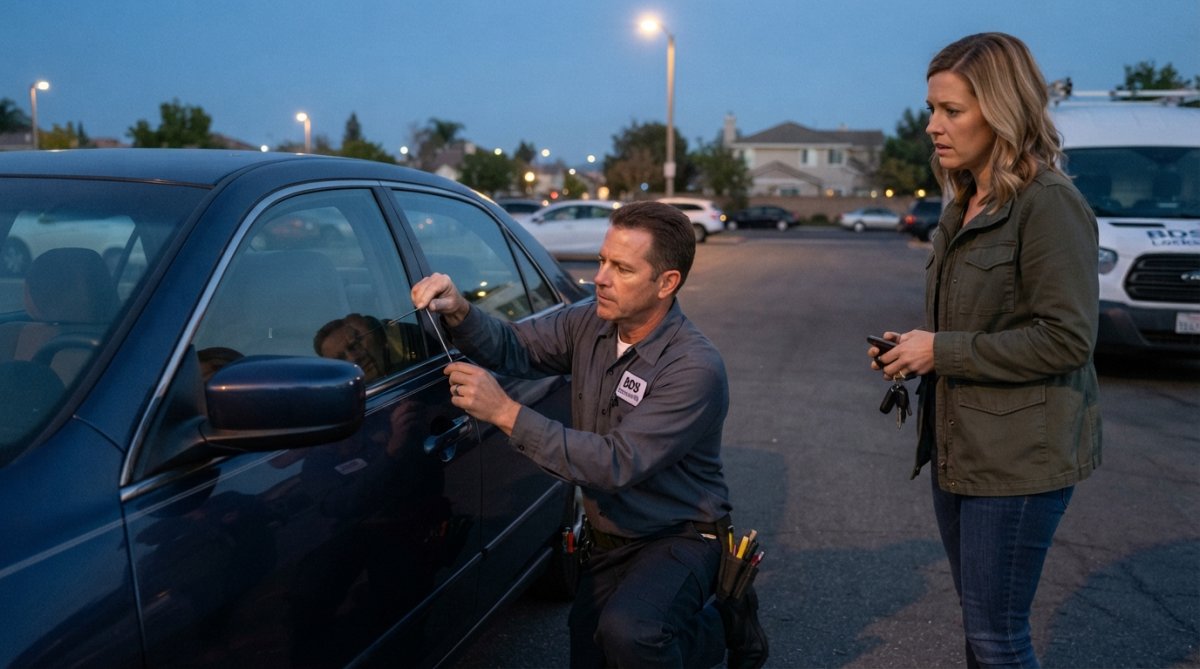
The first thing a good dispatcher asks is your location and vehicle make and model. That tells them which tools and blanks to load. From there, the technician gives you an arrival window, and in most metro areas that’s measured in minutes, not hours.
The Tools That Actually Open a Car Without Damage
What most guides skip is how a modern lockout is opened. The old coat-hanger trick is a myth that damages door seals and window regulators. A trained technician picks from a small kit based on the vehicle’s door architecture:
- Long-reach tools (Slim Jim-style), a flat steel strip slid between the window glass and the weather seal to trip the vertical lock rod. Works on many older domestics; risky on frameless windows and modern side-impact beams.
- Wedge and reach tools, a rubber or plastic wedge creates a small gap at the top of the door, and a flexible rod reaches in to pull the interior handle or lock button. The wedge is inflated with a hand pump, not forced, to avoid bending the door frame.
- Air wedge plus long-reach rod, the standard combination on late-model vehicles with anti-theft shields inside the door cavity.
- Lockout picks and decoders, used on the exterior lock cylinder itself when the door can’t be wedged, common on European makes with tight tolerances.
- Vehicle-specific tools, some makes require a dedicated tool that releases the door latch through a factory access point, and a technician who works your model regularly will already own it.
A competent technician chooses the least invasive method for your specific door. If a dispatcher can’t tell you which method they’ll use, that’s a sign they’re guessing.
How Security Verification Works Before Any Unlock
Security verification is the step that separates a licensed locksmith from someone who just owns a lockpick set. Before touching your car, a professional confirms you have the right to access it. This isn’t a formality, it’s the legal line that protects both parties, and it’s why a legitimate provider will sometimes turn down a job on the spot.
Acceptable proof usually includes:
- Your driver’s license matching the vehicle registration
- The vehicle title or a lease agreement in your name
- Insurance documents listing you as a covered driver
- A police report if the car was reported stolen and later recovered
- For a company vehicle, a letter on company letterhead authorizing access, plus your ID
What most articles won’t tell you: the technician is also checking the vehicle against its own records. They’ll confirm the VIN on the dash matches the VIN on your paperwork, and they’ll note the plate. If the VIN plate has been tampered with or the registration name doesn’t match your ID, the job stops. That’s not the locksmith being difficult, it’s the same due-diligence standard any bonded trade follows, and it’s what keeps a stolen vehicle from being handed back to a thief.
Ask for the technician’s license number and a written estimate before they start. Reputable shops provide both without hesitation. If a dispatcher dodges the question, that’s your signal to call someone else.
What Can Go Wrong (and Why It Usually Doesn’t)
A non-destructive lockout is exactly that, non-destructive, when the technician knows the vehicle. The failure modes are predictable:
- Bent door frame or cracked glass from forcing a wedge too far or prying against tempered glass.
- Stripped interior linkage from a reach tool that snags the wrong rod.
- Triggered alarm that won’t disarm until the key is in the ignition, which is normal and not damage.
- Dead key fob battery misdiagnosed as a lockout, the door was never locked, the fob just stopped transmitting. A technician can test the fob on-site before opening anything.
If your car has a factory alarm with an interior motion sensor, tell the dispatcher up front. The technician can disable the sensor through the door before reaching in, which avoids a 30-second siren blast in your driveway.
After the Door Is Open
Once you’re back in, the technician can usually address the root cause in the same visit: cut and program a spare key, replace a dead fob battery, or diagnose a sticky ignition cylinder. That’s the practical advantage of a mobile unit over a tow to a shop, the fix happens where the problem happened.
Mobile Car Key Replacement Cost: What Drives the Price
Mobile car key replacement cost depends on four variables: the key type, whether you need programming, the vehicle’s immobilizer system, and your location. A basic cut key for an older car costs far less than a smart key with remote programming for a late-model vehicle.
Because pricing varies so widely by vehicle, BDS Locksmith directs customers to its website for current rates. That transparency matters, given how often drivers report being quoted one price and charged another.
The Four Cost Drivers, Explained
Most pricing pages list the variables and stop. Here’s what actually moves the number:
1. Key type and blank sourcing. A traditional edge-cut key blank is a few dollars of metal. A transponder key blank contains a sealed chip and costs more. A proximity smart key contains a circuit board, a battery, and an antenna, and the blank alone can run into the hundreds on luxury makes. Aftermarket blanks exist for many vehicles and cost less, but not every immobilizer system accepts them, some require an OEM blank or the vehicle won’t recognize the chip.
2. Programming method. Three tiers exist:
- On-board programming, a sequence of ignition turns and door cycles the owner can perform with two working keys. No tool needed. Cheapest.
- OBD-II programming, a diagnostic tool plugged into the port under the dash writes the new key to the immobilizer. Requires a licensed tool and, on many makes, a security clearance step.
- Bench or VIN-based programming, the immobilizer module or a dealer-level server must be accessed. This is the most expensive tier and the one most likely to require a dealer visit.
3. Immobilizer generation. First-generation transponder systems (roughly late 1990s to mid-2000s) are simple and cheap to service. Later systems added rolling codes, encrypted handshakes, and in some cases a requirement that all keys be present during programming. The newer the system, the more tooling and time the job takes.
4. Location and timing. A daytime job in a dense metro area costs less than a 2 a.m. call 40 miles out. After-hours dispatch, mileage, and traffic all factor in. Ask whether the quote includes a trip charge or a night/weekend surcharge before you authorize work.
Why Two Shops Quote Different Prices for the Same Car
A common pattern is a wide spread between quotes for identical work. The reasons are usually one of these:
- One shop is using an aftermarket blank, the other an OEM blank.
- One has the manufacturer-level tool for your make, the other has to subcontract or decline.
- One bundles programming into the quote, the other quotes the key and adds programming later.
- One is a legitimate local shop, the other is a lead-generation call center that dispatches a subcontractor and marks up the price.
The classic bait-and-switch pattern: a very low phone quote, then a much higher on-site price once the technician has your key in hand and you’re stranded. The Federal Trade Commission publishes consumer guidance on recognizing this pattern. The defense is simple, get the estimate in writing, including the programming fee, before the technician starts.
Dealership vs. Mobile Locksmith Pricing
Dealerships typically charge more because you’re paying for OEM parts, a service writer, and shop overhead. Mobile locksmiths cut the overhead and pass some of that back to you, though the gap narrows on high-end vehicles where the blank itself is expensive.
| Factor | Dealership | Mobile Locksmith |
|---|---|---|
| Parts source | OEM factory key | OEM or quality aftermarket |
| Programming | In-shop only | On-site |
| Tow required | Often yes | Rarely |
| Wait time | Days to weeks | Same day |
| Warranty work | Covered | Not covered |
| Price transparency | Quote after inspection | Estimate before dispatch |
For a straightforward lost-key job, mobile service usually comes in lower. For warranty-covered module failures, the dealer’s coverage can make it the cheaper path.
What to Ask Before You Authorize the Work
A short script that prevents most pricing surprises:
- “What’s the total out-the-door price, including programming and any trip charge?”
- “Is the blank OEM or aftermarket, and will my vehicle accept it?”
- “Do you have the tool for my make and model, or will you need to subcontract?”
- “What happens if the key won’t program, do I still pay?”
- “Can you email or text the estimate before you dispatch?”
A shop that answers all five clearly is almost always the one that charges what it quoted.
Automotive Ignition Repair Services: Fixing the Cylinder Without Towing
Automotive ignition repair services address a worn or jammed ignition cylinder on-site, which means no tow and no multi-day shop hold. A common failure is a key that turns partway and stops, often caused by worn tumbler pins inside the cylinder.
What most guides miss is that this is usually a mechanical wear problem, not an electrical one. The cylinder’s internal pins wear down over thousands of turns, and eventually the key no longer aligns them cleanly. A locksmith can often repair or replace the cylinder in your driveway, then re-key it to match your existing key.
If the fault is in the ignition switch or the immobilizer module, the job changes. That’s when you want your state’s motor vehicle licensing authority to confirm any repair-shop licensing requirements before authorizing work, and it may be a job for a full-service auto repair shop rather than a locksmith.
Key Fob Programming, Transponder Keys, and Smart Key Technology
Key fob programming and transponder key work both rely on matching a coded chip to your vehicle’s immobilizer system. A transponder key is a key with an embedded chip that communicates with the immobilizer; a smart key adds proximity detection so you can start the car without inserting anything.
Modern vehicles use several key technologies, and knowing which one you have helps you describe the problem accurately:
- Transponder chip keys, common on vehicles from the 2000s onward
- Remote head keys, which combine a chip and a lock/unlock button
- Smart keys with keyless entry and push-button start
- Laser-cut keys, which use a sidewinder track instead of a traditional edge cut
Remote programming is possible on many models, but not all. Some immobilizer systems require VIN-based key generation through a dealer or a locksmith with manufacturer-level access. A technician with proper credentials can handle this on-site for most makes.
DIY vs. Professional Automotive Locksmith Work: Where the Risk Is
DIY key and lock work carries real risk on any vehicle with an immobilizer system. The savings look attractive until a botched attempt locks the system entirely, at which point the repair cost can exceed the original job.
Here’s the honest breakdown. Ordering a blank online and having it cut at a hardware store can work for a simple spare on an older car. Everything beyond that gets risky fast. Programming a transponder chip without the right tool can trigger a security lockout that requires a dealer reset. Prying a door open with improvised tools can bend the frame or damage the window regulator.
Forcing a locked door with a coat hanger or wedge can crack the window glass or strip the door’s internal linkage. The repair bill for that damage often runs higher than a professional lockout call would have cost.
The one DIY task worth doing is preventative: keep a spare key somewhere secure and test your fob batteries twice a year.
Preventative Maintenance That Keeps You Out of a Lockout
Preventative maintenance is the cheapest insurance against a lockout, and it takes about ten minutes twice a year. Most lockouts and dead-fob emergencies are predictable, which means most are avoidable.
Start with your fob battery. Keyless entry fobs draw constant power, and a weak battery is the single most common cause of a “dead” key that actually still works. Replace it on a schedule rather than waiting for failure.
Next, test your spare. A spare key that’s been sitting in a drawer for five years may have a dead chip battery or a worn cut. Try it once a year so you’re not discovering the problem in a parking garage at midnight.
A few more habits that pay off:
- Keep a physical spare key with a trusted person, not locked inside the car
- Note your key code or VIN somewhere secure for faster replacement
- Address a sticky ignition cylinder early, before it fails completely
- Avoid hanging heavy keychains, which wear the ignition cylinder faster
How to Request a Mobile Locksmith and What to Have Ready
Requesting a mobile locksmith starts with a phone call that includes your location, vehicle make and model, and a description of the problem. The more accurate that information, the faster and more accurate the service.
Have these ready before the technician arrives:
- Government-issued photo ID
- Vehicle registration, title, or proof of insurance
- The VIN, usually visible through the windshield
- A clear description of the symptom
For emergencies, BDS Locksmith operates 24/7 and can be reached at (408) 300-4369. Ask for a free estimate up front, and confirm the arrival window. A shop that stands behind its response time will commit to one.
The single most important thing to have ready is proof of ownership. Without it, no licensed locksmith can legally open your vehicle, no matter how urgent the situation.
Vehicles We Service and Coverage Across the South Bay Area
Coverage matters as much as skill when you’re stranded. BDS Locksmith serves the South Bay Area with mobile units that handle most domestic and imported makes.
Service includes car lockouts, key duplication, key fob and transponder programming, ignition cylinder repair, and broken key extraction.
For dealerships, auto repair shops, and body shops, fleet and trade accounts are available. BDS Locksmith is licensed, bonded, and insured, and offers a 5% military discount for service members in the area.
Federal Trade Commission consumer guidance on avoiding locksmith scams recommends confirming a locksmith’s physical address and license before authorizing work, a step that protects you against the bait-and-switch pricing some drivers run into.
Getting locked out or stranded by a dead key is stressful, and the last thing you need is a vague quote or a technician who never shows. BDS Locksmith handles automotive lockouts, key replacement, fob programming, and ignition repair on-site across the South Bay Area, with 24/7 emergency dispatch, competitive pricing, and licensed, bonded, and insured technicians. Call (408) 300-4369 to get a free estimate and same-day service, and keep our number saved for the day your key decides to quit.
Frequently Asked Questions
How much do auto locksmiths charge for emergency services?
Emergency call-out pricing depends on the time of day, your location, and the vehicle type. Late-night, weekend, and holiday calls usually carry a higher rate than standard business hours. A mobile locksmith should give you a clear quote before dispatching a technician. BDS Locksmith offers free estimates and same-day availability across the South Bay Area, so you know the price before anyone touches your car.
Can a mobile locksmith repair a damaged ignition switch on-site?
Yes, most ignition cylinder problems can be handled on-site. A mobile locksmith can extract a broken key, replace a worn ignition cylinder, or repair a sticking switch without towing your vehicle to a shop. The technician brings key cutting and diagnostic equipment in the mobile unit. If the damage extends into the steering column or wiring, the locksmith will tell you upfront and recommend the next step.
Are mobile locksmiths more expensive than dealership services?
For most key fob replacements and transponder key programming, a mobile locksmith costs less than a dealership because you skip the tow and the dealership’s labor rate. Dealerships often require the vehicle on-site and may need to order the key, adding days to the process. A mobile locksmith comes to you with the key blank and programming tools, completing the job in one visit. Get a quote from both and compare the total, including any towing.
How do I know a mobile locksmith is licensed and insured before letting them work on my car?
Ask for the license number and proof of insurance before the technician starts. A legitimate locksmith will provide a certificate of insurance and a state or local license on request, and will verify your ownership documents (registration, ID) before making a key or unlocking the car. BDS Locksmith is licensed, bonded, and insured, and will show credentials on-site. If a provider hesitates to prove credentials, call someone else.