
Table of Contents
- What Is Professional Locksmith Liability Insurance?
- Why Locksmiths Need Insurance
- General Liability Insurance for Locksmiths
- Errors and Omissions Coverage
- How to Verify Locksmith License and Insurance
- Risks of Hiring Uninsured Locksmiths
- Bonding vs. Insurance for Locksmiths
- Cost Factors and Coverage Limits
- The Claims Process for Locksmith Damage
- Step 1: Document the Damage Immediately
- Step 2: Notify the Locksmith Within 24-48 Hours
- Step 3: Obtain and Review the Certificate of Insurance
- Step 4: File a Claim with the Insurance Company
- Step 5: Cooperate with the Claims Adjuster
- Step 6: Understand Coverage Decisions and Denials
- Step 7: Appeal or Escalate If Necessary
- Common Claim Denials and How to Avoid Them
- Timeline Expectations
- Frequently Asked Questions
Last Updated: October 4, 2026
What Is Professional Locksmith Liability Insurance?
Professional locksmith liability insurance is a form of business coverage that protects locksmiths against financial losses when their work causes property damage, bodily injury, or other harm to a client. This type of insurance is essential for any locksmith operating as a business, whether you work on residential homes, commercial properties, or vehicles.
When working on locks, doors, or vehicles, accidental damage can occur, a scratched frame, a dented door, or an inadvertent security breach. Without proper coverage, a single incident could drain your business savings or force you into bankruptcy. Locksmith liability insurance typically covers property damage, bodily injury, and legal defense costs if you’re sued, protecting your business reputation and financial stability.
Why Locksmiths Need Insurance
The risks in locksmithing work are substantial. You’re handling expensive locks, working on valuable doors and vehicles, and operating in clients’ homes and businesses where accidents happen quickly. A slip of the tool, a miscalibration, or an unforeseen structural issue can cause damage costing hundreds or thousands to repair. One client lawsuit without insurance can end a locksmith business.
Beyond property damage, liability insurance protects you against bodily injury claims. If a client is injured while you’re working on their property, perhaps they trip over your tools or are struck by equipment, they may sue for medical expenses and lost wages. Without coverage, you’re personally responsible.
Insurance also builds client trust. When homeowners and business owners ask if you’re insured, they’re assessing whether they can trust you with their property. Being able to produce a certificate of insurance demonstrates professionalism and gives clients peace of mind.
General Liability Insurance for Locksmiths
General liability insurance is the foundational coverage most locksmiths carry. This policy covers bodily injury and property damage caused by your work or business operations.
For locksmiths, general liability insurance typically covers:
- Accidental damage to a client’s door, frame, lock, or surrounding property while performing locksmith services
- Bodily injury if a client or bystander is hurt due to your work
- Legal defense costs if you’re sued, even if the claim is eventually dismissed
- Medical expenses for injured parties (up to your policy limit)
The coverage applies to your mobile locksmith services, whether you’re working at a residential home, commercial building, or parking lot. This is crucial because you never know when an accident might occur or how expensive the repair might be.
General liability insurance covers accidents and unintentional harm. It does NOT cover intentional damage, criminal activity, or work that violates local laws. If you’re operating legally and following proper locksmith procedures, general liability insurance protects you from unexpected accidents.
Errors and Omissions Coverage
Errors and omissions (E&O) coverage, also called professional liability insurance, differs from general liability. While general liability covers physical damage and bodily injury, E&O coverage protects you against claims that your work was negligent, incomplete, or caused financial loss to the client.
For locksmiths, E&O coverage might apply to situations like:
- You fail to properly install a lock, and the client is later burglarized
- You provide incorrect advice about a security system, leading to a breach
- You damage a client’s property during service, and they claim you were negligent rather than accidental
- You mishandle sensitive information about a client’s security setup
E&O insurance is less commonly carried by locksmiths than general liability, but it’s increasingly important as locksmith work becomes more technical and security-focused. If you’re installing access control systems, programming smart locks, or providing security consultations, E&O coverage protects you against claims that your professional judgment was flawed.
The key difference: general liability covers accidents; E&O covers mistakes in your professional work or judgment.
How to Verify Locksmith License and Insurance
Before hiring any locksmith, you should verify their credentials. This protects you from uninsured operators and ensures you’re working with someone legitimate.
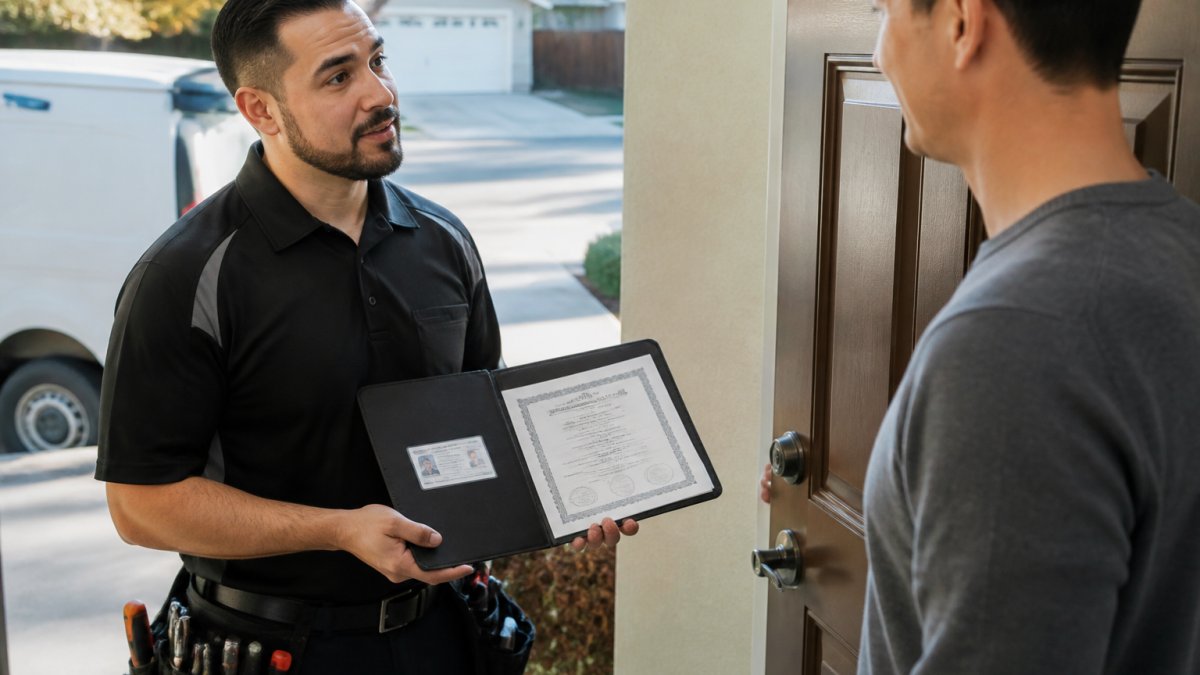
Request a certificate of insurance. A legitimate locksmith should provide a certificate of insurance (COI) on demand. This document shows your coverage limits, policy dates, and the insurance company’s contact information. You can verify the certificate by contacting the insurance company directly.
Check licensing status. Locksmith licensing requirements vary by state and sometimes by city. Search your state’s licensing board or contractor database to confirm whether the locksmith holds a valid license. If your state requires licensing and the locksmith cannot provide one, that’s a red flag.
Ask for proof of bonding. Many jurisdictions require locksmiths to carry a surety bond, which is different from insurance. A bond protects clients if the locksmith commits fraud or theft. Request proof of bonding and verify it with the bonding company.
Contact the Better Business Bureau. The BBB maintains records of complaints and resolution history. A locksmith with a solid track record should have few complaints and a high rating.
Ask for references. Legitimate locksmiths should be willing to provide customer references or point you to online reviews.
Risks of Hiring Uninsured Locksmiths
Hiring an uninsured locksmith creates significant financial and legal risk for you as the property owner or business.
If an uninsured locksmith damages your property, you have no insurance claim to file. Your only recourse is to sue them personally, which is time-consuming, expensive, and often unsuccessful if the locksmith has minimal assets.
If an uninsured locksmith causes bodily injury, you could be held liable. Depending on the circumstances, you might be considered negligent for hiring an uninsured contractor. Your own homeowner’s or business insurance might deny the claim because you hired someone without proper coverage.
Uninsured locksmiths also pose security risks. Without professional liability insurance and licensing requirements, there’s no accountability mechanism. If they mishandle sensitive information about your locks or security setup, or if they fail to properly secure your property, you have limited recourse.
The cost of hiring an uninsured locksmith might seem lower initially, but the risks far outweigh any savings. One incident can cost thousands in repairs, medical bills, or legal fees.
Bonding vs. Insurance for Locksmiths
Many people confuse bonding and insurance, but they serve different purposes and protect different parties.
Insurance protects the locksmith (and their business) against claims. If the locksmith causes damage, their liability insurance covers the repair costs. Insurance is primarily for the locksmith’s protection, though it benefits clients by ensuring claims are paid.
Bonding protects the client. A surety bond is a three-party agreement: the locksmith (the principal), the client (the obligee), and the bonding company (the surety). If the locksmith commits fraud, theft, or fails to complete contracted work, the bonding company compensates the client up to the bond amount. The locksmith then owes the bonding company for the payout.
Many states and cities require locksmiths to carry a surety bond as part of licensure. Some require both bonding and insurance. The best locksmiths carry both because it demonstrates a commitment to professional standards and client protection.
Bonding and insurance are complementary, not interchangeable. A locksmith with only bonding but no liability insurance leaves you exposed to property damage claims. A locksmith with only insurance but no bond leaves you exposed to fraud or theft. The most trustworthy locksmiths carry both.
Cost Factors and Coverage Limits
The cost of professional locksmith liability insurance depends on several factors. Equally important is recognizing that insurance requirements and minimum coverage limits vary significantly by state and sometimes by city.
Factors That Affect Locksmith Insurance Premiums
Business size and revenue. Larger locksmith operations with higher annual revenue typically pay higher premiums.
Claims history. Locksmiths with previous claims pay higher premiums. A clean claims history results in lower rates.
Coverage limits. Higher coverage limits mean higher premiums.
Type of work.
Location and state regulations. Insurance costs vary by state and region based on local liability trends, regulatory requirements, and market competition. States with strict licensing requirements often have more standardized premiums due to higher professional standards.
Deductible. A higher deductible results in lower premiums.
Years in business. New locksmith businesses pay higher premiums than established ones.
State-by-State Insurance and Licensing Requirements
Insurance requirements are not uniform across the country. Some states impose strict minimums while others impose none.
States with strict licensing and insurance requirements:
-
California: Requires locksmith licensing through the Department of Consumer Affairs. Many cities require locksmiths to carry liability insurance as a condition of local licensing.
-
New York: Requires locksmith licensing through local authorities. New York City requires locksmiths to carry liability insurance with minimum limits of $100,000 per claim / $300,000 aggregate. Bonding is also required.
-
Texas: Does not require state-level locksmith licensing, but many cities require local licensing and proof of liability insurance.
-
Florida: Requires locksmith licensing through the Department of State. Licensees must carry liability insurance with minimum limits of $100,000 per claim / $300,000 aggregate. A surety bond of $10,000 is also required.
-
Illinois: Requires locksmith licensing in Chicago and some municipalities. Minimum liability insurance is typically $100,000 per claim / $300,000 aggregate.
States with minimal or no licensing requirements:
- Arizona, Colorado, Georgia, North Carolina, Ohio, Pennsylvania, Tennessee, Virginia, Washington: These states do not require state-level locksmith licensing. Insurance is not mandated by state law, though individual cities or counties may impose requirements. Property owners should be especially cautious about verifying insurance in these states.
States with moderate requirements:
- Massachusetts, Connecticut, New Jersey: Require locksmith licensing in some municipalities. Insurance requirements vary by city but typically start at $100,000 per claim. Bonding is often required as well.
Recommended Coverage Limits by Work Type
While minimum requirements vary, industry best practices suggest higher limits depending on the work:
Residential lockout services: $100,000 per claim / $300,000 aggregate is typically adequate for basic residential work.
Commercial and industrial work: $250,000 per claim / $500,000 aggregate is recommended for commercial properties where damage or security failures could be more costly.
High-security and access control systems: $500,000 per claim / $1,000,000 aggregate is advisable for locksmiths installing advanced access control or security systems.
Safe and vault work: $250,000-$500,000 per claim is standard for locksmiths working on safes and vaults.
How to Find Your State’s Requirements
To determine what insurance and licensing requirements apply in your area:
-
Contact your state’s licensing board or Department of Consumer Affairs. Search online for “[State] locksmith licensing requirements.”
-
Check your city or county’s business licensing office. Many requirements are local, not state-level.
-
Ask your insurance agent. A locksmith insurance specialist can tell you the minimum requirements for your specific state and city.
-
Review your local business ordinances. Many cities publish their contractor licensing and insurance requirements online.
-
Consult a locksmith association. Organizations like the Associated Locksmiths of America (ALOA) maintain resources on state and local requirements.
The Hidden Cost of Underinsurance
Many locksmiths carry only the minimum required coverage to save on premiums. However, this creates significant risk. A single claim exceeding the policy limit leaves the locksmith personally liable for the difference. For example, if a locksmith with $100,000 coverage causes $150,000 in damage, they are personally responsible for the $50,000 gap. This can result in wage garnishment, asset seizure, or bankruptcy.
Property owners should verify not only that a locksmith is insured but that their coverage limits are appropriate for the work being performed.
The Claims Process for Locksmith Damage
Understanding how a locksmith damage claim works helps you know what to expect if something goes wrong.
Step 1: Document the Damage Immediately
The moment you discover damage caused by a locksmith’s work, document it thoroughly. Take multiple photographs and video from different angles, showing the damage in context. Capture close-ups of the damage itself.
Obtain written repair estimates from at least two independent contractors. These estimates serve as proof of the damage’s cost and are critical if the insurance company disputes the amount. Keep all receipts, invoices, and correspondence.
Write a detailed account of what happened: the date, time, locksmith’s name, what work was performed, and exactly when and how you discovered the damage.
Step 2: Notify the Locksmith Within 24-48 Hours
Contact the locksmith immediately and inform them of the damage. Most professional locksmiths will want to assess the damage themselves or discuss resolution options. This notification also creates a paper trail (email is best) that documents when the locksmith became aware of the issue.
Some locksmiths will offer to repair the damage at no cost or negotiate a settlement directly. If you reach an agreement, get it in writing. However, do not accept cash settlements in lieu of filing an insurance claim, this can complicate things later if the damage is more extensive than initially apparent.
Step 3: Obtain and Review the Certificate of Insurance
If you don’t already have the locksmith’s certificate of insurance (COI), request it immediately. The COI shows:
- The locksmith’s insurance company name and policy number
- Coverage limits (e.g., $250,000 per claim / $500,000 aggregate)
- Policy effective dates and expiration date
- The insurance company’s claims contact information
Review the coverage limits carefully. If the damage repair cost exceeds the per-claim limit, the insurance will only pay up to that limit, and you may need to pursue the locksmith personally for the remainder.
Verify that the policy is still active by checking the expiration date. If the policy has lapsed, the locksmith was uninsured at the time of the incident.
Step 4: File a Claim with the Insurance Company
Contact the insurance company listed on the COI. Most insurers have a claims hotline (typically available 24/7) and an online claims portal. Provide:
- Your name, contact information, and property address
- The locksmith’s name and policy number
- The date and nature of the damage
- Your repair estimates and photographs
- Your detailed account of the incident
The insurance company will assign a claims adjuster to your case.
Step 5: Cooperate with the Claims Adjuster
The adjuster will contact you within 2-5 business days. They may ask detailed questions, request additional documentation, schedule an in-person inspection, obtain their own repair estimates, or contact the locksmith for their account of what happened.
Be cooperative and provide all requested information promptly. However, do not admit fault or sign anything without reading it carefully. Stick to the facts: what happened, when it happened, and what the damage is.
If the adjuster’s estimate differs significantly from yours, ask for an explanation. You can dispute the estimate and provide your own contractor’s assessment as evidence.
Step 6: Understand Coverage Decisions and Denials
After investigation, the insurance company will issue a coverage determination. There are three possible outcomes:
Coverage Approved: The insurance company agrees the damage is covered. They will either pay you directly (reimbursement) after you submit paid invoices for repairs, or pay the contractor directly.
Coverage Denied: The insurance company denies the claim, usually because the damage falls under an exclusion in the policy, the locksmith was not performing covered work, the policy was not in effect when the damage occurred, or the damage is deemed to be normal wear and tear. Request a written explanation citing the specific policy language. You have the right to appeal the decision.
Partial Coverage: The insurance company approves coverage for part of the damage but denies the rest. This often happens when the adjuster’s repair estimate is lower than yours, or when some damage is deemed pre-existing.
Step 7: Appeal or Escalate If Necessary
If you disagree with the coverage decision, you can appeal. Send a written appeal to the insurance company’s claims department within 30 days of the denial letter. Include your claim number, a clear explanation of why you believe the claim should be covered, any new evidence or documentation, and references to specific policy language that supports your position.
If the appeal is denied, you can file a complaint with your state’s Department of Insurance or pursue a lawsuit against the locksmith personally. Small claims court is an option if the damage is under your state’s small claims limit.
Common Claim Denials and How to Avoid Them
“The damage was pre-existing.” Prevent this by photographing the property before the locksmith arrives and having the locksmith sign off on the property’s condition.
“The locksmith was not performing covered work.” Ensure the locksmith is performing locksmith services, not construction or repair work.
“The policy was not in effect.” Always verify the policy dates on the COI match the date of the incident. If the locksmith’s policy lapsed, you have no coverage.
“The damage is not the locksmith’s fault.” If the locksmith can demonstrate they followed proper procedures and the damage was unavoidable, the claim may be denied. This is where E&O (errors and omissions) coverage becomes important, it covers claims of negligence even when the locksmith followed standard procedures.
Timeline Expectations
- Days 1-2: Document damage, notify locksmith, request COI
- Days 3-5: File claim with insurance company
- Days 5-10: Adjuster assigned and initial contact
- Days 10-30: Investigation, inspections, estimate negotiations
- Days 30-45: Coverage determination issued
- Days 45-60: Payment issued (if approved)
Staying organized and responsive to the adjuster’s requests accelerates the process.
Frequently Asked Questions
What type of insurance does a locksmith need?
Locksmiths need general liability insurance to cover property damage and bodily injury claims, plus errors and omissions (E&O) coverage for mistakes in their work. Many also carry surety bonds to protect clients financially if the locksmith fails to complete a job or commits theft. Some locksmiths add cyber liability coverage if they handle digital lock systems or customer data. The specific combination depends on the services offered, residential, commercial, or automotive work may require different coverage levels.
Why should you verify a locksmith’s insurance before hiring them?
Verifying insurance protects you financially if the locksmith damages your property or performs work incorrectly. An uninsured locksmith leaves you responsible for repair costs. Ask the locksmith for proof of insurance before work begins, request a certificate of insurance, and confirm coverage limits are adequate for your situation. Licensed and insured locksmiths demonstrate professionalism and accountability.
What is the difference between general liability and professional liability insurance for locksmiths?
General liability insurance covers accidental property damage (like scratching a door frame) and bodily injury claims. Professional liability, also called errors and omissions (E&O) coverage, protects against claims that the locksmith’s work was faulty, incomplete, or caused financial loss. For example, if a locksmith installs a lock incorrectly and a break-in occurs, E&O coverage addresses the claim that poor workmanship enabled the theft. Together, these policies provide comprehensive protection for locksmith businesses.
Are locksmiths required by law to carry liability insurance?
Liability insurance is not universally mandated by federal law, but many states and local jurisdictions require it as a condition of licensure or bonding. Requirements vary by state and service type. Some states require locksmiths to carry minimum coverage amounts, while others make it a licensing board condition. Always check your state’s locksmith licensing regulations and ask prospective locksmiths about their local compliance. Hiring an insured locksmith ensures they meet professional standards in your area.