Table of Contents
- Understanding Lock Mechanisms and Pin-Tumbler Locks
- Lock Picking Tools for Non-Destructive Entry
- Can Lock Picking Damage a Lock?
- How to Open a Locked Door Without Damage
- Non-Destructive Lock Opening Alternatives
- When to Call a Locksmith Emergency Lockout Service
- Legal Boundaries and Authorization
- Common Mistakes to Avoid When Picking Locks
- Frequently Asked Questions
Last Updated: October 6, 2026
Understanding Lock Mechanisms and Pin-Tumbler Locks
Most people don’t realize how locks actually work until they’re stuck outside their own door. Understanding the basics of pin-tumbler locks is the first step toward learning damage free lock picking methods safely and effectively.
How pin-tumbler locks work
A pin-tumbler lock is the most common residential and commercial lock type. It contains a series of pins stacked inside a cylinder called the plug. When you insert the correct key, it pushes each pin to a specific height. Once all pins align at the shear line, the plug rotates and the lock opens.
Without the correct key, the pins block the plug from turning. This simple mechanism has protected doors for over a century because it’s reliable and difficult to bypass without understanding how it works.
The shear line and binding pins
The shear line is the critical boundary between the plug and the housing. When all pins sit at exactly the right height at this line, the lock opens. This is where damage free lock picking methods focus your effort.
Binding pins are the pins that resist movement most during picking. As you apply tension, some pins bind tighter than others. Learning to identify and manipulate binding pins is essential to picking without damage. The pin that binds first usually needs to be set first.
Lock Picking Tools for Non-Destructive Entry
Damage free lock picking depends less on how many picks you own than on whether each tool matches the lock in front of you. The wrong pick profile, an oversized tension wrench, or a tool that is too thick for the keyway will scratch the plug, mar the warding, or bend a pin long before it opens anything.
What actually belongs in a starter set
A usable beginner kit is small. Most practitioners recommend starting with:
- Two or three tension wrenches in different thicknesses. Tension wrenches are measured in thousandths of an inch (commonly around 0.020 in to 0.032 in for residential pin-tumbler locks). A wrench that is too thick will not fit the keyway; one that is too thin will twist and slip.
- One short hook in a standard profile. The short hook is the workhorse for single-pin picking because its tip reaches the bottom pins without over-lifting the ones behind it.
- One rake (a bogota or a triple-peak style). Rakes trade precision for speed and are best reserved for low-security locks.
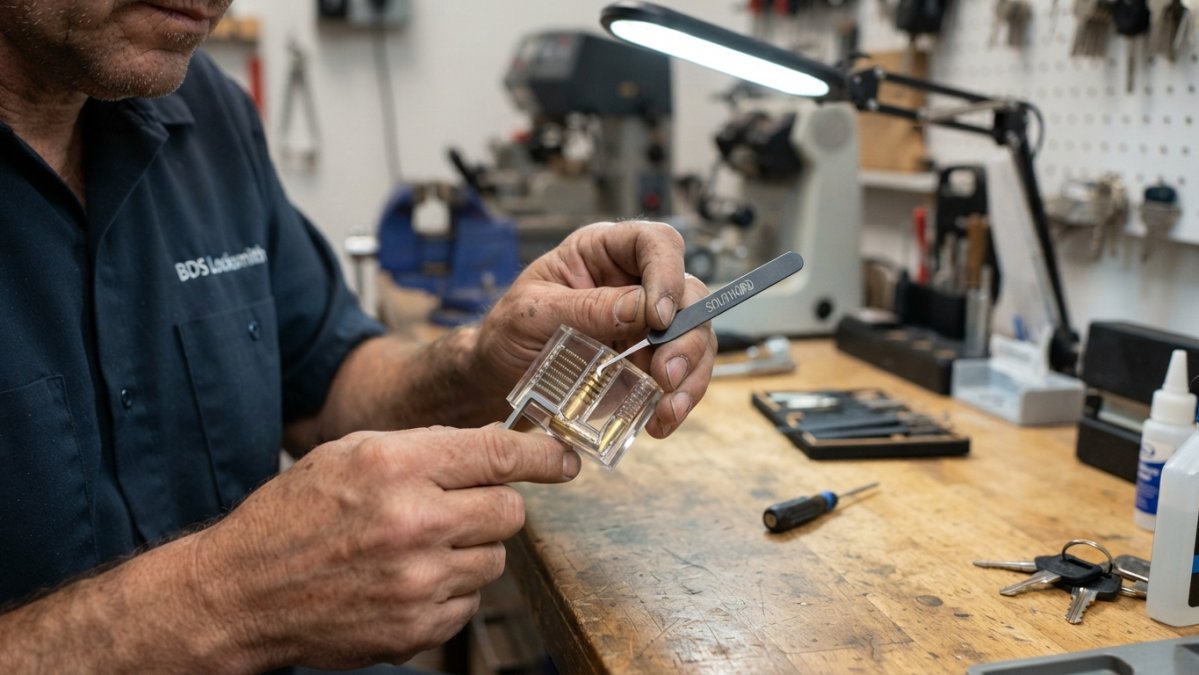
- A transparent practice lock or a cutaway cylinder. Being able to see the pins set is the fastest way to learn how little force is actually required.
Skip the 30-piece kits. Extra picks you do not understand encourage guessing, and guessing is what damages locks.
Hooks, rakes, and tension tools: what each one does to the lock
Hook picks. The hook lifts one pin at a time to the shear line. Because contact is limited to a single pin, the hook is the least likely tool to scratch the plug or bend a pin, provided you keep the tip below the shear line and lift rather than pry. Hook profiles range from short to deep; a short hook handles most residential cylinders, while a deep hook is used when the first pins sit high in the keyway.
Rake picks. A rake is scrubbed or rocked across several pins at once. It is fast on worn or low-tolerance locks, but the same motion that sets pins can also over-lift them and jam the cylinder. Raking is where most beginner damage happens.
Tension tools. Tension is the variable that decides whether a picking attempt is damage free or destructive. Too little tension and set pins drop back down; too much and you bind the plug against the housing, gall the cylinder walls, or snap a pin. The correct feel is light, steady rotational pressure, roughly the force you would use to turn a key that is already halfway rotated. Tension tools come in L, Z, and curved shapes; the shape matters less than the thickness fitting the keyway without wobble.
Buy one quality short hook and two tension wrenches before you buy any specialty tool. A single well-fitted hook and a correctly sized tension wrench will open more locks without damage than a full case of picks used with the wrong tension.
Matching the tool to the lock, not the other way around
The tool that protects the lock is the one sized for its keyway. Before inserting anything, look at the keyway opening. A narrow, paracentric keyway (common on newer residential deadbolts) will reject a thick pick and force you to angle the tool, which is exactly when scratches and bent pins occur. A wide, open keyway on an older knob lock tolerates a wider range of tools.
If a pick does not slide in with almost no resistance, stop. Forcing it is the single most common cause of damage to the plug and warding, and it is entirely avoidable by switching to a thinner tool or a different method.
Can Lock Picking Damage a Lock?
Yes, lock picking can damage a lock if done incorrectly. This is why learning proper damage free lock picking methods matters. Excessive force, wrong tool angles, and poor tension application all risk breaking pins or scratching the cylinder.
Damage risks and how to avoid them
The most common damage happens when you apply too much force. Pins can break if you push them too hard against the top of the cylinder. The cylinder itself can scratch if tools slip or bind incorrectly.
To avoid damage:
- Use light, controlled pressure on the tension tool
- Never force a stuck pin
- Keep tool angles shallow and smooth
- Stop immediately if you feel strong resistance
- Practice on transparent locks first
Scratches inside the lock don’t always prevent it from working, but they can affect how smoothly it operates. Deep gouges in the cylinder can make the lock unpredictable or cause future keys to stick.
Post-opening inspection and verification
After opening a lock, inspect it carefully. Look for fresh scratches, bent pins, or debris inside. If you see damage, the lock may need professional servicing or replacement.
Test the lock with the correct key. It should turn smoothly without grinding or sticking. If it does, the lock may have internal damage from the picking attempt. This is why damage free lock picking methods emphasize precision over speed.
How to Open a Locked Door Without Damage
Opening a locked door without damage requires patience, the right tools, and realistic expectations about what will work and when to stop.
Step 1: Assess the lock type and condition
Before attempting damage free lock picking, identify the lock type. Pin-tumbler locks are the easiest to pick. Wafer locks are simpler but less common on residential doors. Deadbolts are different from knob locks.
Check the lock’s condition. Does it turn smoothly with the key? Does it have visible rust or corrosion? Damaged locks are harder to pick without causing more damage. If the lock looks neglected, stop and call a professional.
Step 2: Apply proper tension and manipulate pins
Insert the tension tool into the bottom of the keyway. Apply steady, light rotational pressure. The direction depends on which way the lock turns to open.
With tension applied, insert the hook pick. Feel for pins that bind. These usually need to be set first. Lift each binding pin gently until it clicks into place at the shear line. As each pin sets, you’ll feel slight resistance decrease.
Move through the lock methodically. Rush this step and you’ll apply too much force. Take your time. Damage free lock picking methods require patience.
Step 3: Use alternative methods before picking
Before attempting to pick, consider easier options. Is there a window you can safely access? Can you contact the property owner for a key? Is the lock old enough that a bump key might work?
Many locked doors can be opened without picks. Bypass tools, shims, and other non-destructive methods often work faster and with less risk of damage than traditional picking.
Non-Destructive Lock Opening Alternatives
Not every method that opens a lock leaves it in the same condition. Some alternatives are truly non-destructive, meaning the lock works exactly as before once you are done. Others open the door but wear, deform, or weaken the lock in ways you may not notice until later. The table below separates them, because the difference is the whole point of a damage free approach.
| Method | Works on | Truly non-destructive? | Notes |
|---|---|---|---|
| Shim (latch slip) | Spring-latch knob and lever locks | Yes | Slides between door and frame to retract the latch; does nothing for a deadbolt |
| Bypass tool | Specific lock families (some padlocks, some knobs) | Usually yes | Designed to actuate the mechanism without touching the pins |
| Bump key | Many pin-tumbler locks | No | Uses impact to bounce pins; can deform pins and springs over repeated use |
| Single-pin picking | Pin-tumbler locks | Yes, if done correctly | Slow but the most lock-friendly method when tension is light |
| Raking | Low-security pin-tumbler locks | Marginal | Fast, but over-lifting pins is common |
| Improvised tools (paperclip, screwdriver) | Loose, older locks | No | High risk of scratching the plug and bending pins |
Shims and latch slips
A shim is a thin, flexible strip of metal that slides into the gap between the door and the frame to push the spring latch back. It is fast, requires no picking skill, and leaves the lock untouched. It only works on spring latches, so it will not open a deadbolt, and it will not work on a door with a tight frame gap or an anti-shim latch guard.
Bypass tools
Bypass tools are purpose-built for a specific lock family. A padlock shim, for example, slips over the shackle to release the locking pawls without touching the cylinder. Because the tool acts on the mechanism rather than the pins, it is generally non-destructive when used on the lock it was designed for. Using a bypass tool on the wrong lock is how people bend shackles and crack housings.
Bump keys: effective but not damage free
A bump key is cut to a specific depth pattern and struck while light turning pressure is applied. The impact bounces the pins above the shear line so the plug can rotate. It works on many pin-tumbler locks, but it is not a damage free method. Repeated bumping can deform pin tips, weaken springs, and leave the lock easier to open with a bump key than with its own key. Treat bumping as a last resort, not a first choice.
Improvised tools
A paperclip bent into a hook, or a flat screwdriver used as a tension wrench, can open a loose, older lock. They are also the fastest way to scratch a plug or snap a pin, because they have no controlled tip geometry and no consistent thickness. On any modern lock with tight tolerances, improvised tools are more likely to damage the lock than to open it.
If your goal is genuinely damage free entry, rank your options in this order: (1) a spare key or key recovery, (2) a shim or bypass tool matched to the lock, (3) single-pin picking with light tension, and only then (4) bumping or improvised tools. The first two leave the lock as it was; the last two may not.
Choosing by lock type and situation
The right alternative depends on what is in front of you, not on which tool you happen to own.
- Knob or lever lock with a spring latch: Try a shim first. It is the fastest and cleanest option.
- Single-cylinder deadbolt: A shim will not work. Single-pin picking with a short hook and light tension is the most lock-friendly option.
- Padlock: A padlock shim or a dedicated bypass tool is usually faster and safer than picking.
- Older, loose lock: Picking is easy, but the lock is also more fragile. Use light tension and stop at the first sign of resistance.
- High-security or restricted-keyway lock: Do not attempt to pick or bump it. These locks use security pins and tight tolerances specifically to defeat amateur tools, and forcing them is the most reliable way to cause damage.
Before you pick anything: the non-entry alternatives
Picking should not be the first thing you try. In most real lockouts, one of these resolves the situation without touching the lock:
- Spare key or key recovery. Check for a spare with a neighbor, a family member, or a hidden key safe. Many lockouts end here.
- Property manager or landlord. Renters and condo owners usually have a management contact who holds a key or can authorize entry.
- Roommate, family member, or coworker. Anyone with a key to the same door solves the problem without tools.
- Vehicle lockouts. Many auto insurance policies and motor-club memberships include lockout coverage; using it avoids any risk to the door or window seals.
If none of those apply and you are not confident in your technique, the safest damage free option is to stop and call a qualified locksmith. A professional can open most residential locks non-destructively in minutes, and the cost of a service call is almost always less than repairing or replacing a lock you damaged yourself.
When to Call a Locksmith Emergency Lockout Service
Knowing when to stop and call a professional is crucial. Locksmith emergency lockout service exists because some situations require expertise, speed, and proper equipment.
Signs you should stop and seek professional help
Stop if you’ve been attempting to open a lock for more than 15 minutes without progress. Stop if you feel strong resistance or hear cracking sounds. Stop if the lock appears damaged or corroded. Stop if you’re not confident in what you’re doing.
Professional locksmiths have specialized tools and training. They can open most locks in minutes without damage. They carry equipment for situations where picking won’t work. They have insurance covering accidental damage.
BDS Locksmith provides 24/7 emergency lockout service throughout the South Bay Area. Our licensed and insured team arrives on-site with the tools and expertise to handle residential, automotive, and commercial lockouts. We prioritize non-destructive entry methods and guarantee safe access to your property without damage.
What professional locksmiths offer
Professional locksmiths can open locks that picking won’t work on. They can identify lock types instantly and select the best opening method. They carry specialized tools for high-security locks, electronic locks, and unusual situations.
They also provide follow-up services. If your lock is damaged, they can repair or replace it. They can rekey locks, upgrade security, or install new locks. A locksmith visit often costs less than replacing a damaged lock yourself.
Legal Boundaries and Authorization
Lock picking is legal in most places when you own the lock or have explicit permission from the owner. Picking locks you don’t own or don’t have permission to open is illegal.
Homeowners can practice lock picking on their own locks. Renters should get written permission from landlords before attempting to open or modify locks. Business owners can pick their own locks but should document the reason.
Never attempt to open someone else’s lock without written authorization. This applies to locked doors in shared spaces, vehicles you don’t own, and padlocks on property that isn’t yours. The legal consequences of unauthorized lock opening are serious.
Common Mistakes to Avoid When Picking Locks
Learning what not to do is as important as learning proper technique. These mistakes damage locks and waste time.
Applying too much force. The most common mistake is pushing or pulling too hard. Locks open with light, precise pressure, not brute force.
Ignoring binding pins. Trying to set all pins equally won’t work. Binding pins need individual attention.
Using the wrong tension. Too little tension and pins won’t stay set. Too much tension and you’ll break pins or damage the cylinder.
Practicing on real locks. Always use practice locks first. Real locks are harder to pick and easier to damage.
Rushing the process. Damage free lock picking methods require patience. Hurrying causes mistakes and damage.
Skipping alternatives. Trying to pick first when a bypass tool would work faster wastes time and risks damage.
Getting locked out is stressful, and attempting to open a lock yourself can make the situation worse. Understanding damage free lock picking methods helps you recognize when professional help is needed. BDS Locksmith offers free locksmith estimates and same-day service for emergency lockouts. Our licensed, bonded, and insured team uses non-destructive entry methods to restore access to your home, business, or vehicle safely. Call us at (408) 300-4369 for immediate assistance, and ask about our 5% military discount.
Frequently Asked Questions
Can lock picking damage a lock?
Lock picking can damage a lock if improper tension is applied, picks are forced, or the wrong technique is used. Overset pins, scratched keyways, and broken springs are common damage risks. Proper technique, using light tension and controlled pin manipulation, minimizes damage. Professional locksmiths employ damage-free methods because their reputation depends on it. If you’re unsure about your skill level, contacting a licensed locksmith emergency lockout service is safer than risking damage to your door or lock mechanism.
What tools do I need to pick a lock without damage?
A starter set typically includes a tension tool (wrench) and a hook pick, which are the foundation for damage-free lock picking. The tension tool applies controlled pressure to the lock cylinder, while the hook manipulates individual pins. Quality matters: cheap picks bend or break easily and increase damage risk. Clear practice locks help you learn proper technique before attempting real locks. Many people find that bypass tools or shims work faster and safer for simple locks than traditional picks.
When should I call a professional locksmith instead of trying to pick a lock myself?
Stop and call a locksmith emergency lockout service if the lock is high-security, you’ve tried for more than 15 minutes without success, the lock feels stuck or damaged, or you’re locked out of a rental property (landlord permission may be required). Professional locksmiths have specialized tools, training, and insurance to handle complex locks and guarantee non-destructive entry. They arrive quickly and legally, eliminating the risk of damage charges or legal issues. For residential lockouts, same-day service is typically available.
Is it legal to own lock picking tools?
In most states, owning lock picking tools is legal if you intend to use them on locks you own or have permission to open. Intent matters: possessing picks with intent to commit burglary is illegal. Carry them responsibly and avoid using them on locks that don’t belong to you. Some states and cities have restrictions, so check your local laws. If you’re locked out of your own property, contacting a licensed locksmith is always the safest and most legal option.