Table of Contents
- Residential Lockout Service Price Range in 2026
- Home Lockout Locksmith Cost Breakdown
- Emergency Locksmith Service Call Fee Explained
- After-Hours Locksmith Prices and Surcharges
- Key Factors That Affect Your Final Lockout Cost
- How Long Does a Locksmith Take to Unlock a House
- Lockout Service Versus Lock Replacement Pricing
- How to Verify a Locksmith Quote and Avoid Bait Pricing
- What to Do Before Calling a Locksmith
- Frequently Asked Questions
Last Updated: October 14, 2026
Residential Lockout Service Price Range in 2026
Getting locked out of your home is stressful enough without worrying about surprise costs. Understanding what a residential lockout service price actually covers helps you make informed decisions when you need emergency help. At BDS Locksmith, we’ve helped thousands of homeowners navigate lockout situations with transparent pricing and professional service.
The cost of a residential lockout service varies based on several factors: time of day, lock type, entry method, and whether additional services are needed. Most homeowners face costs that range across a spectrum depending on these variables. Rather than guessing, knowing what to expect before you call makes the process less stressful.
This guide breaks down residential lockout service pricing, explains what drives costs up or down, and shows you how to verify quotes before work begins.
Home Lockout Locksmith Cost Breakdown
A home lockout locksmith cost is not one number. It is a stack of line items, and the only way to compare quotes fairly is to price each line separately. Most advertised prices you see online are starting prices for the simplest possible job: a standard single-cylinder deadbolt, daytime, non-destructive entry, no parts. Your final bill is that starting price plus or minus the variables below.
The nationwide 2026 residential-only range
Treat this as a planning band, not a quote. Your actual price depends on the four line items below.
Separate the four line items so quotes are apples-to-apples
When you call, ask the dispatcher to break the estimate into these four buckets. A quote that only gives one lump number is not comparable to one that itemizes.
| Line item | What it covers | Typical 2026 residential range |
|---|---|---|
| Service call / trip fee | Dispatch, travel, on-site assessment | $25-$75 |
| Labor | Time to open the lock, non-destructive or drilling | $40-$120 |
| After-hours surcharge | Evenings, weekends, holidays | +$30-$150 (or 25-50% of base) |
| Parts | Replacement cylinder, deadbolt, or smart lock if drilling is required | $20-$150+ |
Two quotes can both say “$95” and mean completely different things. One may include the service call in the labor rate; the other may add it on top. Ask which line items are bundled and which are separate before you agree to anything.
Scenario-based sample totals
These examples show how the line items add up. Assumptions are stated so you can adjust for your market.
Notice that drilling is not automatically the most expensive outcome. A high-security lock that resists non-destructive entry can cost more in labor than a quick drill-and-replace on a standard lock. That is why the technician’s on-site assessment matters more than the phone quote.
What usually resolves in 15-30 minutes
Most standard residential lockouts open in 15-30 minutes of on-site time when the lock is a basic pin-tumbler deadbolt or knob and entry is non-destructive. High-security cylinders, smart locks with electronic components, and reinforced frames extend that window and push labor toward the top of the range. When you request a home lockout locksmith cost estimate, ask two questions: what is included in the quoted price, and what could be added on-site. The answer tells you whether the number you heard is a starting price or a likely total.
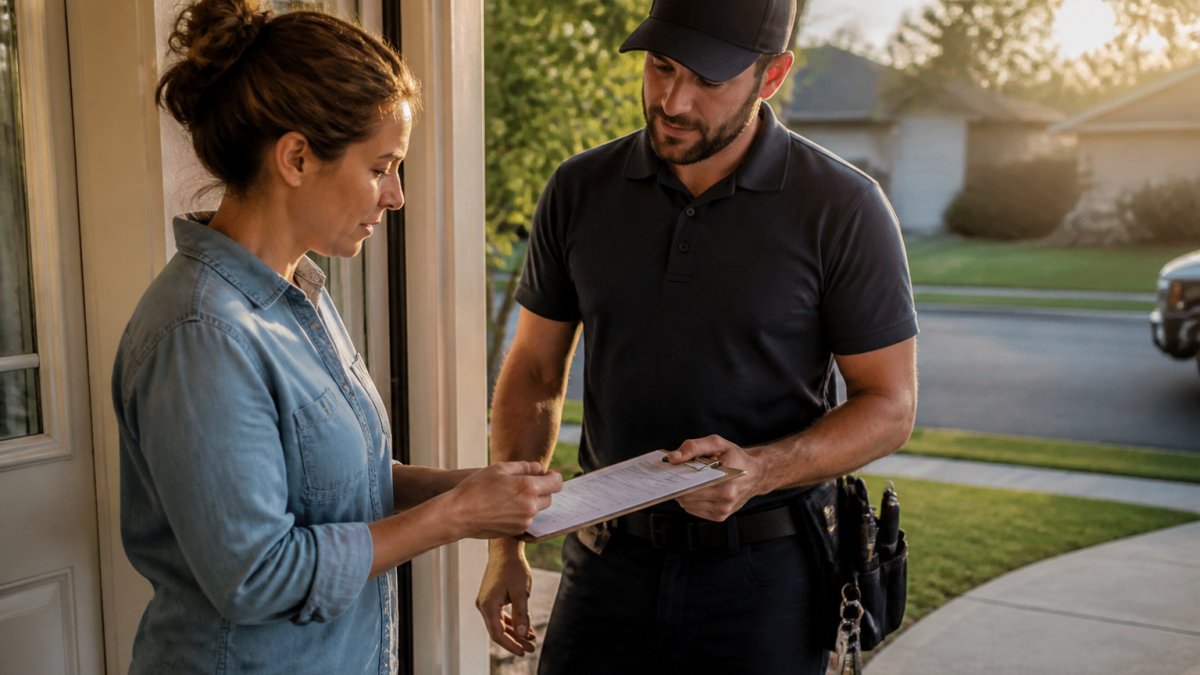
Ask the dispatcher to text or email the itemized estimate before the technician is dispatched. A written breakdown of service call, labor, surcharge, and parts is the single best defense against a starting price that balloons into a final bill.
Emergency Locksmith Service Call Fee Explained
The emergency locksmith service call fee is what you pay for the technician to arrive and assess your situation. This fee exists whether the lock opens in five minutes or thirty. It covers dispatch, travel time, and the technician’s expertise in evaluating your specific lock and door.
Time of day affects this fee significantly. Standard business hours typically carry a base service call fee. After-hours calls, evenings, weekends, and holidays, add surcharges to reflect the higher operational cost of maintaining 24/7 availability. An emergency locksmith service call fee during normal hours differs substantially from the same service at midnight.
When you contact a locksmith, ask if the service call fee is applied toward the final bill if work proceeds, or if it’s a separate charge. Some providers credit the service call fee against labor costs. Others charge it separately. Getting this detail upfront prevents billing surprises.
After-Hours Locksmith Prices and Surcharges
After-hours locksmith prices reflect the reality of maintaining round-the-clock emergency response. A lockout at 2 AM costs more than the same lockout at 2 PM because technicians work outside standard business hours.
Weekend surcharges apply to Saturday and Sunday calls. Holiday surcharges apply to major holidays when technicians are away from their regular schedules. These aren’t arbitrary markups, they represent genuine operational costs: paying technicians premium rates to be available when most people need them.
The surcharge structure varies by provider. Some add a flat percentage to the standard rate. Others charge a separate after-hours fee on top of service and labor costs. Understanding how your chosen provider structures these charges prevents confusion on your final bill.
Before calling for emergency help, check whether your homeowner’s insurance covers lockout services. Some policies include locksmith coverage, which can offset after-hours surcharges and service fees.
Key Factors That Affect Your Final Lockout Cost
Four variables move your final bill more than anything else: the lock, the entry method, the time you call, and where you are. Each one maps to a specific line item from the breakdown above, so you can predict which way your total will move before the technician arrives.
Lock type and door complexity
The lock on your door determines how long non-destructive entry takes, and time is labor. A standard single-cylinder pin-tumbler deadbolt is the fastest case. A double-cylinder deadbolt (keyed on both sides) is slower because there is no thumb-turn to bypass. A high-security cylinder with a restricted keyway, hardened steel pins, or anti-pick and anti-drill features can multiply labor time, sometimes pushing the job into the top of the labor range or forcing a drill.
Smart locks and keypad locks add a different problem: the technician may need to work around electronics, and a failed electronic component can mean the lock has to be removed rather than picked. Older mechanical locks are often easier, a 1980s deadbolt may open in a couple of minutes, while a modern security-focused design can take considerably longer.
Door and frame construction matter too. A standard wood frame allows straightforward entry. A reinforced strike plate, a security door, a metal frame, or a door that has settled and is binding against the frame all add time. When you describe your situation, be specific: lock brand if you know it, single- or double-cylinder, deadbolt or knob, wood or metal door, and whether the door is sticking.
Non-destructive entry versus drilling
Non-destructive entry uses picks, tension tools, bypass shims, or decoder tools to open the lock while leaving it usable. Drilling destroys the cylinder and requires a replacement. The trade-off is time versus parts.
Non-destructive entry usually takes longer in labor but avoids a parts charge, so the total is often lower for a standard lock. Drilling is fast but adds the cost of a new cylinder or deadbolt plus the time to install it. For a standard residential lockout, non-destructive entry is usually the cheaper total unless the lock is already damaged or is a high-security design that resists picking.
Some locks genuinely cannot be opened non-destructively in a reasonable time. Restricted-keyway high-security cylinders, certain anti-pick designs, and some smart locks fall into this category. A professional assesses the lock and recommends the approach that minimizes your total cost, not the approach that is fastest for the technician.
Time of day and day of week
This is the single biggest swing factor in the total. A daytime weekday call sits at the base rate. Evenings, weekends, and holidays add a surcharge that is typically 25-50% of the base, or a flat fee in the $30-$150 range depending on the provider. The surcharge reflects the real cost of keeping technicians on call around the clock, not an arbitrary markup.
Ask how the provider structures the surcharge: a flat fee, a percentage, or a separate after-hours rate that replaces the daytime rate. A flat fee is usually cheaper for short jobs; a percentage is usually cheaper for long ones.
Travel distance and technician availability
Urban and dense suburban areas with many locksmiths nearby tend to have competitive rates and short travel times. Rural areas with fewer technicians charge more because the service call covers longer travel. Peak demand periods, such as cold snaps when frozen locks are common, or the first week of a new month when moves are frequent, can also raise prices because available technicians are stretched.
Availability interacts with time of day: a 2 a.m. call in a rural area is the most expensive combination, while a Tuesday morning call in a city is the cheapest. If your situation is not urgent, calling during a slower window can meaningfully reduce the total.
How the factors stack
A standard deadbolt, daytime, urban, non-destructive is the low end. A high-security smart lock, holiday evening, rural, requiring drilling and replacement is the high end. Most real jobs sit somewhere in between, which is why the nationwide planning range is wide and why an itemized quote matters more than a single advertised number.
If a phone quote sounds far below the ranges above, treat it as a starting price, not a total.
How Long Does a Locksmith Take to Unlock a House
A locksmith typically takes 15-30 minutes to unlock a standard residential door with a basic deadbolt using non-destructive entry. This timeframe covers arrival, assessment, and opening. The actual picking or bypass technique usually takes just a few minutes once the technician begins work.
However, time varies dramatically based on lock type and condition. A damaged lock, a high-security lock, or a lock the technician hasn’t encountered before extends the timeline. Smart locks with electronic components may require different approaches than mechanical locks.
If drilling becomes necessary, the total time increases slightly because the technician must also install a replacement lock. This adds 15-20 minutes to the overall service. When calling for help, ask for a time estimate based on your specific lock type, and understand that estimates may shift once the technician assesses the situation in person.
Never attempt to force your own lock open. Forcing can damage the door frame, lock mechanism, or both, creating additional repair costs that exceed what a professional locksmith would charge. Patience while waiting for professional help is cheaper than DIY damage.
Lockout Service Versus Lock Replacement Pricing
A lockout service gets you inside your home. A lock replacement installs a new lock entirely. These are different services with different costs, and understanding when each applies prevents confusion.
Lockout service focuses on opening your existing lock without damage. You keep your original lock and key. This is the service you want if your lock is in good condition and you simply lost or forgot your key.
Lock replacement is necessary if your lock is damaged, broken, or compromised. If someone forced the lock, if the lock is worn out and won’t open reliably, or if you want to change who has keys to your home, replacement is the right choice. Replacement costs more than lockout service because you’re purchasing a new lock and paying for installation.
Sometimes a lockout situation leads to lock replacement. If the locksmith determines your lock can’t be opened non-destructively, drilling becomes necessary, which destroys the lock. In that case, you’ll need a replacement lock installed. Budget for both the lockout service and the lock replacement cost.
| Service Type | Typical Scope | When to Choose |
|---|---|---|
| Lockout Service | Open existing lock non-destructively | Lost key, forgot key, lock works fine |
| Lock Replacement | Install new lock entirely | Damaged lock, security upgrade, lost keys with no copies |
| Lockout + Replacement | Open lock via drilling, then install new lock | Lock can’t be opened without damage |
How to Verify a Locksmith Quote and Avoid Bait Pricing
Bait pricing, quoting a low price over the phone then charging substantially more on-site, is a real problem in the locksmith industry. Protecting yourself starts with asking the right questions before the technician arrives.
Request a written estimate before work begins. A reputable locksmith provides a detailed breakdown: service call fee, estimated labor time and cost, any parts needed, and after-hours surcharges if applicable. This written estimate becomes your protection against surprise charges.
Ask which costs are included in the quoted price and which are separate. Does the service call fee apply toward the final bill? Are parts included or added separately? Is the quoted labor time fixed or an estimate? Understanding these details prevents misunderstandings.
Compare quotes from multiple providers. Call at least two locksmiths and ask identical questions about your specific situation. This reveals whether one provider is significantly higher or lower than others. A price that’s far below market rate often indicates bait pricing; an extremely high quote may reflect unnecessary upselling.
Verify licensing and insurance before inviting anyone to your home. Ask for proof of licensing, bonding, and insurance. A legitimate locksmith carries liability insurance to cover accidental damage. BDS Locksmith is licensed, bonded, and insured, details you can verify before we arrive.
Always get a written estimate before work begins. This single step eliminates most bait-and-switch pricing schemes and gives you a clear agreement about costs.
What to Do Before Calling a Locksmith
Taking a few minutes before you call a locksmith saves time and often reduces costs. Start by checking whether you’re truly locked out. Verify that all doors and windows are actually secured and that you haven’t left another entry point unlocked.
If you’re renting, contact your landlord or property manager first. Many rental agreements require landlord involvement for lockouts, and the landlord may cover the cost. Calling a locksmith without permission could violate your lease.
Check your homeowner’s insurance policy for locksmith coverage. Some policies include emergency locksmith services, potentially covering all or part of the cost. A quick call to your insurance agent takes minutes and could save hundreds.
Gather information about your lock before calling. Know your lock type if possible, deadbolt, keypad, smart lock. Know your door type, wooden, metal, reinforced. Know whether you want non-destructive entry or whether replacement is acceptable. This information helps the locksmith provide an accurate quote.
Have your phone number and address ready. Be prepared to describe your situation clearly: Are you locked out of your home, or is there a broken lock? Is this happening during business hours or after hours? Are you in a secure location or exposed to weather? These details help the locksmith prioritize and prepare.
When you’re locked out of your home, the stress of the moment can cloud your judgment about costs and service quality. Understanding residential lockout service pricing before an emergency happens puts you in control. You’ll know what’s fair, what questions to ask, and how to verify quotes. BDS Locksmith provides free estimates and transparent pricing so you know exactly what you’re paying before work begins. Our licensed, bonded, and insured technicians arrive promptly with same-day service availability. Call us at (408) 300-4369 for a no-obligation estimate or emergency assistance, we’re here 24/7 to get you back inside safely.
Frequently Asked Questions
How much does a residential lockout service cost in 2026?
Residential lockout service pricing varies based on lock type, entry method, time of day, and location. Most residential lockout services include a service call fee, labor charges, and any required parts. Non-destructive entry typically costs less than drilling. Emergency calls during nights, weekends, or holidays carry additional surcharges. Contact your local locksmith for a written estimate before work begins to understand your total cost.
Do locksmiths charge more for nights, weekends, or holidays?
Yes. After-hours locksmith prices include surcharges for service outside standard business hours. Weekend and holiday emergency locksmith service call fees are typically higher than standard rates. The exact surcharge depends on the time and day you need service. Always ask about after-hours pricing when you call, and request a written quote that itemizes the base fee, surcharge, and labor estimate before the technician begins work.
How long does it take a locksmith to unlock a house door?
Response time depends on the technician’s availability and distance to your location. Most emergency locksmith services aim for 30-60 minute arrival. The actual unlock time varies: non-destructive entry on a standard residential door typically takes 15-30 minutes, while complex locks or drilling may take longer. Ask about estimated arrival and unlock duration when you call so you know what to expect.
What should I ask a locksmith before agreeing to the price?
Request a written upfront estimate that itemizes the service call fee, labor charge, and any parts cost. Confirm whether the quote includes non-destructive entry or if drilling will increase the final bill. Ask if the technician is licensed, bonded, and insured. Verify the total price before work begins and confirm there are no hidden fees. A reputable locksmith provides transparency to avoid surprise charges when you’re already stressed from a lockout.