Last Updated: November 4, 2026
Quick Summary
Mobile locksmith ignition services bring a technician to your vehicle to diagnose and repair ignition faults on-site, instead of towing the car to a shop. The main benefits are faster repairs, lower cost in many cases, and less disruption to your day.
- A sticking, hard-turning, or jiggle-to-start key is an early warning sign of ignition trouble.
- Most cylinder, key, fob, and switch jobs can be done on-site without a tow.
- Forcing a binding key with pliers or a screwdriver can turn a simple repair into a larger one.
- A dealership key job often requires a tow, which can cost more than the programming itself.
- Verify that any technician is licensed, bonded, and insured, and ask who covers damage during the job.
Table of Contents
- How Mobile Locksmith Ignition Service Works On-Site
- Car Ignition Repair: Common Faults and What Gets Fixed
- Car Key Replacement Without the Original Key
- Key Fob Programming and Remote Setup
- Locksmith vs Dealership Car Key Replacement: Cost Breakdown
- Safety Checks, Licensing and Insurance to Verify
- Booking Mobile Ignition Service in the South Bay Area
- Frequently Asked Questions
Few things are more frustrating than turning the key and getting nothing. A failing ignition cylinder, a worn switch, or an immobilizer fault can leave a car stuck in a parking lot, a driveway, or on the side of a busy road. NHTSA vehicle safety and recall resources covers many of the electrical and key-related issues drivers encounter, and it’s a useful place to check for open recalls on your vehicle.
Ignition problems rarely announce themselves. A key that sticks, turns hard, or needs jiggling is usually an early warning. Many drivers ignore it until the car refuses to start at all. By then, the choice is often between waiting for a tow and hoping a locksmith can come out the same day.
Mobile locksmith ignition services exist to close that gap. Instead of towing a car to a dealership or shop, a technician comes to the vehicle, diagnoses the fault, and repairs or replaces the affected part where it sits. The main benefits of mobile locksmith ignition services are speed, lower cost in many cases, and less disruption to your day.
Our team at BDS Locksmith has built this guide to explain what fails and what can be fixed on-site. For current pricing, visit the BDS Locksmith website or request a free estimate.
How Mobile Locksmith Ignition Service Works On-Site
A mobile locksmith arrives at the vehicle equipped to handle automotive key and ignition work on-site. The technician first confirms ownership or authorization, then assesses whether the problem is mechanical, electrical, or related to the key itself.
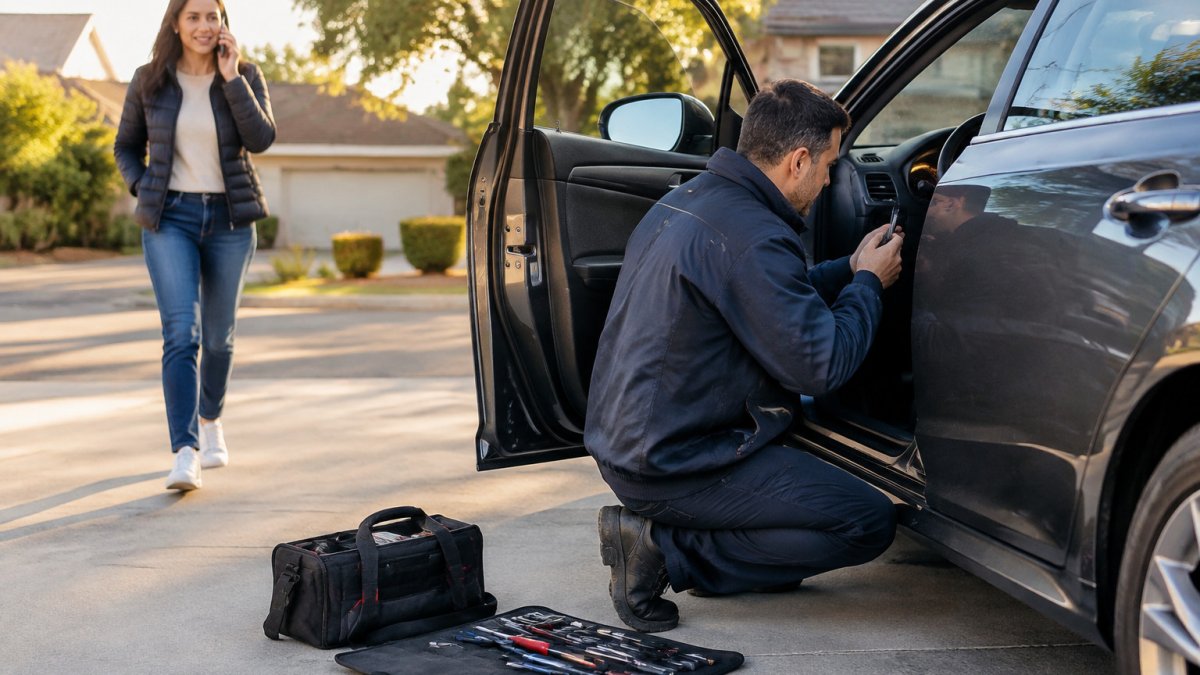
Once the cause is identified, most repairs happen right in the driveway or parking space. Common steps include removing the ignition cylinder, testing the switch, reprogramming a transponder key, or replacing a damaged fob.
Watch out: Forcing a stuck key or prying at the ignition can damage the cylinder and turn a simple repair into a larger one.
Car Ignition Repair: Common Faults and What Gets Fixed
Not every ignition complaint has the same cause, and the difference matters when you call. A technician who knows whether the fault is mechanical, electrical, or key-related can help you judge whether the job can be done on-site or requires a tow. Here are the faults mobile ignition specialists see most, what each one actually is, and what typically gets fixed.
Ignition Cylinder Wear and Key Binding
The ignition cylinder is the lock your key slides into. Inside it are spring-loaded pins (also called wafers) that must align with the cuts on your key before the cylinder will rotate. Over years of use, those pins wear, the key’s edges round off, and debris or graphite buildup packs into the keyway. The result is a key that sticks, turns hard, or needs to be jiggled or pushed in at an angle before the car starts.
A mobile technician can often extract a worn key, decode the cylinder, cut a fresh key, and lubricate or re-pin the cylinder on-site. If the pins are too far gone, the cylinder itself may need to be replaced.
Watch out: Forcing a binding key with pliers or a screwdriver can turn a cylinder repair into a broken-key extraction plus a full cylinder replacement.
Ignition Switch Failure
The ignition switch is a separate electrical component behind the cylinder. When you turn the key, the cylinder mechanically rotates the switch, which closes circuits for accessory power, run, and start. A failing switch can cause a no-crank condition, an engine that cranks and dies, accessories that cut out over bumps, or a starter that engages intermittently. Heat, age, and voltage spikes are the usual culprits.
Switch replacement is a different job from cylinder work, and the two are often confused. A technician will test for voltage at the switch terminals and at the starter signal wire to isolate which side is failing before replacing anything.
Transponder and Immobilizer Faults
Since the late 1990s, most vehicles sold in the U.S. have used a passive anti-theft system, a transponder chip in the key head that must be read by an immobilizer antenna around the ignition before the engine will run. If the chip is damaged, the key is a clone that was never properly programmed, or the immobilizer module loses its key memory after a battery drain or module swap, the car may crank freely but never fire, or start for two seconds and shut off.
This is the fault most likely to strand a driver because the symptom looks like a dead battery or starter. Not every make is programmable on-site, some European and newer domestic platforms require dealer-level online programming, so ask the dispatcher to confirm your year, make, and model before booking.
Push-Button Start and Smart Key Failures
Push-button ignition adds another layer: a smart key fob, interior antennas, a brake-pedal switch, and a start button. A no-start with a push button is frequently a dead fob battery, a fob that lost its pairing, or a brake-pedal switch that isn’t registering. Technicians test the fob signal, the antenna reception, and the pedal switch in sequence.
What Can Be Fixed On-Site vs. What Needs a Shop
Most cylinder, key, fob, and switch jobs are mobile-capable. The exceptions are faults that require lifting the vehicle or major disassembly, a failed starter motor, a damaged steering column lock housing that requires column removal, or a wiring harness fault buried in the dash.
Car Key Replacement Without the Original Key
Losing every copy of a car key is one of the most common reasons people call a locksmith. The good news is that replacement is often possible without the original key, provided the locksmith can verify your ownership.
Expect the technician to ask for your vehicle identification number, registration, and a photo ID. The locksmith then cuts a new key blank to the car’s code and programs the transponder to the immobilizer. A common mistake is assuming the dealership is the only option.
Key Fob Programming and Remote Setup
Key fobs combine remote locking, unlocking, and sometimes push-button start. When a fob stops working or a replacement arrives blank, it needs to be programmed to the vehicle before it functions.
Programming usually takes a short visit. The technician connects to the vehicle’s system, pairs the new fob, and tests every function, including the trunk and panic button. If the battery is dead, replacing it often solves the problem first. Confirm the fob works in your hand before the technician leaves.
Locksmith vs Dealership Car Key Replacement: Cost Breakdown
Cost is the question most drivers ask first, and the honest answer is that the gap between a mobile locksmith and a dealership is driven less by the price of the key itself and more by everything around it, the tow, the diagnostic fee, the shop time, and the programming labor. Here is how the two paths actually break down.
The Line Items That Make Up the Bill
Whether you go mobile or dealer, a replacement key or fob job is built from the same components:
- Key or fob hardware. A basic transponder key blank is the cheapest; a smart key or proximity fob with push-button start is the most expensive, and the spread between the two is wide. The hardware cost is set largely by the manufacturer and is similar whether a locksmith or a dealer supplies it.
- Cutting. Laser-cut and sidewinder keys require a code-cutting machine; traditional edge-cut keys are simpler. Mobile vans carry code-cutting equipment, so this is rarely a separate trip.
- Programming. The transponder or smart key must be paired to the immobilizer. This is where labor varies most, some vehicles program in minutes, others require a security access procedure.
- Service call or diagnostic fee. A mobile locksmith charges a service call; a dealership charges a diagnostic or shop fee.
- Tow or vehicle transport. This is the line item that most often decides the comparison. A dealership cannot program a key to a car that isn’t at the dealership.
Why the Tow Changes the Math
A dealership key replacement requires the vehicle on-site. If the car won’t start because every key is lost or the immobilizer has locked out, the car has to be towed in, and a flatbed tow for a no-start vehicle is frequently the largest single line on the invoice, often exceeding the cost of the key programming itself. A mobile locksmith eliminates that line entirely because the programming happens where the car sits.
For rare or high-security keys, the dealership may be the only option, and the mobile provider should tell you so rather than book a job it can’t finish.
Questions That Reveal the Real Price
Because published prices vary by make, model, and key type, the reliable move is to get a written quote that itemizes every line above before anyone dispatches. Ask specifically:
- Does the quote include the service call, the key or fob hardware, cutting, and programming, or are any of those added at the door?
- Is the quoted price guaranteed if the programming takes longer than expected, or is labor billed hourly after a threshold?
- If the vehicle turns out to need dealer-level programming, is the service call refunded or credited?
- Is there a separate charge for extracting a broken key or for a second key?
When Insurance or a Warranty Covers It
Before paying out of pocket, check two things. First, some auto policies include a key replacement endorsement or roadside assistance that reimburses lost-key costs, review your declarations page. Second, some manufacturers’ roadside programs and extended warranties cover key replacement, though usually through a dealer. If either applies, confirm whether the coverage requires a dealership or pays a mobile provider, because that can flip the cheaper option.
The article breaks the cost of a key or fob job into the line items that drive the final bill.
| Line item | What it covers | Why it matters |
|---|---|---|
| Key or fob hardware | Transponder key or smart key | Cost varies widely by key type |
| Cutting | Laser-cut or sidewinder keys | Mobile vans carry code-cutting equipment |
| Programming | Pairing the key to the immobilizer | Labor varies most by vehicle |
| Service call or diagnostic fee | Mobile call or dealership shop fee | Charged by both options |
| Tow or vehicle transport | Moving a no-start car to a dealer | Often the largest single line item |
Safety Checks, Licensing and Insurance to Verify
Before you let anyone work on your car, verify their credentials. Look for a business that is licensed, bonded, and insured, and ask for proof of those credentials. Confirm the technician’s name and company match the invoice and the vehicle ownership details.
Ask what happens if something goes wrong during the job and who covers any resulting damage.
Booking Mobile Ignition Service in the South Bay Area
If you’re stranded or your key won’t turn, the fastest path is to call a local mobile service. BDS Locksmith provides mobile locksmith services throughout the South Bay Area. Same-day service and a 5% military discount are offered.
Have your vehicle details, registration, and photo ID ready when you call. To get started, call (408) 300-4369 or visit the BDS Locksmith website for service details and current pricing.
Frequently Asked Questions
How much does it cost to replace a smart car key?
Costs depend on the vehicle, the key type, and whether the key must be cut, programmed, or both. Smart keys and push-to-start fobs generally cost more than basic keys because they include electronics that must be paired to the car’s immobilizer. BDS Locksmith offers free estimates, so you can confirm the figure for your specific vehicle before any work starts. Ask for an itemized quote that lists the key, labor, and programming separately.
Can a locksmith program a replacement key fob?
In many cases, yes. A mobile locksmith with the right diagnostic and programming equipment can pair a replacement key fob to your vehicle on-site, without towing the car to a dealership. Programming capability varies by make and model, so confirm that your vehicle is supported before scheduling.
What should I do if my push-to-start key is lost?
Stay with your vehicle and call a licensed mobile locksmith rather than attempting to force the ignition, which can damage the cylinder or steering components. Have your vehicle registration and proof of ownership ready, since a reputable locksmith will verify ownership before cutting or programming a new key.
Is it cheaper to use a locksmith or a dealership for a replacement car key?
Dealerships typically work from the vehicle identification number and may require a tow. A mobile locksmith comes to you, so the vehicle does not need to be moved. Request written pricing from both options and compare the full total, including any travel or diagnostic charges.
Stranded drivers need a fast, verified answer. BDS Locksmith offers licensed, bonded, and insured mobile ignition service across the South Bay, and our team is ready to get your vehicle moving. Call (408) 300-4369 today for a free estimate.