Last Updated: November 4, 2026
Quick Summary
Preventing lockout liability means verifying the locksmith’s license and insurance, documenting the customer’s right to access, photographing the door’s condition before work, and getting written approval of the scope and estimate. These steps close the gaps where damage claims, unauthorized entry claims, and billing disputes begin.
- Call the insurer directly to confirm a certificate of insurance is genuine.
- Photograph the customer’s ID and log the time of verification.
- Get a landlord’s written approval before opening a door for a tenant not on the lease.
- Photograph existing scratches and dents and have the customer initial the notes.
- File an incident report the same day and keep original files unedited.
Table of Contents
- Why Lockout Liability Starts Before the Technician Arrives
- How to Verify Locksmith License and Insurance Before Work Begins
- Locksmith Proof of Authorization: Confirming the Customer’s Right to Access
- The Emergency Locksmith Service Checklist for Every Job
- Locksmith Damage Documentation: Before, During, and After
- Non-Destructive Entry and Safe Work Practices That Reduce Claims
- Scope of Work, Estimates, and Customer Consent
- Incident Reporting and Evidence Preservation After a Dispute
- Book a Documented Emergency Lockout Service with BDS Locksmith
- Frequently Asked Questions
Why Lockout Liability Starts Before the Technician Arrives
Lockout liability is the legal and financial responsibility a locksmith carries when a lockout job causes property damage, personal injury, or a billing dispute. Most of that risk gets decided before the technician arrives. This guide from BDS Locksmith walks through the full process, from license checks to incident reports.
Here is the uncomfortable truth: the biggest claims rarely come from a broken lock. They come from a missing signature, an undocumented scratch, or a customer who never proved they belonged there.
The Federal Trade Commission’s guidance on unfair business practices treats unclear pricing and unauthorized work as consumer protection issues, not just bad service.
Below, we’ll show you exactly how to close those gaps on every job.
How to Verify Locksmith License and Insurance Before Work Begins
Verification is the first line of defense, and it takes about five minutes. A locksmith who cannot produce proof of licensing and coverage on request is a liability risk worth avoiding.
State licensing rules vary, so check your state’s consumer affairs or business regulation office for the current requirements. Ask for three things before any work starts:
- License number, checked against the state database
- Certificate of insurance showing general liability coverage, with the insurer’s phone number
- Proof of bonding, if your state requires it
Call the insurer directly. Certificates get faked, and a two-minute call settles it. Our own team keeps documents ready for inspection on every call, because we are licensed, bonded, and insured.
For a deeper walkthrough, see our guide on how to verify a locksmith license and insurance before work begins. If you want to understand what a policy actually pays for, read our breakdown of professional locksmith liability insurance.
Locksmith Proof of Authorization: Confirming the Customer’s Right to Access
Locksmith proof of authorization is the documented evidence that the person requesting entry has the legal right to the property or vehicle. Skipping this step risks opening a door for someone who does not own it, which can lead to a police report, a civil claim, or both.
The legal logic is simple. A locksmith who opens a property for someone without the right to access can face claims for trespass, conversion of property, or negligent provision of services. Even a good-faith mistake does not automatically shield you if you never asked for proof. Documented authorization is the evidence that your entry was lawful and consensual.
A workable authorization process looks like this:
- Ask for a government-issued photo ID and match the name to the address, lease, or vehicle registration.
- For homeowners, compare the ID to a utility bill, property tax record, or mortgage statement showing the service address.
- For renters, request the lease or a landlord’s written approval that names the tenant and the unit.
- For roommates and family members, confirm the requester lives at the address and note who else has access.
- For vehicles, check the registration or title against the ID, and confirm the vehicle identification number on the dash matches the paperwork.
- For commercial jobs, get the property manager’s or business owner’s name and contact number, and confirm authorization in writing.
- Photograph the ID and log the time of verification.
Never take a verbal “it’s my place” as proof. A short, polite refusal costs you one job. A bad entry costs you far more.
Watch out: a tenant who is locked out but whose name is not on the lease is a common trap. Get the landlord’s written approval before opening the door, even if the tenant is clearly upset and the hour is late.
Document the consent itself, not just the ID. A signed authorization form or a written message that states the requester’s name, the service address, the date and time, and the scope of entry gives you a record that survives a later dispute. Keep that record with the job file and the pre-service photos.
For vehicle lockouts, the registration is the strongest single document, but it is not the only one. A title, a current insurance card naming the requester, or a dealership service record can support authorization when the registration is locked inside the car. Photograph whatever you rely on and note why you accepted it.
If authorization is unclear, stop. Offer to return when the customer can produce documentation, or ask the customer to contact the property owner or lender. A delayed job is recoverable. An unauthorized entry is not.
The Emergency Locksmith Service Checklist for Every Job
An emergency locksmith service checklist turns a rushed call into a repeatable process. The faster the job, the more the checklist matters.
Run this before touching any hardware:
- License and insurance confirmed
- Customer ID verified and photographed
- Right to access documented
- Pre-service condition photos taken
- Scope of work explained and signed
- Estimate given and accepted in writing
- Tools inspected for damage risk
- Work area protected from scratches and debris
That last item gets skipped constantly. A moving blanket under the door costs nothing. A replaced door frame does not.
The checklist is not paperwork for its own sake. Each line closes a specific hole where a claim can start.
Run this checklist before touching any hardware on an emergency lockout job.
| Checklist step | What it closes |
|---|---|
| License and insurance confirmed | Unlicensed or uninsured provider risk |
| Customer ID verified and photographed | Access by the wrong person |
| Right to access documented | Trespass and unauthorized entry claims |
| Pre-service condition photos taken | Disputes over pre-existing damage |
| Scope of work explained and signed | Billing disputes |
| Estimate given and accepted in writing | “You said it would be cheaper” complaints |
| Tools inspected for damage risk | Tool-caused damage |
| Work area protected from scratches and debris | Frame and door surface damage |
Locksmith Damage Documentation: Before, During, and After
Documentation is the cheapest insurance you will ever carry. Photos taken before, during, and after a job settle most disputes before they become claims.
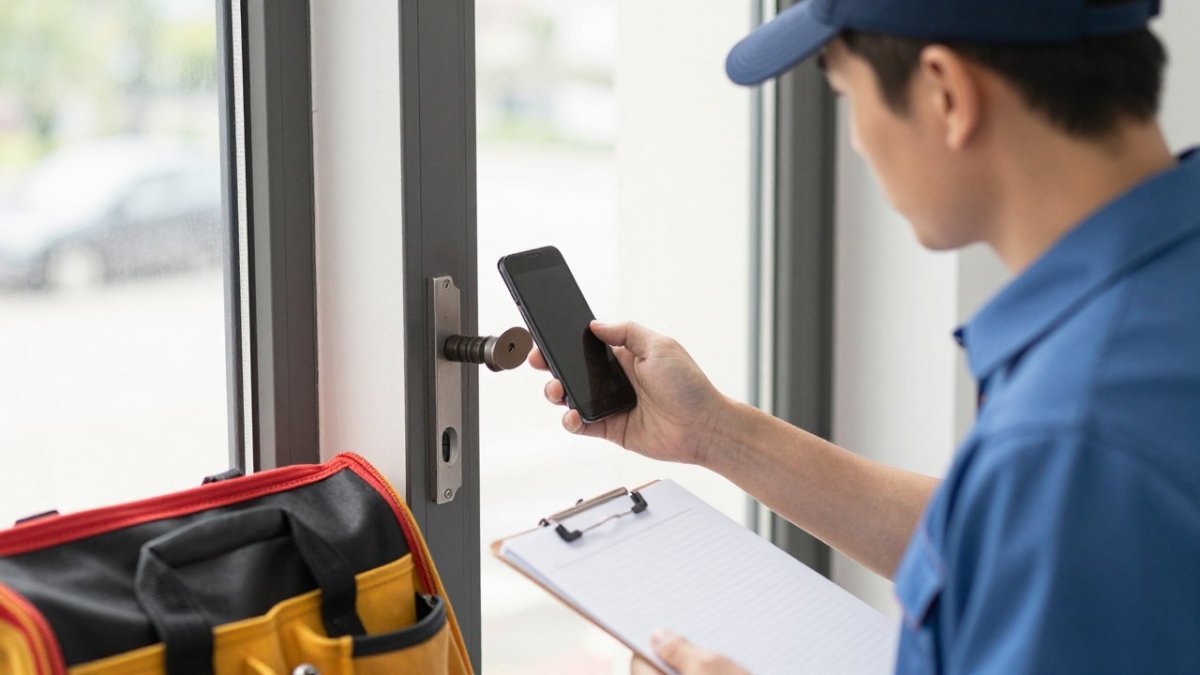
The pre-service walkaround matters most. Photograph existing scratches, dents, loose hinges, and worn weatherstripping. Note any pre-existing damage in writing and have the customer initial it.
During the job, capture the keyway, latch mechanism, and any point where a tool contacts the door. After the job, photograph the finished work and the surrounding area.
If damage happens anyway, our article on what to do if a locksmith damages your door covers your options step by step.
Non-Destructive Entry and Safe Work Practices That Reduce Claims
Non-destructive entry is the practice of opening a lock without drilling, prying, or damaging the door, frame, or lock hardware. It is the single biggest cost saver in this trade.
Most locks can be opened through lock manipulation, picking, or bypass techniques that leave the hardware intact. A skilled technician reads the keyway, works the pins, and the door opens. No drill bit, no replacement cylinder.
Safe work practices that cut claims:
- Use proper tension tools instead of forcing a keyway
- Keep dust and debris out of the latch mechanism
- Lubricate lock hardware with the right product, not whatever is in the van
- Brace the door before applying pressure to avoid frame damage
- Stop and reassess if a lock resists instead of escalating force
Forced entry should be a last resort, reserved for genuine emergencies where safety is at risk. Even then, document why it was necessary.
Scope of Work, Estimates, and Customer Consent
The estimate is where most billing disputes are born. A clear scope of work, agreed in writing before the first tool comes out, prevents nearly all of them.
State plainly what the job includes and what it does not. Include the price, the expected time, and any conditions that could change the total. Get a signature or a written message approving it.
Watch out: a phone quote that never gets confirmed in writing is the number one source of “you said it would be cheaper” complaints. Confirm it on arrival, in writing, every time.
BDS Locksmith offers free locksmith estimates.
Incident Reporting and Evidence Preservation After a Dispute
An incident report is a written record of what happened, created as soon as a problem surfaces. It protects both the customer and the technician, and it is the document an insurer, a court, or a licensing board will read first if a claim escalates.
Most competitors mention incident reports in a sentence and move on. The process below connects the report to the evidence that supports it, which is the part that actually decides claims.
File the report the same day, while memory is fresh. Include the date, time, and location; the names and contact details of everyone present; a plain chronological description of the event; the tools used; the condition of the lock and door before and after; and any witness contact details. Keep the original files unedited, with timestamps intact.
Separate facts from opinions. Write “the deadbolt cylinder would not turn after three attempts with a tension wrench” rather than “the lock was defective.” Opinions in an incident report become admissions later.
Preserve the physical evidence. Do not discard a damaged lock, cylinder, key, or door hardware until the claim is resolved. Bag and label each item with the job number and date, and store it somewhere dry and secure. If the customer wants the damaged part, photograph it first and note in the report that the customer took possession.
Preserve the digital evidence with the same care. Export photos and videos to a folder named for the job, keep the original files rather than edited copies, and back them up. Screenshots of text messages and authorization forms should show the sender, recipient, and timestamp.
Watch out: overwriting or deleting the original photo files destroys the metadata that proves when the images were taken. Copy, do not move, and never crop the only version.
Notify your insurer promptly if a claim looks likely. Most general liability policies require timely notice, and a late report can complicate coverage even when the underlying claim is weak. Keep a copy of the notice and the claim number with the job file.
If the customer files a complaint with a state consumer affairs office or licensing board, respond in writing and attach the incident report, the authorization record, and the before-and-after photos. A complete file often resolves a complaint before it becomes an investigation.
Close the loop internally. Note what went wrong, what corrective action was taken, and whether the customer was made whole. That record shows a pattern of responsible practice if the same issue ever comes up again.
If a dispute escalates, our guide on locksmith insurance coverage for damage explains how the claims process works and what coverage typically handles.
Book a Documented Emergency Lockout Service with BDS Locksmith
Every step above comes down to one idea: a documented job is a defensible job. That is how we run every call.
BDS Locksmith is licensed, bonded, and insured. We provide free locksmith estimates. Our team offers 24/7 emergency service, same-day availability, and a 5% military discount. Owner Benjamin has helped thousands of Bay Area residents get out of tough lockout situations.
If you want a documented emergency lockout service from a team that shows its credentials before you ask, book a documented emergency lockout service or call (408) 300-4369.
Frequently Asked Questions
How can locksmiths reduce liability during an emergency lockout?
The strongest protection is a repeatable process: verify the license and insurance, confirm the customer’s authorization, photograph the lock and door before touching anything, and get a signed estimate before work starts. Documenting pre-existing damage prevents disputes later. Using non-destructive entry methods whenever possible also limits the chance of a claim, and a written incident report after any dispute keeps the record clear.
What should a customer ask before authorizing emergency locksmith work?
Ask for the license number and proof of general liability insurance, and confirm the total price in writing before any tool touches the lock. Ask whether the technician will document the condition of the door or vehicle first, and whether non-destructive entry is an option. A reputable provider answers these questions without hesitation and gives you a written estimate instead of a phone quote that changes on arrival.
Can a locksmith be liable for damage caused during a lockout?
Yes. If a technician drills a lock unnecessarily, scratches a door frame, or damages a vehicle window regulator, the customer can pursue a claim. General liability insurance typically covers third-party property damage, which is why verifying coverage matters before work begins. Documenting the condition of the lock and surrounding surfaces beforehand protects both sides and makes any claim resolution faster.
What should a locksmith do if ownership or authorization cannot be verified?
Stop and do not open the lock. Ask for alternative proof such as a registration, lease, utility bill, or ID matching the address, and note the refusal in the service record. If proof still cannot be established, decline the job and document why. Opening a property or vehicle for an unauthorized person exposes the locksmith to liability and can create serious legal exposure.
A lockout is stressful enough without wondering who pays if something goes wrong. BDS Locksmith removes that doubt with licensed, bonded, and insured technicians, free estimates, and written documentation on every job. Get started with BDS Locksmith and get back inside without the liability headache.