Last Updated: October 29, 2026
Quick Summary
To secure exterior doors against break-ins, audit each door for flex, gaps, and a loose strike plate, then upgrade to a Grade 1 or Grade 2 deadbolt with a 1-inch bolt throw. Reinforce the strike plate and jamb and replace short screws with 3-inch screws driven into the wall stud.
- Push on each closed door and look for flex, cracks, and daylight gaps around the frame.
- A deadbolt should throw at least 1 inch into the frame to hold under force.
- Grade 2 is the practical minimum for an exterior door; Grade 3 is builder-grade hardware.
- Most exterior doors are 1-3/4 inches thick with a 2-3/8-inch or 2-3/4-inch backset.
- Garage side doors and back entries are the doors burglars test first, so treat them like front doors.
Table of Contents
- Start With a Door Security Audit
- Upgrade to a High-Quality Deadbolt With the Right Security Grade
- Reinforce the Strike Plate and Door Jamb
- Replace Short Screws With 3-Inch Screws
- Install Door Frame Reinforcement Kits for Kick-In Resistance
- Choose the Best High-Security Deadbolts for Your Entry Door
- How to Secure Garage Side Doors and Other Weak Entry Points
- Protect Glass Panels, Patio Doors, and Sliding Doors
- Book a Professional Door Security Assessment
- Frequently Asked Questions
Start With a Door Security Audit
Most break-ins don’t involve clever lock picking. They involve secure exterior doors that were never strong enough in the first place.
You can walk through every exterior door and check the slab, frame, and hardware before buying a lock.
Check the Door Slab and Frame
Start by pushing on the door while it’s closed. Does it flex? A hollow or thin door gives way under a hard kick. Look for cracks around the frame and gaps between the door and the jamb. Any daylight showing through means an easy entry point.
Test the Lock and Strike Plate
Jiggle the deadbolt when it’s extended. If it moves, the strike plate isn’t holding it tight. Check that the strike plate screws bite into the wall stud, not just the thin trim.
Here’s a quick audit checklist you can run today:
- Push the closed door hard; note any flex or movement
- Look for cracks or gaps around the frame
- Extend the deadbolt and wiggle it side to side
- Check strike plate screw length and depth
- Confirm the deadbolt throws at least 1 inch into the frame
- Test every exterior door, including side and back entries
If your locks show several of these weaknesses, our guide to the signs your home locks need an upgrade walks through each warning sign in detail.
Upgrade to a High-Quality Deadbolt With the Right Security Grade
A deadbolt is the right first hardware upgrade for most secure exterior doors, but “buy a Grade 1 or Grade 2 deadbolt” is only half the decision. The other half is whether it fits your door, whether you can install it without weakening the door, and whether it is the highest-priority fix for your home right now.
What the Grade Actually Means
Lock grades come from standards set by ANSI/BHMA lock standards, which rate residential hardware from Grade 3 (basic) to Grade 1 (best). The grade reflects tested performance under force, cycles, and finish wear, not brand prestige or finish color.
- Grade 3 is builder-grade hardware. It is common on new construction and often the first thing to fail under a kick.
- Grade 2 is the practical minimum for an exterior door. It handles real residential use and resists more force than Grade 3.
- Grade 1 is the top residential rating and is worth the upgrade on a primary entry door or any door that is out of view.
Grade matters more than brand or finish, but grade alone does not tell you whether the bolt will fit your door or whether the strike will hold. Those are separate checks.
Compatibility Checks Before You Buy
Measure before you shop. Most deadbolt installation mistakes come from buying hardware that does not match the existing door prep.
- Door thickness. Most exterior doors are 1-3/4 inches thick. Thinner doors, older doors, and some storm-door combinations may need a different lock body.
- Backset. Measure from the door edge to the center of the existing lock hole. The two common residential backsets are 2-3/8 inches and 2-3/4 inches. Buying the wrong one means redrilling or returning the lock.
- Cross bore and edge bore. The cross bore is the large hole through the face of the door; the edge bore is the smaller hole through the edge. Standard residential prep uses a 2-1/8-inch cross bore and a 1-inch edge bore. Confirm your door matches before ordering.
- Door material. Solid wood, steel, and fiberglass doors accept standard deadbolt prep. Hollow-core doors and some glass doors need reinforcement or a different lock type.
- Strike side. Check that the jamb has enough solid material for the strike plate and long screws. A hollow or particle-board jamb needs a reinforcement kit before a deadbolt will hold.
If you are replacing an existing deadbolt, take the old lock to the store or photograph the door edge, the face bore, and the jamb. Matching the existing prep is faster and cheaper than drilling new holes.
What to Look For in the Lock Body
- A bolt that throws 1 inch or more into the frame
- A solid steel or hardened bolt, not pot metal
- A reinforced strike plate included in the box
- A cylinder that resists drilling and prying, often with hardened pins and an anti-pry collar
- No plastic internal parts in the bolt or cylinder
Smart locks can add convenience, but check the mechanical grade first. A smart lock built on a weak bolt is still weak. For a deeper look at what high-security options offer, see our guide to the benefits of high security deadbolts.
Prioritize the Upgrade by Door
Not every door needs the same lock. A prioritized approach saves money and puts the strongest hardware where it matters most.
- Primary entry door that is visible from the street: Grade 1 or Grade 2 deadbolt, reinforced strike, 3-inch screws, and a frame reinforcement kit.
- Back, side, and garage entry doors that are out of view: Grade 2 deadbolt at minimum, plus long screws and a reinforcement kit. These are the doors burglars test first.
- Doors with glass or sidelights: a deadbolt plus glass protection, and a careful decision about a double-cylinder lock given egress rules.
- Rental properties: check the lease before drilling. Many leases require landlord approval for lock changes, and some require the landlord to keep a key. A portable door reinforcement bar or a renter-friendly secondary lock may be the better first step.
Cost, Effort, and DIY Versus Professional
A deadbolt upgrade is one of the few security fixes most homeowners can do themselves with a drill, a screwdriver, a tape measure, and a chisel or hole saw if new prep is needed. Replacing a lock in an existing hole is a beginner-level job. Drilling new prep in a steel or fiberglass door is not; a mistake there can ruin the door.
Call a locksmith or contractor when:
- The door has no existing deadbolt prep and you need new holes drilled
- The door is steel, fiberglass, or glass, where a wrong cut is expensive
- The jamb is hollow or damaged and needs reinforcement before a lock will hold
- You want a high-security lock keyed to match your other doors
- You are in a rental and need landlord-approved work
For local homeowners ready to schedule, visit our locksmith service page.
Buy the grade that matches the door’s risk, confirm the backset and door thickness before you order, and put the strongest hardware on the doors that are out of sight. A Grade 2 deadbolt with long screws and a reinforced strike beats a Grade 1 lock in a weak jamb every time.
Before you shop, match the lock to your door’s existing prep and risk level.
| Spec | Value | Note |
|---|---|---|
| Door thickness | 1-3/4 inches | Most exterior doors; thinner doors may need a different lock body |
| Backset | 2-3/8 inches or 2-3/4 inches | Two common residential backsets |
| Cross bore | 2-1/8 inches | Standard residential prep through the door face |
| Edge bore | 1 inch | Standard residential prep through the door edge |
| Bolt throw | 1 inch or more | Should extend into the frame |
| Grade 3 | Basic | Builder-grade hardware, first to fail under a kick |
| Grade 2 | Practical minimum | Handles real residential use |
| Grade 1 | Top residential rating | Worth it on a primary entry door |
Reinforce the Strike Plate and Door Jamb
The strike plate is the metal piece the bolt slides into, and it’s where most forced entries succeed. A thin plate held by two short screws will tear out of the frame under a kick.
Upgrade to a heavy-duty strike plate with four screw holes. Make sure the screws reach deep into the wall stud behind the jamb. The door jamb itself should be solid wood, not particle board, at the lock and strike points.
Why does this matter so much? Because the bolt is only as strong as what holds it. A great deadbolt in a weak jamb still fails.
Replace Short Screws With 3-Inch Screws
Swapping the screws in your strike plate and hinges for 3-inch screws is the cheapest, highest-impact fix on this list. The screws that come with most locks are often under an inch long. They grip only the soft trim, not the structural stud.
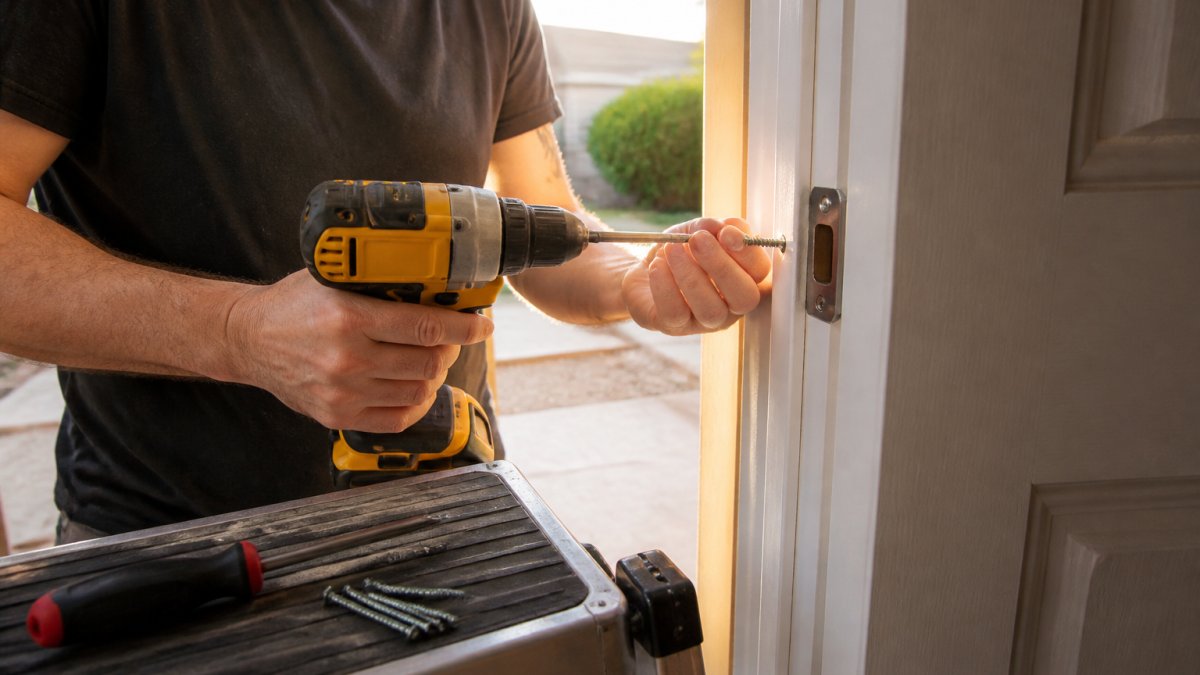
Use stainless steel screws where moisture is a concern, like garage and patio doors. Drive them through the strike plate and into the stud. Do the same at the top and bottom hinges.
A common mistake is overtightening and stripping the hole. If a screw spins, move up slightly and start a fresh pilot hole. This single upgrade makes a door dramatically harder to kick in.
Install Door Frame Reinforcement Kits for Kick-In Resistance
Door frame reinforcement kits spread the force of a kick across a wider section of the frame. Instead of two screws taking the hit, a reinforced plate distributes it across the jamb and stud.
These kits are simple to install and work with most standard deadbolts. They’re especially worth it on back doors and any entry that’s out of view from the street. Pair a kit with long screws and a Grade 2 deadbolt, and you’ve built real kick-in resistance.
If you’d rather have it done right the first time, our high-security lock installation guide covers the steps and tools for a proper upgrade.
Choose the Best High-Security Deadbolts for Your Entry Door
The best high-security deadbolts combine a hardened bolt, a drill-resistant cylinder, and a reinforced strike, all rated Grade 1 or Grade 2. For a front door, that combination is what stops both a kick and a pick.
Look for these features when comparing models:
- Hardened steel bolt that resists cutting
- Anti-drill cylinder with hardened pins
- Anti-pry collar to protect the cylinder from grips
- Grade 1 or Grade 2 rating from ANSI/BHMA
- Solid construction with no plastic internal parts
Smart locks can add convenience, but check the mechanical grade first. A smart lock built on a weak bolt is still weak. For a deeper look at what high-security options offer, see our guide to the benefits of high security deadbolts.
How to Secure Garage Side Doors and Other Weak Entry Points
Garage side doors and back entries are the doors burglars test first, because they’re often out of sight and poorly secured. A garage side door frequently has a builder-grade knob lock and nothing else.
Here’s how to secure garage side doors:
- Add a Grade 2 deadbolt with a 1-inch bolt throw
- Replace strike plate screws with 3-inch screws into the stud
- Install a door frame reinforcement kit
- Add a heavy-duty strike plate
- Keep the door solid-core or steel, not hollow
The same approach applies to back doors, basement entries, and any door that opens into a garage. Treat every exterior door as a front door. For a full walkthrough on these entries, read our guide on how to secure garage side doors.
Protect Glass Panels, Patio Doors, and Sliding Doors
Glass doors are the entry point most guides gloss over, and they are also where the wrong upgrade can trap you inside during a fire. Treat this section as a compatibility and safety check, not just a shopping list.
First, Identify What You Actually Have
Sliding patio doors, French doors, and doors with sidelights fail differently, so the fix differs too:
- Sliding patio doors ride on a track and latch at the jamb. The weak points are the latch, the track, and the glass itself.
- French doors have two active leaves and a fixed or inactive leaf. The inactive leaf often has flush bolts that are easy to defeat if they are short or loose.
- Doors with sidelights put glass within arm’s reach of the main lock. A burglar can break the sidelight and reach the thumb turn.
- Glazed entry doors combine a lock and a large glass panel in one slab, so glass protection and lock protection have to work together.
Harden the Glass Without Blocking Exit
Security film is the lowest-effort upgrade. A quality security film holds shattered glass in the frame long enough to slow entry, but it does not make glass unbreakable. Apply it to the full pane, not just the center, and have it installed by a film professional if the pane is large.
When you replace glass, ask for laminated glass rather than tempered. Tempered glass breaks into small cubes that fall away; laminated glass holds together on an interlayer. Laminated glass is the better security choice for doors and sidelights, and it is commonly available through glass shops and door suppliers.
Do not rely on glass alone. A determined intruder can defeat most residential glass given time and noise tolerance. Film and laminated glass buy time; they do not replace a lock, a reinforced frame, or visibility from the street.
Secure the Sliding Door Mechanism
A sliding door needs two things: a lock that resists prying and a physical block that stops the panel from sliding even if the latch is defeated.
- Secondary latch or patio door lock: mounts on the jamb and pins the sliding panel. Look for one that throws a steel pin at least 1/2 inch into the frame.
- Charley bar or track block: a rigid bar or dowel cut to fit the lower track. It stops the panel from sliding back when the latch is jimmied. Measure the track opening with the door closed and cut the bar slightly long so it seats firmly.
- Track screws: drive a screw into the upper track above the sliding panel so the panel cannot be lifted out of the track. This is a common bypass that many homeowners never check.
For French doors, check the inactive leaf first. Flush bolts should be long enough to seat deeply into the head and sill, and the active leaf should have a deadbolt rated Grade 2 or better. If the inactive leaf only has a surface bolt, add a flush bolt or a heavy-duty barrel bolt that engages the frame.
The Double-Cylinder Deadbolt Trade-Off
A double-cylinder deadbolt uses a key on both sides, so breaking glass does not give an intruder a thumb turn to open. That is a real security benefit on a glazed door. It is also a real safety risk: in a fire, anyone inside needs a key to get out.
Before installing one, check three things:
- Local fire and building codes. Many jurisdictions restrict double-cylinder deadbolts on egress doors, especially in sleeping areas. Confirm with your local building department before you buy.
- Who lives in the home. Children, older adults, and anyone who might panic in smoke need a door they can open without searching for a key.
- Where the key lives. If you install one anyway, keep the key in a fixed location immediately next to the door, and make sure everyone in the household knows where it is.
The NFPA emergency egress guidance explains why every sleeping area needs a door that opens easily from the inside. Security that blocks escape is not security; it is a different hazard.
Compatibility and Installation Checks
Before you buy hardware for a glass or patio door, confirm:
- Door thickness. Most residential exterior doors are 1-3/4 inches thick. Sliding doors and some older doors are thinner, and standard deadbolts may not fit.
- Backset. Measure from the edge of the door to the center of the lock hole. Most homes use a 2-3/8-inch or 2-3/4-inch backset. Buying the wrong backset is the most common installation mistake.
- Stile width. The lock and strike need solid material to bite into. Narrow stiles on glass doors may not accept a full deadbolt without a reinforcement plate.
- Existing prep. Replacing a lock in an existing hole is easier than drilling a new one. If you are adding a secondary lock, check that the mounting screws land in the frame, not just the glass stop.
If you are unsure whether your door can take a deadbolt, take a photo of the door edge, the lock, and the jamb to a locksmith or door supplier. A five-minute compatibility check prevents a drilled hole you cannot use.
Layer the Deterrents
Hardware is one layer. Motion-activated lighting at the patio, a clear line of sight from the street or a neighbor’s window, and a door or glass-break sensor on an alarm system all raise the odds that an intruder is seen or heard before the door is defeated. None of these replaces a lock, and a lock alone does not replace them. The goal is to make your glass door the slowest, most visible option on the block.
Book a Professional Door Security Assessment
At BDS Locksmith, our licensed, bonded, and insured team provides mobile locksmith services on site.
We offer free estimates, same-day service, and mobile visits across the South Bay Area.
You don’t need to guess which door is weakest. We’ll show you, then fix it without damaging your door or frame. For local homeowners ready to schedule, visit our locksmith service page to book an assessment.
Frequently Asked Questions
What locks do police recommend for exterior doors?
A deadbolt is one option to consider for an exterior door. Check that the lock is compatible with your door and frame.
How can I reinforce a door frame to prevent kick-ins?
A door frame reinforcement kit is one option to consider. Check that any hardware you choose is compatible with your door and frame.
Are strike plates effective at stopping forced entry?
When considering a strike plate, check that its screws and installation are compatible with your door frame.
How do I secure garage side doors, which are often the weakest entry point?
Check the door, frame, and hardware on your garage side door. Consider whether the door and lock are suitable for your property, and consult a qualified professional if you need help assessing them.
Your exterior doors are only as strong as their weakest point, and most homes have several. BDS Locksmith provides on-site assessments, same-day service, and free estimates, backed by licensed, bonded, and insured technicians. We install high-security deadbolts, reinforcement kits, and long-screw upgrades that make forced entry far harder. Call (408) 300-4369 or get started with BDS Locksmith and secure every entry point in your home.