Last Updated: October 30, 2026
Quick Summary
Check locksmith credentials by writing down the license number and confirming its status through the official state or local lookup, then verify the company name matches the one you called. Ask for a current insurance certificate, match the technician’s photo ID to the license, and get a written estimate before any work begins.
- Run the credential checklist before anyone touches a lock; it takes about five minutes.
- A license number alone proves nothing because numbers get copied and reused.
- There is no single national registry, so license lookups depend on your state, county, or city.
- In states without locksmith licensing, lean hardest on insurance and identification checks.
- If credentials don’t check out, send them away and file a complaint with consumer protection.
Table of Contents
- Why Locksmith Credentials Decide Who Touches Your Door
- The Credential Checklist: What to Verify Before Work Starts
- How to Check a Locksmith License by State and City
- Locksmith Identification and Business Details That Must Match
- Locksmith Proof of Insurance: What the Certificate Should Show
- Employee License vs Company License: Who Is Actually Covered
- Spotting Forged, Expired, or Mismatched Credentials
- Questions to Ask Before Hiring a Locksmith
- Checking Credentials in States Without Locksmith Licensing
- What to Do When a Locksmith’s Credentials Don’t Check Out
- Frequently Asked Questions
Why Locksmith Credentials Decide Who Touches Your Door
A stranger with a pick set is standing at your front door at 11 p.m. You called them, so that part is fine. But do you actually know who they are? Checking locksmith credentials is the whole game. A real locksmith carries a state or local license, proof of insurance, and ID that matches the company they claim to work for. A scammer carries a phone number and a story.
The stakes are not abstract. A locksmith who isn’t licensed may not carry liability coverage. If they crack your door frame or damage a lock cylinder, you eat the repair bill. Worse, an unvetted stranger now knows your home’s weak points and has a key impression if they made one.
Here is what most guides get wrong. They list credentials as a formality, like a box to tick after the price quote. In practice, credentials are your only filter between a trained professional and a person running a bait-and-switch operation. Below, we break down exactly what to check, how to check it, and what to do when something doesn’t add up.
The Credential Checklist: What to Verify Before Work Starts
Run this checklist before you let anyone touch a lock. It takes about five minutes.
- License number, written down, not just shown
- License status confirmed through the official lookup
- Company name on the license matches the company you called
- Proof of insurance certificate, current date
- Technician’s photo ID matches the name on the license
- Vehicle markings match the business name
- Written estimate before any work begins
- Phone number on the card matches the number you dialed
Most people skip steps two and three. That’s where the problems hide.
License Number and License Status
Ask for the license number and write it down. A legitimate locksmith gives it without hesitating. Then look it up yourself. Many states run an online license lookup through a regulatory agency or consumer affairs office. Some cities handle it at the municipal level instead.
A license number alone proves nothing. Numbers get copied from websites and reused. The lookup tells you whether that number is active, expired, or tied to a different business entirely. If the tech can’t produce a number, end the call. That’s not a paperwork problem. That’s a red flag.
Insurance, Bonding, and Proof of Coverage
Locksmith proof of insurance is the second half of the check. General liability coverage protects you if the technician damages your door, frame, or lock during entry or installation. A bond is a separate instrument that covers certain losses from dishonest acts.
Ask to see the certificate of insurance. Check the expiration date and the business name on it. A certificate that expired two years ago is worth nothing. If the company can’t produce one, you are self-insuring their mistakes. For a deeper look at what these policies actually cover, see our guide to locksmith insurance coverage for damage.
Run through these checks before letting anyone touch a lock, it takes about five minutes.
| Item to check | What to confirm |
|---|---|
| License number | Written down, not just shown |
| License status | Confirmed through the official lookup |
| Company name | On the license matches the company you called |
| Proof of insurance | Certificate with a current date |
| Technician photo ID | Matches the name on the license |
| Vehicle markings | Match the business name |
| Written estimate | Provided before any work begins |
| Phone number on card | Matches the number you dialed |
How to Check a Locksmith License by State and City
How to check a locksmith license depends entirely on where you live. There is no single national registry. Credential rules sit with states, counties, and cities, and they vary widely. That means the lookup itself changes depending on your address, and the document you should ask for changes with it.
Start by identifying which of three regulatory models applies to you. The model determines what to ask for and where to look it up.
- State licensing with an online lookup. A state agency, often a department of consumer affairs, a licensing board, or a division of occupational and professional regulation, issues locksmith licenses and publishes a searchable database. You enter a name or license number and see status, expiration, and sometimes disciplinary history.
- Local licensing only. The state does not license locksmiths, but your city or county requires a business license or an occupational permit. The lookup is usually a municipal business license search or a call to the city clerk or county recorder.
- No dedicated locksmith license. Neither the state nor the locality issues a locksmith-specific credential. You fall back to business registration, insurance, and identification checks, covered below.
A practical lookup sequence:
- Search your state’s consumer affairs or licensing board website for a locksmith lookup tool. Use the agency’s own search page, not a third-party directory that may cache stale data.
- If your state has no locksmith licensing, check your city or county for a business license requirement. The city clerk, county recorder, or local business license office is the usual starting point.
- Call the number listed on the official site, not the number the technician gave you. Confirm the license is active, the expiration date is in the future, and the name matches the company you hired.
- Ask the agency what a consumer complaint history looks like and whether any disciplinary actions are public. Some databases show this; others require a public records request.
Write down the agency name, the license number, the status you saw, and the date you checked. If a dispute arises later, that record is far more useful than a memory of a phone call.
State requirements range from full licensing with exams and background checks to no statewide system at all. Some states require a company license only. Others license individual technicians. Knowing which model your state uses tells you what document to ask for. Our walkthrough on how to verify a locksmith license and insurance covers the lookup step by step, including what to do when the search returns nothing.
When the Lookup Returns Nothing
A blank result is not proof of fraud, but it is a stop sign. Common explanations include a license issued under a different legal business name, a recently renewed license not yet reflected in the database, or a technician working under a company license rather than an individual one. Ask the technician to reconcile the discrepancy in writing before any work begins. If they cannot, treat the credential as unverified and move to the fallback checks below.
Fallback Checks Where No Locksmith License Exists
Where no dedicated license exists, build a paper trail from documents that do exist:
- Business registration. Ask for the legal business name and look it up through your state’s business entity search or your local business license office. Confirm the entity is active and the name matches the invoice and the vehicle.
- Insurance certificate. Request a certificate of insurance by email and verify the insured name and policy period. Call the insurer’s listed number to confirm the certificate is genuine if anything looks off.
- Identification. Match the technician’s photo ID to the name on the estimate and the business registration.
- References and history. Ask how long the company has operated at its current address and request two recent local references. A company with a fixed address and a verifiable history is easier to hold accountable than a dispatch number.
These four checks do not replace a license, but together they give you a documented basis for trusting or declining the technician. Lean hardest on insurance and identification, because those are the two that protect you when something goes wrong.
Locksmith Identification and Business Details That Must Match
Matching details is where scams fall apart. The name on the license, the name on the business card, the name on the van, and the name on your phone screen should all be the same company.
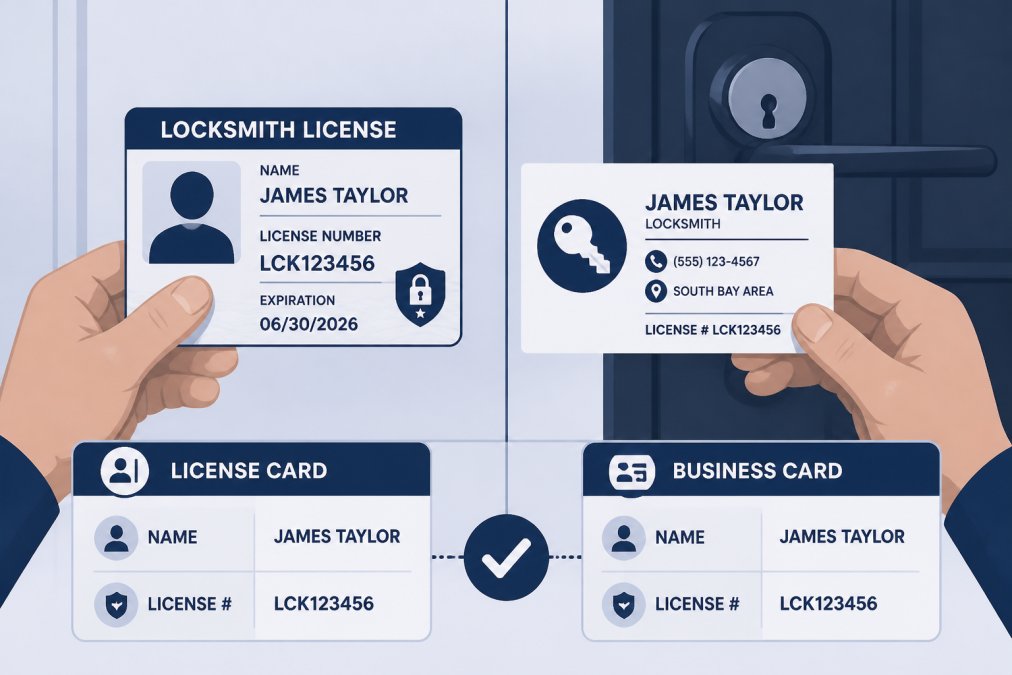
Ask these three questions:
- What’s the legal name of your company?
- What name is on your license?
- What number did I call to reach you?
If the answers don’t line up, stop. Generic vans with no markings are a common warning sign, and our article on why to avoid locksmiths with generic van markings explains what those unmarked vehicles usually signal. A real company puts its name where customers can see it.
Locksmith Proof of Insurance: What the Certificate Should Show
A valid certificate of insurance shows four things: the insured business name, the policy type, the coverage period, and the insurer. Check that the business name matches the license. Check the dates. A current certificate has an expiration date in the future.
Ask the technician to send a copy by email before work starts. Legitimate operations do this without friction. If you get excuses about the office being closed or the certificate being “in the truck,” treat it as a no.
The coverage question matters most when something goes wrong. If a technician snaps a deadbolt or gouges a door frame, liability coverage is what pays for the fix. Without it, you’re negotiating with an individual who may simply stop answering calls. Our explainer on professional locksmith liability insurance breaks down what a policy should and shouldn’t cover.
Employee License vs Company License: Who Is Actually Covered
Here’s a distinction most homeowners miss. Some states license the company. Others license each individual technician. A few require both. The document you should inspect depends on which model applies, and the person standing at your door may not be covered by the credential you verified.
The Three Models and What to Ask For
- Company-licensed model. The business holds the license; individual technicians may not carry their own. Ask for the company license number and confirm the technician is on staff. A quick call to the company’s published number settles it: ask whether the person at your door is an employee or a subcontractor.
- Individual-licensed model. Each technician holds a license card or pocket card. Ask for the technician’s own credential, not just the company’s registration. Verify the name and license number through the official lookup, and confirm the photo matches the person in front of you.
- Dual model. Both the company and the technician are licensed. Check both. A valid company license does not cure an expired or missing individual credential.
Worked Example: What a Mismatch Looks Like
Suppose the company license checks out, but the technician’s name is not on the company’s published staff list and the technician cannot produce an individual license in a state that requires one. That combination is a pause signal. It may mean the company dispatched a subcontractor, or it may mean the technician is not covered by the credential you verified. Either way, ask the company to confirm in writing who is authorized to perform the work at your address. If the answer is vague, request a different technician or decline service.
Subcontractors and Dispatch Networks
A company license does not automatically cover every employee who shows up, and it rarely covers a subcontractor from another business. Bait-and-switch operations often rely on this gap: the company you called has a license, but the person dispatched works for someone else. The pattern is consistent: the quote changes at the door, and the credential story gets vague. Our guide to avoiding locksmith bait and switch walks through how those tactics work and what they look like in the moment.
If the technician arrives in an unmarked vehicle, cannot name the company that dispatched them, or gives a company name that differs from the one on your phone screen, stop and verify before any work begins. Generic vans with no markings are a common warning sign, and our article on why to avoid locksmiths with generic van markings explains what those unmarked vehicles usually signal.
A Quick Decision Path
- Identify your state’s model: company, individual, or both.
- Ask for the credential that model requires, and write down the number.
- Verify it through the official lookup.
- Confirm the technician is an employee or an authorized subcontractor by calling the company’s published number.
- If any answer does not match, request another technician or decline service.
A real company puts its name where customers can see it and can tell you, without hesitation, who is authorized to work at your address. If the answers don’t line up, stop.
Spotting Forged, Expired, or Mismatched Credentials
Fake credentials are rarer than expired ones, but both happen. Watch for these signs:
- The license number doesn’t return a result in the official lookup
- The name on the card differs from the name on the license
- The expiration date has passed
- The photo on the ID doesn’t match the technician
- The company name on the card uses a slight variation of a real business
Bait-and-switch operations often pair a low phone quote with a technician who arrives under a different company name. Our guide to avoiding locksmith bait and switch walks through how those tactics work and what they look like in the moment. The pattern is consistent: the quote changes at the door, and the credential story gets vague.
One more check. Look up the phone number you called. If it routes to a call center that dispatches whoever is closest, the person at your door may have no connection to the company you thought you hired.
Questions to Ask Before Hiring a Locksmith
These questions to ask before hiring a locksmith separate professionals from operators. Ask them on the phone, before anyone is dispatched.
- What’s your license number, and which agency issued it?
- Are you licensed, bonded, and insured? Can you email proof?
- Is the technician coming an employee or a subcontractor?
- What’s the written estimate, including any after-hours fee?
- Will you provide a receipt with the company’s legal name?
A professional answers all five without irritation. BDS Locksmith is licensed, bonded, and insured.
Checking Credentials in States Without Locksmith Licensing
Not every state licenses locksmiths. If yours doesn’t, you can’t verify a license that was never issued. You still have options.
Check for a local business license through your city or county. Ask for proof of insurance, which any serious operator carries regardless of licensing rules. Confirm the business address and look it up. Ask how long the company has operated in the area.
Without a state license, insurance becomes your main protection. A bonded, insured company has skin in the game. An uninsured one doesn’t. Lean harder on the insurance check, the ID match, and the written estimate. Those three carry most of the weight when the license lookup comes up empty.
What to Do When a Locksmith’s Credentials Don’t Check Out
If the license lookup fails, the insurance certificate is expired, or the names don’t match, don’t let them start. Send them away. You are not obligated to let anyone work on your property.
Then do three things:
- Call the company’s published number and report what happened
- File a complaint with your state or local consumer protection office
- Call a different locksmith and run the checklist again
If you’re locked out and time is short, ask the dispatcher to confirm credentials before arrival. A legitimate company will do it. If they won’t, that’s your answer.
Frequently Asked Questions
What credentials should I ask a locksmith to show?
Ask for a state or local license card with a number you can look up, a certificate of insurance showing general liability coverage, and a business card whose company name matches the vehicle and the invoice. In states without licensing, ask for proof of insurance and a written estimate instead. Write down the license number and call the regulator while the technician is still at your door, before any work begins.
How do I check a locksmith license and insurance before letting them work?
Start with the license number on the technician’s card, then search it in your state or city licensing database or call the issuing agency. For insurance, ask for a certificate of insurance naming the company, the policy period, and the coverage limits, then call the insurer’s number on the certificate to confirm the policy is active. A legitimate locksmith will wait a few minutes for you to do this.
Do you have to be certified to be a locksmith?
It depends on where you live. Some states and cities require locksmith licensing with background checks, exams, and registration cards, while others have no statewide license at all. Certification from a trade association is voluntary and separate from a government license. Always check your own state and city rules, because a credential that is mandatory in one place may not exist in another.
What should I do if a locksmith cannot prove their credentials?
Do not let them start work. Ask them to leave, and if they refuse or demand payment for a service you did not approve, call local law enforcement and report the incident to your state consumer protection office. Then contact a licensed, insured company directly. Getting a written estimate by phone or text before dispatch, and confirming the license number, prevents most of these situations.
A credential check takes five minutes and protects your home, your vehicle, and your wallet. If you’re in the South Bay Area and want a locksmith who hands over license and insurance details without being asked, call BDS Locksmith at (408) 300-4369. We’re licensed, bonded, and insured, we provide free estimates before any work starts, and we offer same-day service for lockouts, re-keys, and lock installs. Get started with BDS Locksmith and know exactly who is working on your door.