Last Updated: October 24, 2026
Quick Summary
Generic van markings are a serious warning sign because the vehicle tells you nothing about who is inside it, who employs them, or who to call if something goes wrong. A real locksmith business puts its name, phone number, address and website on its vehicles so you can verify the business in seconds.
- A properly marked locksmith van shows the company name, phone number, business address or service area, and website.
- Ask for the legal business name, license number, proof of insurance and a written estimate before work starts.
- Dial the number printed on the van from your own phone to confirm it reaches the dispatcher you spoke with.
- If the van or technician does not match your booking, decline the service and owe nothing for work not started.
- Snap a photo of the van’s markings and the technician’s ID before work begins as a record or evidence.
Table of Contents
- What Generic Van Markings Actually Tell You
- Locksmith Scam Warning Signs to Watch For
- How to Verify a Locksmith’s License and Insurance
- Questions to Ask a Locksmith Before Hiring
- Getting a Locksmith Price Estimate Before Work Starts
- Your Arrival-Day Verification Checklist
- When the Van or Technician Doesn’t Match the Booking
- Unnecessary Drilling and Lock Damage: A Costly Red Flag
- Reporting a Suspected Locksmith Scam and Documenting Evidence
- Booking a Locksmith Who Shows Up Properly Identified
- Frequently Asked Questions
What Generic Van Markings Actually Tell You
A locksmith with generic van markings is a serious warning sign. The vehicle tells you nothing about who is inside it, who employs them, or who to call if something goes wrong. At BDS Locksmith, we have watched too many homeowners and drivers learn this lesson the hard way. The van pulls up, the tech gets you back inside, and then the bill arrives at three times the phone quote.
Here is the core problem. A real locksmith business puts its name on its vehicles because it wants you to find it again. Generic van markings do the opposite. They make the technician hard to trace.
Generic van markings are vehicle graphics that show no company name, no business address, no phone number, or only a vague logo that means nothing. Sometimes the van is completely blank. Sometimes it says something like “24 Hour Locksmith” with no other detail. Both are red flags.
What a Properly Marked Service Vehicle Looks Like
A properly marked locksmith van shows four things clearly:
- The company name in large, readable letters
- A phone number you can call and confirm
- A business address or service area
- A website you can check before work starts
That is it. No mystery. The markings exist so you can verify the business in seconds. When a van shows up with none of this, you have no way to confirm who you hired.
Locksmith Scam Warning Signs to Watch For
Locksmith fraud follows patterns. The Federal Trade Commission’s consumer advice on avoiding scams warns that fake lockout services often use generic vehicles and unmarked tools to avoid being identified later.
Here are the signs that matter most:
- A blank or generic van with no company details
- A phone quote that sounds too low compared to other estimates
- No written estimate before work starts
- Pressure to pay in cash with no receipt
- A demand for extra payment once the lock is already open
- Drilling before trying lock picking on a simple lockout
Bait and switch is the most common tactic. The dispatcher quotes a low service call fee on the phone. The technician arrives, opens the door, and then adds charges for labor, parts, and “emergency” rates. You are standing in your doorway with no use.
If you want to understand how these tactics work in detail, read our guide on avoiding locksmith bait and switch.
How to Verify a Locksmith’s License and Insurance
Verification takes about five minutes and protects you from almost every scam on this list. A legitimate locksmith should be able to prove three things: business identity, license status, and insurance coverage.
Ask for the company’s legal business name first. Then ask for the license number. Many states and cities require locksmiths to hold a license, and requirements vary by location. Check with your state’s consumer protection office or licensing board to confirm the number is real and active.
Insurance matters just as much. If the technician damages your door or lock during the job, insurance is what covers the repair. A company that cannot show proof of insurance is a company that will leave you holding the bill.
What Proof to Ask For Before You Let Anyone Touch Your Lock
Ask for these before the technician starts work:
- Legal business name and phone number
- License number, if your state requires one
- Proof of insurance or a certificate of coverage
- A written estimate with the total price
- A business address or website you can check
A professional will hand these over without hesitation. A scam operation will make excuses, stall, or claim the paperwork is “in the truck.”
For a step-by-step walkthrough of this process, see our guide on how to verify a locksmith license and insurance.
Questions to Ask a Locksmith Before Hiring
The right questions cut through most of the risk. Ask them on the phone, before anyone is dispatched.
- “What is your legal business name?” A real company answers immediately. A call center may hesitate or give a name that does not match anything online.
- “Can you give me a written estimate before work starts?” The answer should be yes.
- “Are you licensed and insured in my area?” Ask for proof, not just a yes.
- “Will the technician arrive in a marked vehicle?” This is where generic van markings get exposed.
- “What is the total price, including the service call fee?” Get the full number, not a teaser rate.
- “What payment methods do you accept, and will I get a receipt?” Cash-only with no receipt is a red flag.
Write the answers down. If the person who arrives gives different answers, you have your proof that something is wrong.
Getting a Locksmith Price Estimate Before Work Starts
A written estimate is your best protection against unexpected charges. Get it before the technician touches the lock, and make sure it lists the service call fee, the labor charge, and any parts separately.
Phone quotes are not estimates. They are marketing. The real number should come in writing, or at minimum be confirmed by text or email before work begins.
A fair quote covers:
- The service call fee to get to your location
- The labor charge for the lockout or repair
- Parts, if a lock or key needs replacing
- Any after-hours or emergency fee, stated clearly
If a technician refuses to put a number in writing, stop. That is your exit. For a realistic sense of what a fair quote looks like, check our residential lockout pricing range before you call anyone.
Your Arrival-Day Verification Checklist
The van is in your driveway. Now what? Run this checklist before you let anyone near your lock.
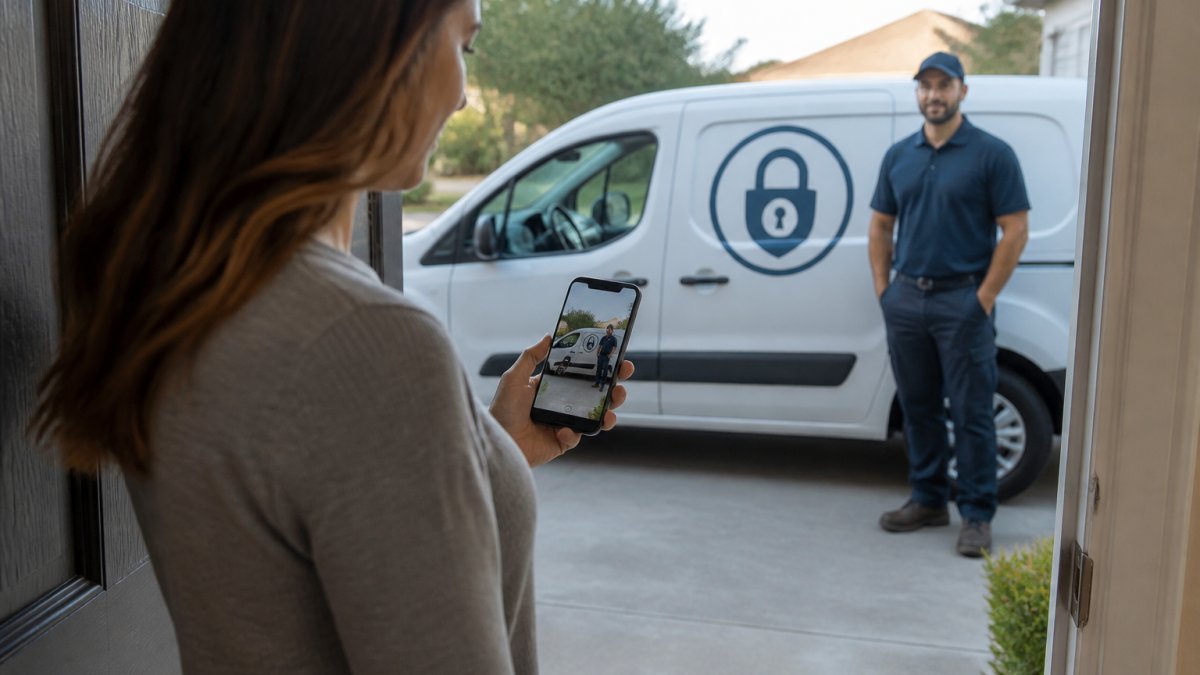
- Does the van have a company name, phone number, and website?
- Does the name on the van match the company you called?
- Is the technician wearing a uniform or carrying ID?
- Does the technician confirm the quoted price before starting?
- Do you have a written estimate in hand?
- Is the phone number on the van the same one you dialed?
If any box stays unchecked, ask questions before work begins. A legitimate technician will not mind. A scam operator will get pushy, and that pushiness is your answer.
How to Compare the Van to Your Booking
Do not treat a blank van as automatic proof of fraud, and do not treat a wrapped van as automatic proof of legitimacy. The check that matters is whether the vehicle and technician match the specific business you contacted. Work through these comparisons in order:
- Company name. Read the name on the van door and compare it to the legal business name you were given on the phone. A vague label like “Locksmith Services” or “24 Hour Locksmith” with no company name is a warning sign because it gives you nothing to trace if the job goes wrong. A name that differs from your booking is a bigger warning sign.
- Phone number. Dial the number printed on the van from your own phone while the technician is standing there. If it rings to the same dispatcher you spoke with, the markings and the booking line up. If it rings nowhere, goes to a different company, or the technician cannot explain the number, pause.
- Website and address. A real business lists a website or a service area you can check in seconds. Look it up on your phone before work starts. A site that was registered recently, has no address, or lists a different city than the one you are in is a reason to ask more questions.
- Technician identification. Ask for the technician’s name and, where required, a license or company ID. Compare the name to what the dispatcher told you. A technician who cannot name the company that dispatched them, or who gives a name that does not match the booking, is a mismatch.
- Written estimate. Confirm the total price in writing before any tool touches the lock. The number on the estimate should match the number you were quoted on the phone, including the service call fee.
Snap a photo of the van’s markings and the technician’s ID before work begins. If everything checks out, you have a record. If it does not, you have evidence for a complaint.
What to Do When a Box Fails
A failed check is not a reason to argue in your driveway. It is a reason to slow down. Tell the technician you need a moment, step back inside or to your phone, and call the number you originally dialed. Confirm whether that company dispatched this person. If the dispatcher cannot confirm the technician, or the details do not line up, decline the service. You owe nothing for refusing work that has not started.
A legitimate operation expects this check and will wait. A scam operation will pressure you to skip it, which tells you what you need to know.
Run through these checks before you let anyone near your lock.
| Check | What to confirm |
|---|---|
| Van markings | Company name, phone number, and website on the van |
| Name match | Name on the van matches the company you called |
| Technician ID | Uniform or ID shown by the technician |
| Quoted price | Technician confirms the quoted price before starting |
| Written estimate | Written estimate in hand before work begins |
| Phone number | Number on the van is the same one you dialed |
When the Van or Technician Doesn’t Match the Booking
This happens more than people expect. You call one company, and a different one shows up. Or the van is blank, or the technician cannot name the dispatcher you spoke with. The mismatch itself is the signal: it usually means a call center routed your job to whoever was closest, and that middleman adds cost without adding accountability.
Here is what to do, in order:
- Do not let them start work. Once the lock is picked or drilled, your leverage disappears. Keep the door closed or stay outside the vehicle until the details are confirmed.
- Call the number you originally dialed. Ask the dispatcher to confirm the technician’s name and the company that was sent. Write down what they say. If the dispatcher cannot confirm the technician, treat that as a failed match.
- Ask the technician for their name, company, and ID. Write it down. Compare it to what the dispatcher told you. A technician who cannot name the company that dispatched them is a mismatch.
- If the details do not match, decline the service. Say clearly that you are not proceeding and ask them to leave. You owe nothing for work that has not started. Do not hand over a card, a deposit, or a “diagnostic” fee to make them go away.
- Document the mismatch before you part ways. Note the van’s markings (or lack of them), the technician’s name, the time, and what was quoted versus what was said on arrival. A photo of the van and any paperwork is worth more than a memory.
- Report the incident if you suspect a scam operation. See the reporting section below for where to file.
Do not get into a negotiation at the curb. A mismatch is not a pricing problem to solve on the spot; it is a reason to stop and re-verify. If the technician becomes pushy or refuses to leave, call local law enforcement non-emergency line and ask for assistance.
Why a Mismatch Matters More Than a Blank Van
A blank van is one data point. A mismatch between the booking and the person who arrives is a stronger signal because it breaks the chain of accountability. If the company you called cannot confirm who is at your door, then no one is responsible for the price, the workmanship, or the damage. That is the specific risk generic markings create: not that every unmarked van is a scam, but that a vague or mismatched vehicle makes follow-up and recourse difficult when something goes wrong.
After You Decline: What to Do Next
Declining is not the end of the process. Call a different provider, and this time ask the booking questions from the earlier section before anyone is dispatched. When the next technician arrives, run the arrival-day checklist again. If you kept notes or photos from the first visit, hold onto them, they are the basis for a complaint if you decide to file one.
If you already let a mismatched technician start work and the bill changed, document the quote versus the charge and read our guide on what to do if a locksmith damages your door before you pay anything you did not agree to.
Unnecessary Drilling and Lock Damage: A Costly Red Flag
A skilled locksmith picks most locks. Drilling is a last resort for damaged or high-security locks, not a first move on a simple home lockout.
If a technician reaches for a drill within the first few minutes, ask why. Legitimate reasons exist, but they should be explained before the drill goes in. A common scam is to drill a lock that could have been picked, then charge for a replacement lock on top of the labor.
Watch for these signs:
- Drilling before attempting lock picking
- No explanation for why drilling is needed
- A sudden claim that the lock “had to be replaced”
- Damage to the door frame or strike plate
If a locksmith damages your door or lock during the job, you have options. Our guide on what to do if a locksmith damages your door walks through the steps to document the damage and seek a fix.
Reporting a Suspected Locksmith Scam and Documenting Evidence
Reporting protects you and the next person who calls that number. The Better Business Bureau’s scam reporting guidance recommends documenting everything before you file a complaint.
Collect this evidence:
- The phone number you called and any texts or emails
- The van’s markings, or a photo showing there were none
- The technician’s name and any ID they showed
- The receipt or invoice, including every charge
- Photos of any damage to your door or lock
- Notes on what was quoted versus what was charged
File a report with your state attorney general’s consumer protection division and your local consumer affairs office. The Consumer Financial Protection Bureau’s complaint process also accepts reports on unfair billing practices. Keep copies of everything you submit.
Booking a Locksmith Who Shows Up Properly Identified
The safest booking is the one you make with a company that expects to be checked. A professional operation wants you to see its name, its license, and its estimate in writing. That transparency is the whole point of proper vehicle markings.
At BDS Locksmith, our vans carry our name and number because we want you to know exactly who is at your door. We are licensed, bonded, and insured, and we will show you proof before we touch a lock. Our technicians arrive in marked vehicles, give free estimates upfront, and offer same-day service across the South Bay Area. Active military members get a 5% discount. If you want a reliable method for finding a trustworthy provider, read our guide on how to find reliable 24/7 locksmiths.
Frequently Asked Questions
Does an unmarked van always mean a locksmith is a scammer?
No. A generic van is a warning sign, not proof of fraud. Some legitimate one-person operations run plain vehicles. What matters is whether the technician can back up the vehicle with verifiable details: a business name that matches your booking, a company phone number, a physical business address, a website, and credentials you can check. If the technician cannot produce those, treat the missing identity as a red flag and do not authorize work until you confirm the company by phone.
How do I verify a locksmith’s license and insurance before they arrive?
Ask for the company’s legal business name, license number, and proof of insurance before dispatch, then confirm them independently. Call the number listed on the company’s own website rather than the number on the van, and ask the dispatcher to confirm the technician’s name and arrival window. Request a certificate of insurance showing current coverage. A professional locksmith should answer these questions without hesitation; a scam operation typically deflects or pressures you to skip the checks.
Should a locksmith give a price estimate before starting work?
Yes. Ask for a written estimate covering the service call, labor, and any parts before anyone touches the lock. Confirm whether the quote is a flat rate or an hourly charge and what could change it. If the technician arrives and the price jumps well beyond the estimate, stop and ask for the reason in writing. Unexpected charges and demands for extra payment are among the most common locksmith scam warning signs, and a documented estimate is your best protection.
What should I do if the locksmith drills my lock unnecessarily?
Most standard home and car lockouts can be opened with lock picking or non-destructive entry. If a technician jumps straight to drilling without trying gentler methods, ask why and request they attempt a non-destructive approach first. If damage occurs, photograph the door and lock, keep the receipt, and get the company’s name and business address in writing. You can then dispute the charge and report the incident to your state consumer protection office or local police.
A blank van at your curb is not a small detail. It is the first sign that nobody is accountable for the work about to happen. BDS Locksmith sends clearly marked vehicles, licensed and insured technicians, and a written estimate before any work begins. We offer 24/7 emergency service, free estimates, and same-day availability across the South Bay Area. Call (408) 300-4369 and get a locksmith who shows up properly identified.