
Last Updated: November 1, 2026
Quick Summary
High security locks protect military housing by combining hardened cylinders, restricted keyways, and reinforced hardware that resist forced entry and unauthorized key duplication. Their biggest benefit is key control: documented issuance, rekeying at turnover, and audit trails show who can open each door.
- Restricted key systems require authorization to copy keys, so residents cannot cut spares at a hardware store.
- Rekey cylinders at every move-out, since a missing key is not visible during inspection.
- Use a tiered master key system so one lost key does not force a full-property rekey.
- Specify ANSI/BHMA Grade 1 hardware for high-traffic unit and common-area doors.
- No security upgrade should ever require a key to exit a unit during an emergency.
Table of Contents
- Why High Security Locks Matter in Military Housing
- What High Security Locks Are and How They Stop Forced Entry
- Restricted Key Systems: Ending Unauthorized Key Duplication
- Key Control for Multi-Unit Housing: Residents, Staff, and Contractors
- Lock Rekeying After Tenant Turnover: Closing the Gap
- Electronic Access Control for Housing: Keyless Entry and Audit Trails
- Emergency Access, Evacuation, and Life Safety Compliance
- Procurement Standards, Certification, and Whole-Door Security
- Schedule a High Security Lock Assessment for Your Property
- Frequently Asked Questions
Why High Security Locks Matter in Military Housing
Military housing presents a security problem that most residential lock advice never addresses. Residents rotate in and out on orders, maintenance staff and contractors need regular access, and dozens of people may hold keys to a single unit over the course of a few years. That combination creates exactly the conditions where ordinary locks fail.
Across property management, the locks themselves are rarely the weak point. Key control is. When keys circulate without a record of who holds them, a deadbolt with a solid cylinder still doesn’t tell you who came through the door last month.
What separates military housing from a typical apartment complex is the threat model. Four conditions recur, and each one changes what a lock system has to do.
Shared buildings and common entries. Many units sit behind a shared entry, a stairwell, or a corridor that serves several households. A single compromised common-door credential exposes every unit behind it. High security hardware on the unit door helps, but the building entry and any controlled-access interior doors need the same standard, or the weakest door sets the risk for the whole stack.
Controlled-access areas. Storage cages, mailrooms, laundry rooms, mechanical closets, and bike rooms are shared by definition and often secured with the same key as a unit or with a generic utility key. These are the doors where a restricted keyway and a documented issue list matter most, because the population with access changes constantly and no one owns the key inventory.
Deployment-related absences. When a resident is away for an extended period, the unit sits empty with predictable patterns. An unoccupied unit with a standard cylinder and an unrecorded spare key is a soft target. Restricted keys, a rekey at turnover, and an audit trail on any electronic access close the gap between “the door is locked” and “we know who can open it.”
Installation constraints. Military housing often involves steel frames, pre-hung doors, fire-rated assemblies, and hardware that must match an existing master key system. You cannot always swap a cylinder freely, and you cannot compromise a fire-rated door’s labeling. A lock that is excellent on a wood residential door may be the wrong specification here, which is why the assessment step matters more than the product brochure.
The 8 sections that follow are built around the questions property managers ask us most often. But first, here’s what most guides get wrong: they treat a lock as a single product. In practice, security comes from the whole assembly, the cylinder, the strike plate, the door frame, and the key policy behind it.
What High Security Locks Are and How They Stop Forced Entry
High security locks are locking systems engineered to resist covert entry techniques and key duplication, typically combining hardened cylinders, restricted keyways, and reinforced hardware. They raise the time and skill required to defeat a door, which is the variable that matters most in a forced-entry attempt.
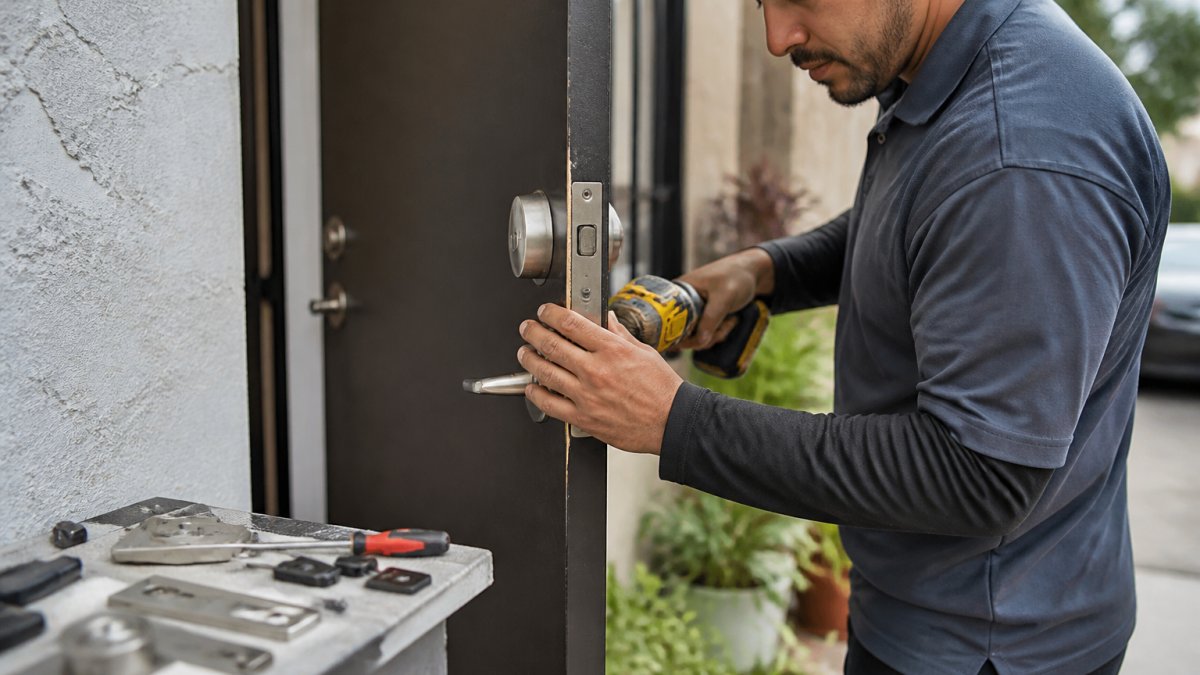
The mechanics are straightforward once you see them. Standard cylinders can be picked, bumped, or drilled by someone who knows the technique. High security cylinders generally add hardened steel inserts, rotating or telescoping pins, and in some designs a secondary locking mechanism that engages when someone tries to drill. Bumping, the practice of using a specially cut key to jolt pins into position, depends on a predictable pin stack; restricted keyways and security pins disrupt that predictability.
Forced entry rarely means picking, though. More often it means kicking, prying, or attacking the frame. That’s why the lock body alone isn’t enough. A quality deadbolt paired with a thin strike plate and a hollow frame gives way under use regardless of cylinder grade. Door reinforcement, longer strike-plate screws that reach the stud, and multipoint locking on the door edge are what convert a good lock into a resistant assembly.
For a closer look at how these systems go in, our high-security lock installation guide walks through the steps and tools involved.
Restricted Key Systems: Ending Unauthorized Key Duplication
Restricted key systems are locking setups where keys can only be copied through a controlled authorization process, using a patented keyway. The practical effect is that a resident cannot walk into a hardware store and cut a spare for a friend, a subletter, or anyone else.
This is the single biggest change a property manager can make in military housing. Standard keys get duplicated constantly, often with good intentions: a spouse copies one for a parent visiting, a roommate copies one for a partner. Each copy is an unrecorded credential. Multiply that across a housing complex with regular turnover and the key inventory becomes unknowable.
With a restricted system, every key is issued against a signature card or authorization record. When a key is lost, you know exactly which one, and rekeying is targeted rather than a full-building project.
The trade-off is administrative: someone has to maintain the authorization list, and replacing a lost key takes a phone call rather than a trip to the hardware store. In practice, that friction is the point. It’s what makes the system work.
Key Control for Multi-Unit Housing: Residents, Staff, and Contractors
Key control for multi-unit housing is the documented process of tracking who holds which keys, under what authority, and for how long. It covers three distinct groups, and each needs a different rule set.
- Residents: issued a unit key and a common-area key, with a signed receipt and a clear return obligation at move-out.
- Staff: issued master keys or sub-master keys scoped to the buildings they service, never a full master unless the role requires it.
- Contractors: issued temporary keys or escorted access, with a log of entry and a defined return window.
The mistake we see most often is a single master key that opens everything, handed out broadly because it’s convenient. One lost master and the entire property needs rekeying. A tiered master key system, where each key opens only its assigned zone, limits the blast radius of a loss.
If you’re setting this up from scratch, our master key system installation guide covers the planning and hardware side.
Each group that touches a unit needs its own rule set for keys and access.
| Group | What they receive | Control measure |
|---|---|---|
| Residents | Unit key and common-area key | Signed receipt and return obligation at move-out |
| Staff | Master or sub-master keys scoped to serviced buildings | Never a full master unless the role requires it |
| Contractors | Temporary keys or escorted access | Entry log and defined return window |
Lock Rekeying After Tenant Turnover: Closing the Gap
Lock rekeying after tenant turnover is the practice of changing a cylinder’s pin configuration so old keys no longer work, without replacing the lock body. It’s faster and less expensive than a full replacement, and in military housing it should be treated as mandatory at every move-out.
The gap it closes is simple. When a unit changes hands, the departing resident may still hold a key, may have given one to a neighbor, or may have left one somewhere. Without rekeying, the new resident’s security depends on assumptions about someone else’s behavior.
A rekey is typically quick per cylinder and preserves the existing hardware, which matters when you’re managing dozens of units on a maintenance budget. Pair it with a restricted key system and the rekey becomes even more targeted: you change the cylinder, issue new restricted keys, and the old ones are dead.
Watch out: skipping rekeying because the unit “looks clean” is the most common way turnover gaps persist. A missing key isn’t visible during an inspection.
Electronic Access Control for Housing: Keyless Entry and Audit Trails
Electronic access control for housing replaces or supplements mechanical keys with keyless entry: PIN codes, fobs, cards, or mobile credentials. The feature that changes property management most is the audit trail, a timestamped record of every entry by credential.
That record answers questions mechanical locks cannot. Who entered the maintenance closet on Tuesday? Did the contractor badge in at the time they claimed? When a resident reports a missing item, an audit trail either supports or rules out an unauthorized entry.
Keyless entry also solves the turnover problem elegantly. Instead of rekeying, you revoke a credential and issue a new one. No hardware change, no locksmith visit for the routine case.
The caveats are real. Electronic locks depend on power and network, so you need an outage plan: battery backup, mechanical override, or a documented fallback. Cybersecurity matters too, since a poorly configured system can expose credentials or lock schedules. And the hardware costs more upfront than a mechanical cylinder. For a buyer’s-level view of system options, our commercial access control buyer’s guide covers the categories and what to evaluate.
Emergency Access, Evacuation, and Life Safety Compliance
Emergency egress is the requirement that occupants can exit a building without a key, special knowledge, or tools during a fire or other emergency. It is non-negotiable, and it constrains every security decision above.
This is where security and safety can appear to conflict. A deadbolt that keeps intruders out can also keep a panicked resident in if it requires a key on the inside. The resolution is hardware that allows free egress from the inside while remaining secure from the outside: single-cylinder deadbolts with a thumb turn, panic hardware on common-area doors, and electronic systems with fail-safe release tied to the fire alarm.
For property managers, the practical rule is that no security upgrade should ever require a key to leave a unit. Before installing anything, confirm the exit hardware meets local fire and building code, and check with the authority having jurisdiction. The NFPA resources on life safety and egress are a useful starting reference for the code language.
Emergency access for staff is a separate question: a documented, audited way for management to enter a unit in a genuine emergency, with a record of who used it and why.
Procurement Standards, Certification, and Whole-Door Security
Procurement standards are the specifications a property requires locks and hardware to meet before purchase. For military housing, they should be written down, referenced in contracts, and applied consistently across every unit. The goal is to replace marketing claims with testable requirements a vendor can be held to.
A practical standard answers four questions.
1. What grade and certification does the hardware carry? In the U.S., the reference point is the ANSI/BHMA A156 series, which grades cylindrical and tubular locks, deadbolts, and auxiliary hardware by durability, strength, and finish performance. Grade 1 is the highest residential/commercial tier and the one to specify for high-traffic unit and common-area doors; Grade 2 is a reasonable middle tier for lower-traffic interior doors; Grade 3 is builder-grade and generally too light for shared entries. Ask for the listing or test report, not just the word “commercial.” For fire-rated doors, confirm the hardware is listed for use on a fire door assembly and that any modification preserves the door’s labeling. ANSI/BHMA lock grading standards is a useful starting reference for the grade language.
2. Is the whole door assembly specified, or just the lock? A certified cylinder on an unreinforced frame is a false economy. The standard should name the strike plate (heavy-duty, with screws long enough to reach the framing stud), the frame reinforcement or security strike, hinge screws, and, where the door and budget allow, multipoint locking on the edge. On shared and exterior doors, glazing and the door material belong in the specification too, because a strong lock next to a breakable panel protects nothing.
3. What is the key and credential policy? Define restricted keyways, the authorization procedure for issuing keys, the rekey requirement at turnover, and the process for revoking electronic credentials. Put this in the contract as a deliverable, not an afterthought. A vendor who cannot document key issuance is not meeting the standard.
4. What does the hardware cost over its life? Lifecycle cost belongs in the standard. Compare purchase price against expected service life, availability of replacement cylinders and parts, and the labor to rekey or reprogram at each turnover. A cheaper lock that fails or needs frequent service costs more over a decade than a certified unit installed once. Durability under heavy use, vandalism resistance, and parts availability all factor in.
Two compatibility checks save expensive mistakes. First, confirm new hardware works with any existing master key system rather than forcing a parallel system. Second, confirm electronic access control integrates with the property’s existing credentials and, where required, releases correctly on fire alarm. A short written standard, applied to every unit and every vendor bid, is what turns “high security” from a label into a specification.
Schedule a High Security Lock Assessment for Your Property
An assessment is the step that turns everything above into a plan for your specific buildings. It looks at your doors, frames, existing cylinders, key inventory, and access patterns, then recommends what to change first.
We handle this on-site, and we’ll give you a free estimate before any work begins. Our team is licensed, bonded, and insured, and we offer same-day service for urgent needs. Military-affiliated residents and staff can also ask about our military discount.
If you’re ready to move, you can call us at (408) 300-4369 to schedule an assessment. You can also visit our locksmith Contra Costa County page to request service.
High security locks only deliver their benefits when the whole system holds together: certified hardware, restricted keys, documented key control, and egress that never depends on a key. BDS Locksmith installs and services high security locks, master key systems, and electronic access control for residential and commercial properties, with free estimates, competitive pricing, and on-site mobile service. Get started with BDS Locksmith and secure your property with hardware and key control that hold up to real turnover.
Frequently Asked Questions
What makes a lock high security?
A high security lock combines hardened steel components, a protected cylinder that resists drilling and bumping, and a restricted keyway that only authorized personnel can duplicate. Reinforced strike plates and multipoint locking add force resistance against leverage attacks. The result is a lock that resists picking, forced entry, and key duplication at the same time, which is why housing managers pair them with key control policies rather than treating the lock as a standalone purchase.
How do high security locks help prevent unauthorized key duplication?
Restricted key systems use patented keyways and blanks that only the lock manufacturer or an authorized dealer can cut. Residents cannot walk into a hardware store and copy a key, because the store will not stock the blank. Each key is issued against a registered serial number, so property managers know exactly how many copies exist and who holds them. When a key is lost, the affected cylinder is rekeyed or the credential is revoked, and the audit trail shows what happened.
Are high security locks suitable for apartment and multi-unit housing?
Yes. Multi-unit properties benefit most from master key systems that give maintenance staff one key to common areas while each resident key opens only their unit. Restricted keyways stop residents from duplicating keys for friends or subletters, and electronic access control adds time-stamped entry records for shared doors. Pair the hardware with a written key control policy covering issuance, return, and rekeying after tenant turnover so the system stays intact between leases.
What should housing managers consider before upgrading door locks?
Start with a door-by-door survey: frame condition, door material, existing deadbolt bore, and whether the door is on an emergency egress path. Confirm the hardware meets local fire and life safety codes so occupants can exit without a key. Budget for rekeying and key issuance, not just the cylinders, and set a written key control policy before the first key goes out. A licensed locksmith can document the existing master key structure so the upgrade does not lock out maintenance staff.