Last Updated: November 14, 2026
Quick Summary
If your key fob range suddenly dropped, the cause is almost always a weak fob battery, radio-frequency interference, damage inside the fob, or a fault in the vehicle’s receiver or antenna. Run a distance test and compare with your spare fob before replacing anything, since a depleted coin-cell battery is the most common cause.
- Stand about 30 feet from the car and press unlock, walking closer until it responds to mark your current response distance.
- Most key fobs use a CR2032 or CR2025 coin-cell battery and most last between two and four years depending on use.
- Drive to a different location and repeat the distance test to rule out radio-frequency interference.
- If both fobs fail at the same short distance, the fault is on the vehicle side, not in the fob.
- A healthy fob should restore the original operating distance, typically 30 to 50 feet for most vehicles.
Table of Contents
- Why Your Key Fob Range Suddenly Shrank
- Run the Distance Test Before Anything Else
- Car Key Fob Battery Replacement: The Most Common Fix
- Key Fob Signal Interference: How to Test Your Location
- Key Fob Not Working Unless Close to Car? Read the Pattern
- Key Fob Receiver or Antenna Problem: Vehicle-Side Faults
- Fob Circuit Board and Button Damage You Can Spot Yourself
- Symptoms That Separate a Fob Fault From a Vehicle Fault
- When to Call a Mobile Locksmith Instead of a Dealership
- Frequently Asked Questions
Why Your Key Fob Range Suddenly Shrank
If your car key fob range suddenly reduced, the cause is almost always one of four things: a weak fob battery, radio-frequency interference at your location, damage inside the fob, or a fault in the vehicle’s receiver or antenna. The order you test things in matters more than the tests themselves.
Here is the good news. Most cases trace back to a battery that costs less than a coffee. A smaller share are interference, and the smallest group are genuine hardware faults.
But first, here’s what most guides get wrong: they tell you to replace the battery immediately. That skips the one test that tells you whether the battery is even the problem.
Key fob range is the distance at which your remote control reliably sends a lock, unlock, or remote start signal to the vehicle receiver. When that operating distance shrinks, the signal strength between fob and car has dropped somewhere along the chain.
Below, we walk through a diagnostic sequence that isolates the cause before you spend a dollar.
Run the Distance Test Before Anything Else
Start with a controlled distance test, because guessing wastes time and money. A proper test tells you whether the problem is constant or intermittent, and whether it follows the fob or the car.
Pick a clear, open spot away from buildings, power lines, and busy parking lots. Then work through this sequence:
- Stand about 30 feet from the car and press unlock. Note whether it responds.
- Walk five feet closer and press again. Repeat until the car responds.
- Mark that spot. That is your current response distance.
- Repeat the test with your spare key fob, if you have one.
- Run the whole test a second time in a different location.
The comparison is the whole point. If the spare fob reaches the car from far away and your daily fob barely works up close, the fault sits in the fob. If both fobs fail at the same short distance, look at the vehicle side.
Intermittent response, where the fob works one minute and fails the next, usually points to a failing battery contact or interference rather than a dead battery. A dead battery fails consistently.
Car Key Fob Battery Replacement: The Most Common Fix
A depleted fob battery is the single most common cause of reduced range, and it is the cheapest thing to rule out. Most key fobs use a coin-cell battery, commonly a CR2032 or CR2025, and most last somewhere between two and four years depending on use. A fob that suddenly drops from 30 feet to a few feet, with no other symptoms, is a classic weak-battery pattern.
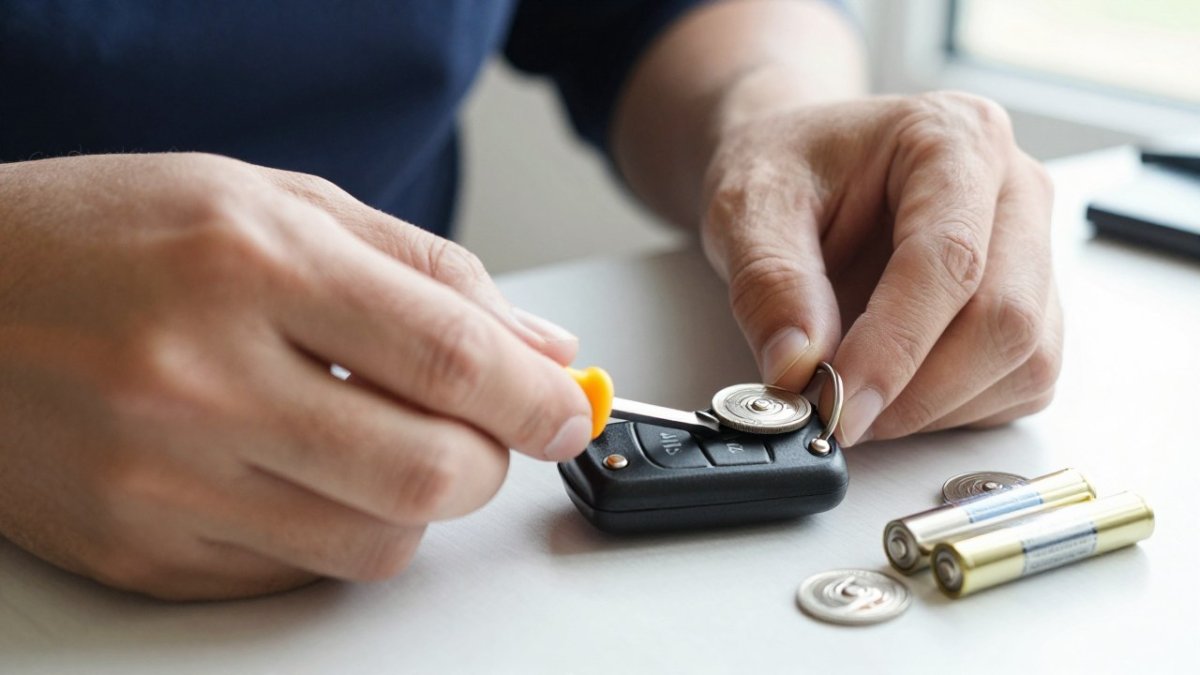
Identify the Correct Battery Before You Open the Fob
Do not guess the battery number. The correct cell is printed on the old battery itself and often on a label inside the fob shell. Write it down before removal. Common sizes include CR2032 and CR2025. They look nearly identical, but the thickness difference means a CR2025 in a CR2032 slot can fail to make contact, and a CR2032 in a CR2025 slot can prevent the shell from closing. Match the number exactly, including the voltage (coin cells are 3V).
Buy from a store with steady turnover, since an old battery starts weak. Check the date code on the package when available. Before you buy a cheap replacement fob or battery online, read up on the risks of buying aftermarket key fobs online so you know what you are getting.
Step-by-Step Replacement
- Press the button to release the emergency key blade, if your fob has one. The blade often doubles as a pry tool.
- Find the seam where the two halves of the shell meet. Many fobs have a small slot designed for the blade or a flathead screwdriver.
- Insert the tool into the seam and twist gently. Work around the seam rather than forcing one spot.
- Lift out the old battery without touching the new one’s flat surfaces. Skin oils add resistance.
- Note which side faced up before you remove it. The flat side with the plus sign usually faces up, but not always.
- Photograph the old battery in place before removal. That photo saves you a second trip to the store.
- Drop in the new battery with the same polarity.
- Snap the shell closed and test the range again.
Watch out: forcing the shell apart with too much pressure cracks the plastic tabs that hold it together, and a fob that pops open in your pocket is a fob you will be replacing.
Check the Battery Contacts While the Fob Is Open
A new battery will not fix a fob whose contacts are bent or corroded. With the battery out, look at the metal contact tabs. They should spring up slightly and sit clean. If a tab is flattened, gently lift it with a non-metallic tool. If you see green or white corrosion, clean it with a cotton swab and a small amount of isopropyl alcohol, then let it dry completely before installing the new cell. A contact that does not touch the battery firmly produces the intermittent response pattern described earlier.
Verify the Fix
After closing the shell, repeat the distance test from a clear spot. A healthy fob should restore the original operating distance, typically 30 to 50 feet for most vehicles, though some systems reach farther. If range improves but does not fully return, the battery was part of the problem but not all of it. Move on to the interference test and the spare-fob comparison. If range does not change at all, the old battery was not the cause, and you should preserve the old cell as a known-good spare while you diagnose further.
Key Fob Signal Interference: How to Test Your Location
Radio-frequency interference is the cause people overlook, and it produces sudden range loss that appears and disappears. Keyless entry systems run on radio frequency, and nearby electronics can drown out that signal.
Common culprits include:
- Cell phone towers and broadcast antennas
- Transformers and heavy electrical equipment
- Fluorescent lighting in some garages
- Other vehicles with active keyless systems
- Certain phone chargers and power banks
The test is simple. Drive the car to a different location, ideally a few blocks away or into an open lot, and repeat the distance test. If the fob works normally there, you have an interference problem, not a hardware failure.
Pay attention to where the failure happens. If the fob only dies in your driveway or your office garage, the location is the variable. If it fails everywhere, keep reading.
Key Fob Not Working Unless Close to Car? Read the Pattern
A key fob that only works when you are standing right next to the door is telling you something specific. The pattern of failure narrows the cause faster than any single test.
Use this table to match what you are seeing to the likely fault:
| Symptom Pattern | Likely Cause | Next Step |
|---|---|---|
| Works only within a few feet, every time | Weak fob battery | Replace the battery |
| Works fine in some places, fails in others | RF interference | Test at a different location |
| Works sometimes, fails randomly | Battery contacts or circuit damage | Inspect the fob internals |
| One fob fails, the spare works | Fob-side fault | Focus on that fob |
| Both fobs fail equally | Vehicle receiver or antenna | Inspect the vehicle side |
| Buttons feel mushy or need hard presses | Button or circuit board damage | Open and inspect the fob |
The most useful line in that table is the last two. A second fob is your best diagnostic tool, and it costs nothing to try.
If you do not have a spare, this is the moment to think about one. A failing fob tends to fail completely at the worst time, and programming a spare car key fob is far easier to arrange before that happens than after.
Key Fob Receiver or Antenna Problem: Vehicle-Side Faults
When both fobs fail at the same short distance, the problem lives in the car. The vehicle receiver and its antenna pick up the fob’s signal, and a fault there mimics a dead battery perfectly. The key distinction: a fob-side fault follows the fob, while a vehicle-side fault stays with the car no matter which fob you use.
Vehicle-side faults we see include:
- A disconnected or corroded antenna wire
- A receiver module that has lost power
- Water intrusion into the antenna housing
- A blown fuse feeding the receiver circuit
- A receiver module that has failed or lost its programming
What an Owner Can Safely Check
Start with the fuse box. Check the fuse that feeds the keyless entry system against the diagram in your owner’s manual. A blown fuse is a five-minute fix. If the fuse is good, move to the antenna.
Next, look at the antenna. In many cars it sits in the rear bumper, the pillar trim, or behind the dashboard. Look for a loose connector or green corrosion on the terminals. If the antenna wire is frayed or unplugged, the receiver hears nothing regardless of how strong the fob’s signal is. Do not disconnect or reposition the antenna unless your owner’s manual shows the connector and you can reach it without removing trim. On many late-model vehicles the receiver is integrated with the body control module, and the antenna is a printed trace on glass or a module behind a panel, which is not an owner-serviceable part.
A common pattern is that the problem appears after bodywork, a windshield replacement, or a bumper repair. Those jobs can disturb antenna connectors or ground points. If the range loss started right after a repair, tell the shop that did the work before you spend money elsewhere.
When a Scan Tool Is Required
This is the point where a professional scan helps. A shop with the right diagnostic tool can read receiver codes. A receiver that has lost power or failed will usually set a code, and a scan can distinguish a dead module from a wiring fault. Owners cannot reliably do this with a generic OBD-II reader, because body-module codes often require manufacturer-level software. Ask whether any diagnostic fee is applied to the repair if you proceed.
What Repair May Involve
If the receiver or antenna is faulty, repair can range from reseating a connector to replacing the receiver module and reprogramming it to the vehicle. Module replacement typically requires programming with a factory-level tool, which is why this work usually goes to a dealership or a locksmith with the right equipment. Ask for the diagnostic findings in writing before authorizing parts. If both fobs fail and the vehicle side needs diagnosis, a mobile locksmith can often confirm the fob side on-site and tell you whether the car needs a shop visit.
Fob Circuit Board and Button Damage You Can Spot Yourself
Physical damage inside the fob is more common than people expect, especially on fobs that live in a pocket with keys and coins. The circuit board is a thin board with small contact pads, and it does not take much to break a connection. A damaged connection can mimic a weak battery, so compare the symptoms before deciding what to inspect next with ADAM Keys & Remote.
Open the fob and look for these signs:
- Cracked solder joints around the battery contacts
- A battery contact that sits flat instead of springing up
- Dark or green corrosion on the board
- Buttons that no longer click
- A loose or missing rubber membrane under the buttons
A common mistake is pressing harder when a button stops responding. That pushes the contact pad down further and often makes the break worse.
If the board looks fine but the buttons feel dead, the fob may simply be worn out. If the fob itself is damaged beyond repair, step-by-step programming instructions for a spare fob will get you back to a working remote without a dealership visit.
Symptoms That Separate a Fob Fault From a Vehicle Fault
Telling a fob fault from a vehicle fault comes down to one question: does the problem follow the fob or stay with the car? Everything else is supporting evidence.
A fob-side fault usually looks like this:
- The spare fob works normally from a distance
- The failing fob needs close proximity every time
- Buttons feel stiff or unresponsive
- The fob has been dropped, wet, or washed
A vehicle-side fault usually looks like this:
- Both fobs fail at the same short distance
- The problem started suddenly with no fob damage
- Other remote functions, like the panic button or trunk release, also fail
- The car’s interior lights or other electronics act up
If the evidence points to the fob and a battery swap does not fix it, the fob needs repair or replacement. If it points to the car, a diagnostic scan is the fastest route to an answer.
When to Call a Mobile Locksmith Instead of a Dealership
Call a mobile locksmith when you have isolated the fault and need a repair, a replacement fob, or programming done on-site. A dealership can handle the work, but you will usually pay more and wait longer for an appointment.
Here is when professional help makes sense:
- The battery swap did not restore range
- The fob is damaged and needs replacement
- You need a new fob programmed to the car
- Both fobs fail and the vehicle side needs diagnosis
- You are locked out right now and need entry today
BDS Locksmith is licensed, bonded, and insured, and offers free estimates. The company also offers a 5% military discount and same-day service.
If you want to understand your options before you call, read our guide on finding a mobile locksmith for car keys. When you are ready, you can book mobile locksmith service in Alameda covering key fobs and automotive lockouts.
A fob that barely reaches the door is a warning, not a permanent condition. Work through the distance test, the battery, the interference check, and the spare-fob comparison, and you will know within fifteen minutes whether you are buying a battery or booking a repair. When the answer is a repair, BDS Locksmith brings licensed, insured technicians to your driveway, and offers free estimates. Call (408) 300-4369 and get your remote working again.
Frequently Asked Questions
Can a weak key fob battery suddenly reduce its range?
Yes. A coin-cell battery does not always fade gradually. Cold weather, a battery that has sat unused, or a cell nearing the end of its service can cause a sharp drop in signal strength, so a fob that worked from 50 feet yesterday may only respond from 10 feet today. Before you assume the fob is broken, swap in a fresh battery of the exact type listed inside the fob shell and retest your key fob range from the same spot.
Why do both key fobs suddenly have a shorter range?
Two fobs losing range at the same time points away from the batteries and toward the vehicle. A shared cause is more likely: a failing receiver, a damaged antenna wire, or a new source of radio frequency interference near where you park. Test each fob from several locations. If both fail everywhere, have the vehicle-side receiver and antenna checked by a mobile locksmith before you spend money on new fobs.
How can I tell if my key fob is going bad?
Look for intermittent response rather than a clean failure. A failing fob may unlock one door but not the trunk, work after you press the button several times, or respond only when you hold it against the door handle. Open the shell and check the battery contacts for corrosion and the circuit board for cracks or dark spots. If the buttons feel mushy or the case is cracked, the fob itself is the likely culprit.
When should I have a locksmith or dealer check my key fob?
Call a professional once you have replaced the battery, tried the spare fob, and moved away from known interference without improvement. BDS Locksmith serves the South Bay Area. Call (408) 300-4369 for more information.