Last Updated: October 30, 2026
Quick Summary
Yes, it is safe to buy aftermarket key fobs online only when you confirm three things first: the aftermarket key fobs match your vehicle’s exact year, make, model, and trim, the FCC ID and part number line up, and the seller offers a real return policy. Skip any of those checks and you’re gambling with your money and your car’s security.
- An aftermarket key fob is a third-party remote built to match an original manufacturer’s signal and chip specs.
- Match the FCC ID printed inside your current fob and the part number stamped on the fob or battery tray.
- Message the seller with your VIN before buying, since that step catches most compatibility mistakes.
- A used fob pulled from a wrecked or sold car can still hold pairing data for the vehicle it came from.
- If you lose a fob and cannot account for it, reprogram the vehicle rather than simply adding a replacement.
Table of Contents
- OEM vs Aftermarket Key Fob: What You’re Actually Buying
- Key Fob Compatibility by Vehicle: The Pre-Purchase Checklist
- Key Fob FCC ID and Part Number: Verifying the Right Match
- How to Program a Replacement Key Fob (and When You Can’t)
- Online Seller and Payment Safety Checks
- Risks of Low-Quality, Incompatible, and Used Fobs
- Realistic Total-Cost Comparison: Online vs. Locksmith vs. Dealership
- What to Do When the Fob Doesn’t Work
- Get Your Replacement Fob Programmed by a Mobile Locksmith
- Frequently Asked Questions
OEM vs Aftermarket Key Fob: What You’re Actually Buying
Is it safe to buy aftermarket key fobs online? Yes, but only when you confirm three things first: the aftermarket key fobs match your vehicle’s exact year, make, model, and trim, the FCC ID and part number line up, and the seller offers a real return policy. Skip any of those checks and you’re gambling with your money and your car’s security.
Buyers often chase a cheap price, then discover the fob won’t pair or won’t start the car.
An aftermarket key fob is a third-party remote built to match an original manufacturer’s signal and chip specs, sold without the automaker’s branding or warranty. The concept is sound. The execution varies wildly by seller.
The Three Tiers: OEM, OEM-Refurbished, and Aftermarket
Not every replacement fob is the same product with a different sticker. There are three distinct tiers:
- OEM (Original Equipment Manufacturer): Built by or for the automaker. Highest price, highest reliability, dealer-backed warranty.
- OEM-refurbished: A genuine OEM fob that’s been tested, cleaned, and re-cased. Often the best value if the seller is reputable.
- Aftermarket: A new third-party build. Cheapest option, widest quality range.
The tier matters more than the price tag.
Key Fob Compatibility by Vehicle: The Pre-Purchase Checklist
Key fob compatibility by vehicle is the single most important thing to confirm before you pay. One wrong digit in the model year or trim level and the fob won’t work, no matter how good the build quality is.
Run this checklist before checkout:
- Confirm exact year, make, model, and trim level
- Match the FCC ID printed inside your current fob
- Match the part number stamped on the fob or battery tray
- Verify the button layout matches (lock, unlock, trunk, panic)
- Confirm the frequency band the listing states
- Check whether the listing says “programming required” or “pre-programmed”
- Message the seller with your VIN before buying
That last step catches most mistakes. A seller who won’t confirm fit by VIN isn’t worth your money.
Year, Make, Model, and Trim: Why All Four Matter
Automakers change fob electronics mid-generation, sometimes within a single model year. A mid-year refresh can swap the frequency or the immobilizer chip.
Trim matters too. A base model and a loaded trim of the same car can use different keyless entry remotes. The listing might say “fits 2021-2023” and still be wrong for your specific build.
Key Fob FCC ID and Part Number: Verifying the Right Match
The FCC ID is the fastest way to verify a match. Every remote that transmits a radio signal carries one, assigned through the FCC equipment authorization database. You can look up the ID and confirm the frequency and transmitter type.
Here’s how to check:
- Open your current fob’s battery compartment.
- Photograph the FCC ID and part number.
- Search the FCC database for the ID.
- Compare the frequency and part number against the listing.
- Ask the seller to confirm the match in writing.
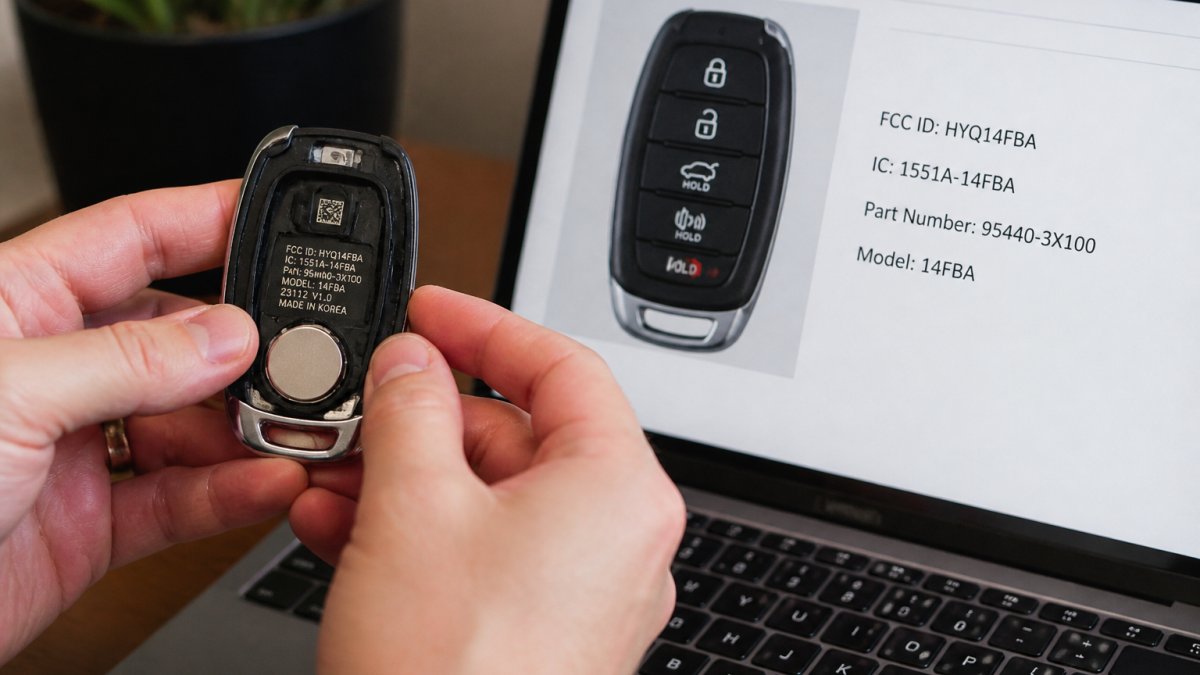
A common mistake is matching only the part number. Part numbers get superseded, and two fobs with the same number can carry different firmware. The FCC ID plus the part number together give you a real match.
How to Program a Replacement Key Fob (and When You Can’t)
How to program a replacement key fob depends entirely on your vehicle. Our step-by-step programming instructions walk through the process so you can judge whether you can handle the aftermarket fob yourself. Some cars let you pair a new fob from the driver’s seat in under a minute. Others require a dealer-level scan tool.
Onboard Programming vs. Diagnostic Equipment
Onboard programming is a sequence you run with the ignition, door locks, and buttons. Many older and mid-generation vehicles support it. Diagnostic programming uses a scan tool connected to the OBD port to write the new fob to the immobilizer.
Which one applies to you:
- Onboard works if: your owner’s manual lists a fob pairing procedure and the vehicle is older or mid-tier.
- Diagnostic required if: the car uses a push-to-start immobilizer, a smart key system, or a rolling-code security module.
- All-keys-lost situations: almost always need diagnostic equipment, even on cars that support onboard pairing.
Online Seller and Payment Safety Checks
Seller reputation decides whether an aftermarket fob is a bargain or a paperweight. Before you pay, check these signals:
- Reviews mention your vehicle model. Generic five-star reviews prove nothing.
- The listing states a compatibility guarantee. No guarantee, no purchase.
- A written return policy covers programming failures. “Doesn’t fit” returns are standard; “won’t program” returns are the ones that matter.
- Payment goes through a platform with buyer protection. Avoid wire transfers and peer-to-peer apps with no recourse.
- The seller responds to technical questions. Ask about frequency and chip type. Vague answers are a warning.
Watch out: a seller who ships fast but refuses returns on programmed fobs leaves you holding a dead remote with no refund path.
Risks of Low-Quality, Incompatible, and Used Fobs
The real risks aren’t hypothetical. They fall into a few clear buckets, and the used-fob risk is the one most buyers underestimate.
- Failed programming: the fob won’t pair, and no refund covers the labor you paid.
- Signal dropouts: cheap remotes lose range and intermittently fail to lock or start.
- Battery drain: poor circuitry pulls power and kills the fob battery early.
- Immobilizer lockout: repeated failed pairing attempts can trigger a security lockout that needs a scan tool to clear.
- Used or cloned fobs: a previously paired fob may still be linked to another vehicle’s system, and you have no way to confirm its history.
Can a Used Fob Stay Paired to Another Vehicle?
A used fob pulled from a wrecked or sold car can still hold pairing data for the vehicle it came from. Whether it works in your car depends on the vehicle’s immobilizer design:
- Fixed-code systems: older vehicles may accept a fob that was already paired elsewhere, which is exactly why a used fob from an unknown source is a security risk.
- Rolling-code and smart-key systems: the fob must be paired to your vehicle’s module, and a fob still linked to another car generally will not start yours until it is reprogrammed.
- Cloned fobs: a fob that carries a copy of another vehicle’s code is the worst case. It may work intermittently or not at all, and it can leave the original vehicle vulnerable.
The safe rule: treat any used fob as unpaired until a professional confirms it, and never buy a used fob without a written return policy.
Removing a Lost or Unknown Fob from Vehicle Memory
If a fob is lost, stolen, or of unknown origin, the fix is not just buying a new fob. The old fob must be removed from the vehicle’s memory, or it may still be able to unlock or start the car. Most vehicles store a limited number of paired fobs, and the pairing procedure either overwrites old slots or requires a scan tool to erase them.
- Onboard systems: some vehicles let you erase all paired fobs and re-pair only the ones you hold, which locks out any lost fob.
- Diagnostic systems: a locksmith or dealer with a scan tool can wipe the memory and pair only your fobs.
- All-keys-lost situations: almost always require diagnostic equipment to clear the memory and pair a new set.
If you lose a fob and cannot account for it, reprogram the vehicle rather than simply adding a replacement. A new fob paired alongside a lost one does not remove the lost fob’s access.
When Reprogramming Is Required
Reprogramming is required when you add a fob, replace a lost fob, buy a used fob of unknown history, or want to lock out a fob you no longer control. It is not required when you replace only the battery or the shell of a fob that is already paired to your vehicle.
Realistic Total-Cost Comparison: Online vs. Locksmith vs. Dealership
The sticker price on an aftermarket fob is not the total cost. Add programming, key cutting, shipping, and the risk of a failed attempt, and the cheapest listing can end up costing more than a bundled professional job. Build your own comparison using the line items below rather than trusting a single advertised price. Current locksmith pricing depends on the vehicle and the job, so request a quote for your specific situation.
The Cost Line Items That Actually Matter
Every replacement path carries some mix of these costs:
- Fob price. The remote itself, whether OEM, OEM-refurbished, or aftermarket.
- Key cutting. Only applies if the fob includes a physical key blade that must be cut to your ignition or door lock. Smart-key fobs without a blade skip this line.
- Programming. Onboard self-programming is free if your vehicle supports it. Diagnostic programming requires a scan tool, a locksmith visit, or a dealer appointment.
- Shipping. Online orders add shipping, and expedited shipping can erase the savings on a low-priced fob.
- Diagnostic or trip fee. A mobile locksmith may charge a service-call fee; a dealer may charge a diagnostic fee even if programming fails.
- Return shipping and restocking. If the fob does not fit or will not program, you may pay to ship it back, and some sellers charge a restocking fee.
- Second attempt. If the first fob fails, you buy again, pay programming again, and lose time.
How the Three Paths Compare
| Cost Line | Online Aftermarket Fob | Mobile Locksmith | Dealership |
|---|---|---|---|
| Fob price | Lowest advertised | Bundled into service price | Highest |
| Key cutting | You arrange it | Included on-site if blade applies | Included |
| Programming | You arrange it (free if onboard, paid if diagnostic) | Included on-site | Included |
| Shipping | Usually added | None | None |
| Trip or diagnostic fee | None, but you make the trips | Possible service-call fee | Possible diagnostic fee |
| Return risk | Yours if it will not program | Low, provider stands behind the work | Lowest |
| Time to working key | Days, plus a second trip if programming is needed | Same visit | Often a scheduled appointment |
The Math Most Buyers Skip
A common pattern is that the online fob looks like the clear winner until programming is priced in. If your vehicle needs diagnostic programming, the cost of a standalone programming session can meet or exceed the savings on the fob. Add return shipping on a failed unit and a second fob purchase, and the online path can land above a bundled locksmith visit.
The online path wins when three things are true: your vehicle supports onboard programming, the seller confirms fit by VIN and FCC ID before you pay, and the return policy covers programming failures. If any of those is false, price the professional bundle before you order.
Compare total cost, not sticker price. Ask the seller and the locksmith for an all-in number that includes the fob, cutting, programming, and any trip fee, then compare those two numbers side by side.
If you want to see what mobile programming actually runs in your area, our onsite car key fob programming cost guide breaks down the line items, and our average car key replacement cost guide gives benchmarks for full replacement.
What to Do When the Fob Doesn’t Work
A fob that won’t work isn’t always a dead fob. Run through this before you blame the seller:
- Replace the battery with a fresh one of the correct size.
- Check the battery contacts for corrosion or a bent tab.
- Try the spare fob to confirm the car’s receiver is fine.
- Re-run the pairing procedure exactly as written.
- Test all buttons, not just lock and unlock.
- Check for a security lockout if pairing keeps failing.
- Contact the seller with your results before the return window closes.
- Book a professional programming session if the fob is confirmed compatible but won’t pair.
Our troubleshooting walkthrough on car key fob not working covers the fixes in order, including the ones that don’t need any tools.
Get Your Replacement Fob Programmed by a Mobile Locksmith
Buying an aftermarket fob online can save money, but only if the fob is verified compatible and someone can program it correctly. That’s where most online purchases fall apart.
BDS Locksmith handles the job on-site. We’re licensed, bonded, and insured. We offer free estimates, same-day service, and a 5% military discount. If you’re not sure how to vet a provider, our guide on how to find a mobile locksmith for car keys covers what to ask before you book.
Get started with BDS Locksmith and call (408) 300-4369 to get your replacement fob programmed today.
Frequently Asked Questions
How reliable are aftermarket key fobs?
Quality varies widely by seller. A well-made aftermarket fob from a reputable source can work for years, but cheap generic remotes often use weaker buttons, shorter signal range, and cases that crack within months. The deciding factors are whether the fob matches your vehicle’s FCC ID and frequency, and whether the seller offers a compatibility guarantee and return policy. Buy only from sellers who publish those terms and have verifiable customer reviews. A licensed locksmith can also test and program the fob on site so you know it works before you rely on it.
How can I tell whether an aftermarket key fob is compatible with my car?
Check four things before ordering: your exact year, make, model, and trim; the FCC ID printed inside your original fob; the part number on the fob or in your owner’s manual; and the button layout (lock, unlock, trunk, panic). Cross-reference all four against the listing. Two vehicles that look identical can use different frequencies, so a match on year and model alone is not enough. If the listing does not show an FCC ID or part number, treat it as unverified and ask the seller directly before paying.
Do aftermarket key fobs need to be programmed?
Yes, in almost every case. A new fob is a blank shell until it is paired with your vehicle’s immobilizer and remote system. Some older vehicles allow onboard programming through a sequence of ignition and door cycles, which you can do yourself. Most vehicles built in the last decade require diagnostic equipment, and some models require a locksmith or dealership with manufacturer-level access. Confirm the programming method for your specific vehicle before you buy, because a fob you cannot program is money wasted.
Is an OEM key fob better than an aftermarket one?
OEM fobs match your vehicle exactly and carry the lowest risk of pairing or durability problems, but they cost the most. OEM-refurbished fobs use a genuine OEM shell and board with a new battery and fresh case, which gets you close to OEM reliability for less. Aftermarket fobs are the cheapest option and can work well when the seller is reputable and the compatibility details check out. The tradeoff is that aftermarket quality is inconsistent, so the return policy and compatibility guarantee matter as much as the price.