Table of Contents
- Why Car Keys Break in the Ignition
- Assess the Broken Key Fragment and Lock Condition
- Safety Precautions Before Attempting Extraction
- How to Remove a Broken Key From a Car Ignition
- Broken Key Extraction Tools and Alternatives
- Common Mistakes to Avoid During Extraction
- Cost to Extract a Broken Car Key and Service Options
- Car Key Replacement After Broken Key Extraction
- When to Call a Professional Locksmith
- Conclusion
- Frequently Asked Questions
Last Updated: October 17, 2026
Why Car Keys Break in the Ignition
A broken key car ignition situation is frustrating, but it happens more often than you’d think. Understanding why keys break helps you prevent it from happening again. Most breaks occur because of wear, stress, or a manufacturing defect in the key itself.
Keys break for several reasons. Over time, repeated turning in the lock wears down the metal. A key that’s already weak or bent will snap under normal pressure. Forcing a stiff ignition lock is another common cause. If your ignition feels stuck, don’t force it, that’s when keys snap.
The ignition lock itself can be the problem. When the lock cylinder becomes damaged or misaligned, it puts uneven pressure on the key. This stress concentrates at one point, making the key more likely to break. Dirt and debris inside the lock can also cause resistance that leads to breakage.
Temperature changes affect metal too. Cold weather can make metal more brittle (Effect of tempering on the ductile-to-brittle transitional behavior of Ni-Cr-Mo low-alloy…). A key that works fine in summer might snap in winter if there’s already internal weakness. Understanding these causes helps you know whether DIY extraction is safe or if you need professional help.
Before you attempt extraction, check if your key was already damaged or bent. A key that broke due to a manufacturing defect is different from one that broke due to ignition lock problems. This affects whether extraction alone will solve your issue.
Assess the Broken Key Fragment and Lock Condition
Before you attempt any removal, you need to see exactly what you’re working with. Look at the broken key fragment and the lock condition. This determines which removal method will work best.
Check how much of the key is visible. If the fragment sticks out from the lock, you have better access. If it’s recessed deep inside the lock cylinder, extraction becomes harder. Shine a flashlight into the ignition to see the full picture.
Feel around the lock gently with your finger. Does it feel rough or smooth? Is there debris inside? A rough, damaged lock cylinder might have broken the key, which means extraction alone won’t fix your problem. You’ll need ignition repair after removal.
Look for these warning signs:
- The lock cylinder is visibly cracked or chipped
- Debris or metal shavings are visible inside the lock
- The lock feels loose or wobbles
- The key fragment won’t budge with gentle pressure
- The ignition position feels stuck or grinding
If you see any of these signs, stop. Call a professional locksmith. Forcing extraction on a damaged lock can cause more harm. Professional locksmiths have the right tools and experience to handle difficult extractions safely.
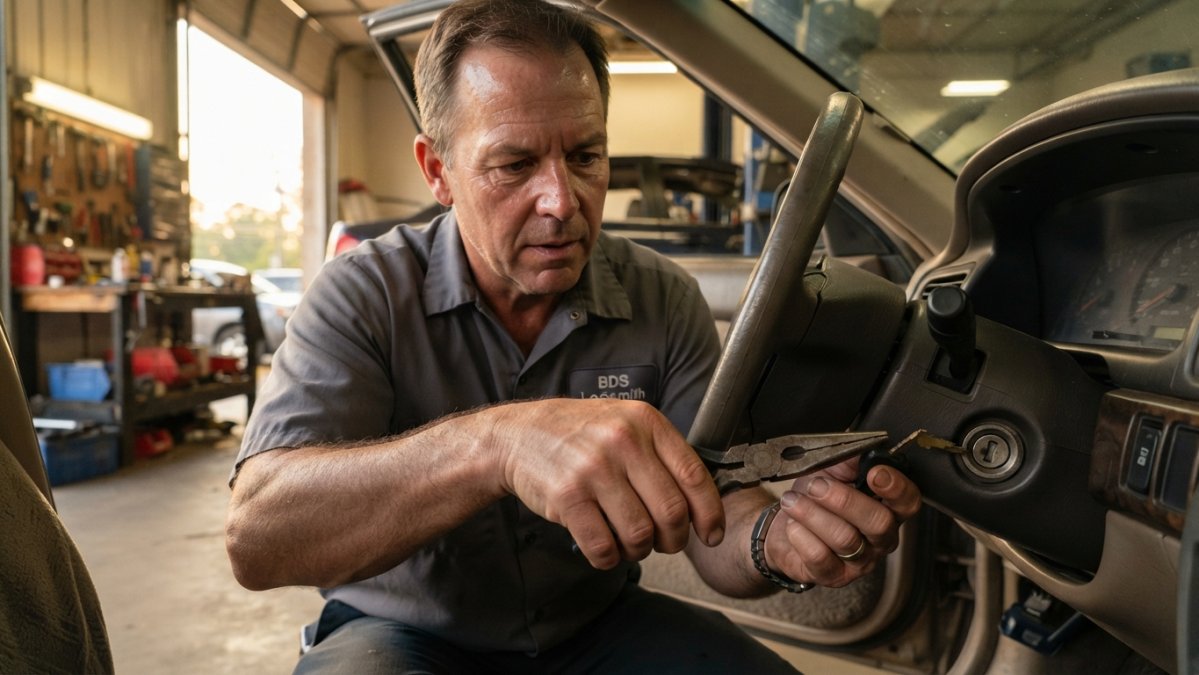
Never push a broken key fragment deeper into the lock. Even gentle pressure can cause it to lodge further or break into smaller pieces, making extraction much harder. If the fragment won’t budge with light pulling, stop and call a locksmith.
Safety Precautions Before Attempting Extraction
Extracting a broken key yourself requires caution. Taking the right safety steps protects your vehicle and prevents injury. Start by turning off your vehicle completely. Remove the key from the ignition position if any part is still accessible.
Engage the parking brake and make sure your vehicle is in park. This prevents accidental movement while you’re working. If your vehicle has a steering wheel lock, understand that it may engage after you turn off the engine. This is normal and doesn’t affect your extraction attempt.
Wear safety glasses to protect your eyes from any metal fragments that might fly out. Broken keys can splinter, and small pieces might scatter. Gloves are optional but helpful if you have cuts or sensitive skin.
Work in good lighting. Use a flashlight or work lamp to see inside the ignition lock clearly. Poor lighting leads to mistakes and can cause you to apply force in the wrong direction.
Gather your tools before you start:
- Needle-nose pliers or tweezers
- Thin metal strip, picture wire, or specialized key extraction tool
- Penetrating lubricant
- Flashlight
- Safety glasses
- Clean cloth or paper towels
Never use excessive force. If something doesn’t move with gentle, steady pressure, stop. Forcing extraction can break the lock cylinder or push the fragment deeper. This turns a simple extraction into an expensive ignition repair.
The most important safety rule: if the key fragment won’t budge with light pressure after a few attempts, stop and call a professional. Forcing it causes more damage and costs more money in the long run.
How to Remove a Broken Key From a Car Ignition
Removing a broken key car ignition yourself is possible if the fragment is accessible and the lock isn’t damaged. Two main methods work for most situations. Choose the method based on how much of the key is visible.
Method 1: Using Needle-Nose Pliers or Tweezers
This method works best when the key fragment sticks out enough to grip. Needle-nose pliers give you better control than your fingers alone.
Step 1: Position yourself comfortably in the driver’s seat. Make sure you have good visibility of the ignition lock. Use a flashlight if needed.
Step 2: Grip the visible part of the key fragment with needle-nose pliers. Hold the pliers as close to the lock as possible. This gives you more control and reduces the chance of the key snapping again.
Step 3: Apply steady, gentle pressure. Pull straight out toward you. Don’t twist or wiggle the pliers. Twisting can break the fragment or damage the lock wafers inside.
Step 4: Pull with consistent, even pressure. Most fragments come out in one smooth motion. If it doesn’t move after 5-10 seconds of gentle pulling, stop. Forcing it will cause damage.
Step 5: Once the fragment is out, inspect it. Check if the entire key came out or if pieces remain in the lock. Use your flashlight to look inside the ignition lock. If you see metal fragments, you may need to repeat the process or call a professional.
For tweezers, the process is the same. Tweezers work better for smaller fragments or if you need more precision. The grip isn’t as strong as pliers, so use tweezers only if the fragment is small and accessible.
Method 2: Using a Thin Metal Tool
This method works when the key fragment is recessed deep in the lock. A thin metal strip can reach fragments that pliers can’t grip.
Step 1: Find a thin metal tool. Picture wire, a thin metal strip, or a specialized key extraction tool works well. The tool needs to fit into the keyway alongside the broken fragment.
Step 2: Insert the tool carefully into the lock. Slide it in next to the key fragment. Don’t force it. If it doesn’t slide in smoothly, try a thinner tool.
Step 3: Once the tool is positioned, try to hook or wedge it against the fragment. The goal is to create contact that lets you pull the fragment out. This requires patience and gentle manipulation.
Step 4: Apply slow, steady pressure. Pull the tool and fragment toward you. Again, straight pulling works better than twisting. Let the tool and fragment move together as one unit.
Step 5: If the tool catches on the key fragment, maintain pressure and pull smoothly. The fragment should slide out. If it doesn’t move after several attempts, stop. Continuing will damage the lock.
Step 6: After removal, check the lock for remaining fragments. Look inside with a flashlight. If pieces remain, you may need to repeat the process or seek professional help.
Both methods require patience. Rushing leads to mistakes. If the fragment won’t come out after 10-15 minutes of gentle attempts, stop. Professional extraction tools and expertise make a difference.
DIY extraction works best for keys that broke cleanly and are partially visible. If the key snapped deep inside the lock or the lock is damaged, professional extraction is safer and faster.
Broken Key Extraction Tools and Alternatives
Several tools can help extract a broken key. Some are household items. Others are specialized tools made for this exact job.
Needle-nose pliers are the most common household tool. They grip the key fragment securely. The long handles give you use and control. Most people have these in a toolbox.
Tweezers work for smaller fragments. They’re less powerful than pliers but offer more precision. Use tweezers if the fragment is small or if you need to work carefully around the lock edges.
Picture wire is thin and flexible. It can slide into tight spaces next to the key fragment. Bend the wire into a hook shape to catch the fragment. This method takes practice but works when pliers won’t fit.
Thin metal strips cut from aluminum or steel work similarly to picture wire. A thin ruler or metal bookmark can work in a pinch. The key is having something thin enough to fit in the keyway.
Specialized key extraction tools are designed specifically for this job. They have hooks, barbs, or serrated edges that grip broken key fragments. Professional locksmiths use these tools. You can buy them online, but they’re not necessary for most extractions.
Penetrating lubricant helps loosen stuck fragments. Apply it around the lock and let it soak for a few minutes. This reduces friction and makes pulling easier. It also protects the lock from rust.
Super glue method is controversial. Some people apply super glue to the end of a key blank, insert it into the lock to bond with the fragment, and pull both out together. This method risks gluing the lock shut permanently. Avoid it unless you’re willing to replace the ignition lock.
The best tool is one you already have. Start with needle-nose pliers. If that doesn’t work, try picture wire or a thin metal strip. Only buy specialized tools if you plan to extract multiple keys or want professional-grade equipment.
Common Mistakes to Avoid During Extraction
Most extraction failures happen because people make preventable mistakes. Knowing these mistakes helps you succeed on your first attempt.
Mistake 1: Forcing the fragment. Applying too much pressure breaks the fragment into smaller pieces or damages the lock. Use gentle, steady pressure instead. If it doesn’t move easily, stop and try a different method.
Mistake 2: Twisting while pulling. Twisting the pliers or tool rotates the fragment inside the lock. This can break it or jam it further. Always pull straight out. Let the tool do the work without rotation.
Mistake 3: Pushing instead of pulling. Some people push the fragment deeper thinking it will come out the other side. This doesn’t work. Push only causes damage. Always pull toward you.
Mistake 4: Using the wrong tool. A tool that’s too thick won’t fit in the keyway. A tool that’s too weak will bend under pressure. Match the tool to the job. Needle-nose pliers work for most situations.
Mistake 5: Working in poor lighting. You can’t see what you’re doing in dim light. This leads to mistakes and wasted effort. Use a bright flashlight and position it so you see inside the lock clearly.
Mistake 6: Ignoring warning signs. If the lock feels damaged, rough, or grinding, stop. Continuing will cause more damage. Professional help is cheaper than fixing a damaged ignition lock.
Mistake 7: Trying for too long. If extraction takes more than 15-20 minutes of gentle attempts, it’s time to call a professional. Continuing increases the risk of damage.
Mistake 8: Not checking for remaining fragments. After you pull out the main piece, look inside the lock with a flashlight. Metal shavings or small fragments can cause problems later. Remove any debris you find.
These mistakes turn a simple extraction into a costly problem. Patience and caution prevent most of them.
Cost to Extract a Broken Car Key and Service Options
Extracting a broken key yourself costs almost nothing if you have basic tools at home. Professional extraction costs vary based on your location and the complexity of the job.
DIY extraction requires only tools you likely already own. Needle-nose pliers, tweezers, and picture wire are free if you have them. Penetrating lubricant costs a few dollars. Total cost for DIY: zero to five dollars.
Professional extraction costs depend on several factors. The complexity of the job matters. A simple extraction of an exposed fragment costs less than removing a deep, recessed fragment. The damage to the lock also affects price. A lock that’s already damaged requires more work.
Most professional locksmiths offer free estimates. Call and describe your situation. They’ll tell you what the job will cost before they start. This lets you decide whether to try DIY or hire a professional.
BDS Locksmith provides free estimates for broken key extraction. Our licensed, bonded, and insured team can assess your specific situation and give you an accurate price. We offer same-day service and competitive pricing for all automotive locksmith needs.
If you damage the ignition lock during extraction, repair costs increase significantly. A damaged lock may need replacement, which costs more than simple extraction. This is why caution matters. Taking your time prevents expensive damage.
Get a professional estimate before you decide on DIY extraction. Knowing the professional cost helps you decide if DIY is worth the risk. Sometimes paying a professional upfront is cheaper than paying for lock damage later.
Car Key Replacement After Broken Key Extraction
After you extract the broken key, you need a new key. Your options depend on your vehicle’s age, make, and model.
Traditional key replacement is the simplest option. A locksmith cuts a new key to match your vehicle’s lock. This works for older vehicles with basic ignition locks. Cost varies but is usually modest.
Transponder key replacement is necessary for most modern vehicles. Transponder keys have a computer chip that communicates with your vehicle’s security system. The key must be programmed to your vehicle. A locksmith or dealership can do this.
Key fob replacement may be needed if your vehicle uses a push-button ignition. Key fobs have electronics and batteries. Replacement involves both the fob and programming.
Dealership replacement is an option but usually costs more than a locksmith. Dealerships have access to your vehicle’s records and can order exact replacements. This is useful if you need multiple keys or have a rare vehicle.
Locksmith replacement is often faster and cheaper than dealership options. Professional locksmiths can cut and program keys on-site. Many offer mobile service, coming to you instead of requiring you to visit a shop.
BDS Locksmith handles car key replacement for all vehicle types. We cut and program keys on-site with mobile service. Our team can replace traditional keys, transponder keys, and key fobs. We offer competitive pricing and same-day service.
Before ordering a replacement, decide what type of key you need. Check your vehicle’s manual or ask a locksmith. Having the right key prevents compatibility issues.
Professional key replacement is usually faster and cheaper than dealership options. A locksmith can often cut and program a new key while you wait, sometimes at your vehicle’s location.
When to Call a Professional Locksmith
Some situations require professional help. Knowing when to call a locksmith prevents damage and saves money.
Call a locksmith if:
- The key fragment is deep inside the lock and not visible
- The ignition lock feels damaged, rough, or grinding
- You’ve attempted extraction for more than 15-20 minutes without success
- The lock cylinder is cracked, chipped, or misaligned
- Metal shavings or debris are visible inside the lock
- The key broke due to a damaged lock, not just wear
- You’re uncomfortable attempting extraction yourself
- You need immediate service and don’t have time for DIY
Call a locksmith immediately if:
- The fragment won’t budge at all
- The lock is completely stuck or frozen
- You accidentally pushed the fragment deeper
- You damaged the lock during extraction attempts
- You need the vehicle running urgently
Professional locksmiths have specialized tools designed for difficult extractions. They have experience with different vehicle types and ignition systems. They can assess lock damage and recommend repair or replacement.
BDS Locksmith provides 24/7 emergency service for broken key situations. Our licensed, bonded, and insured team arrives quickly with the right tools. We handle extraction, lock repair, and key replacement all in one visit. Call (408) 300-4369 for immediate assistance.
Professional extraction takes minutes instead of hours. The locksmith’s expertise prevents damage. This saves money compared to paying for lock repair after a failed DIY attempt.
Professional extraction is best for complex situations, damaged locks, or when you’re unsure about DIY methods. The cost is usually reasonable compared to the risk of damaging your ignition.
Conclusion
Extracting a broken key from your car ignition yourself is possible if the key fragment is accessible and the lock isn’t damaged. Needle-nose pliers or a thin metal tool can remove most exposed fragments with gentle, steady pressure. However, if the lock feels damaged, the fragment is deeply recessed, or your extraction attempts fail, stop and call a professional.
BDS Locksmith specializes in broken key extraction and automotive locksmith services. Our licensed, bonded, and insured team provides same-day mobile service throughout the South Bay Area. We offer free estimates, competitive pricing, and professional expertise to handle your broken key situation safely and efficiently. If DIY extraction isn’t working, we’re ready to help. Call (408) 300-4369 for immediate assistance with broken key extraction, ignition repair, and car key replacement.
Frequently Asked Questions
Can you remove a broken key from a car ignition yourself?
Yes, you can extract a broken key from a car ignition yourself if the fragment is partially exposed and accessible. Use needle-nose pliers, tweezers, or a thin metal tool to grip and pull the fragment straight out. However, if the break is deep inside the lock cylinder, the fragment is recessed, or you risk pushing it further into the ignition, professional extraction is safer. A locksmith has specialized broken key extraction tools and experience to remove fragments without damaging the lock wafers or ignition system.
What tools can remove a broken key from a car ignition?
Common household tools for broken key extraction include needle-nose pliers, tweezers, and thin metal strips like picture wire or a straightened paperclip. Specialized broken key extraction tools, such as key extractors with barbed hooks or spiral extractors, grip the fragment more securely and reduce the risk of pushing the key deeper. A thin metal tool or lubricant can also help you access a recessed fragment. For difficult extractions, a professional locksmith carries professional-grade extraction equipment and can assess whether the ignition lock itself has been damaged.
What should you do if you can’t extract the broken key yourself?
Stop attempting extraction immediately if the fragment is stuck, deeply recessed, or you risk damaging the lock. Pushing the key farther into the ignition can lodge it permanently and damage the lock wafers or ignition switch. Contact a professional automotive locksmith or your vehicle’s dealership. A locksmith can use specialized extraction tools and techniques to safely remove the fragment without harm to your ignition system. They can also assess whether the lock needs repair or replacement and help arrange a replacement key with programming if needed.
Can a broken key damage a car ignition?
Yes, a broken key can damage your car ignition if extraction is attempted incorrectly. Pushing the fragment deeper into the lock cylinder can jam the lock wafers, bend internal components, or break the ignition switch itself. Twisting or applying excessive force during extraction can also cause damage. Rough extraction attempts may scratch the keyway or cause metal shavings to lodge inside the lock. Professional locksmiths use careful, straight-pull extraction methods and proper tools to avoid ignition damage. If damage occurs, ignition repair or replacement may be necessary, which costs more than professional key extraction.