Table of Contents
- What Residential Lock Rekeying Services Cost Actually Includes
- Locksmith Service Call Fee: What You’re Paying For
- How Long Does It Take to Rekey a House?
- Rekeying vs Replacing Door Locks: Which Makes Sense for Your Home?
- Factors That Change Your Lock Rekeying Cost
- Security Implications of Different Lock Grades
- Smart Lock Rekeying Compatibility and Master Key System Costs
- How to Verify Locksmith Credentials and Avoid Scams
- Frequently Asked Questions
Last Updated: September 25, 2026
What Residential Lock Rekeying Services Cost Actually Includes
The price of residential lock rekeying services cost reflects three separate charges: a service call fee, labor time, and any new hardware or keys. Understanding how each piece is billed is the fastest way to spot a fair estimate from an inflated one. At BDS Locksmith, we provide free estimates so homeowners know the full number before work begins.
A service call fee is the flat charge for a locksmith to travel to your home, sometimes called a trip charge. Labor covers the actual time spent disassembling cylinders and swapping pins. Hardware costs apply only when a cylinder is damaged, worn, or the wrong size for the door.
Most homeowners assume the quoted number is the final one. It rarely is unless the locksmith itemizes these three parts in writing. Ask for that breakdown before you book.
Service Call Fee vs. Labor Hours
The service call fee gets you a van at your curb. Labor hours start once the technician begins work.
A common mistake is comparing two quotes by total price alone. One locksmith might waive the trip charge but bill a higher hourly rate; another does the reverse. What matters is the combined figure for your specific job. A single-cylinder rekey on a standard pin tumbler lock takes far less labor than rekeying six doors with mixed hardware, so the labor line should move with the scope.
Ask whether the service call fee is waived if you approve additional work on-site. Many mobile locksmiths fold the trip charge into a larger job, which lowers your effective cost per lock.
Locksmith Service Call Fee: What You’re Paying For
A locksmith service call fee is a flat charge covering travel, fuel, and the technician’s arrival at your property. It is separate from the work itself and usually appears as a single line on the invoice.
What that fee includes varies by provider. Some roll basic lock inspection into it; others charge separately for a security assessment. Before you commit, confirm:
- Whether the fee is fixed or distance-based
- Whether it applies per visit or per lock
- Whether after-hours calls carry a higher trip charge
- Whether the fee is credited toward labor if you proceed
The most reliable way to avoid surprises is to request a written price estimate before dispatch. A professional locksmith will give you a range based on your lock type and door count, then confirm the final number on-site once they see the actual hardware.
How Long Does It Take to Rekey a House?
Rekeying a house typically takes 15 to 30 minutes per lock for a standard pin tumbler cylinder, so a whole-home job usually runs one to two hours. The exact time depends on how many locks you have and whether the cylinders are already in good condition.
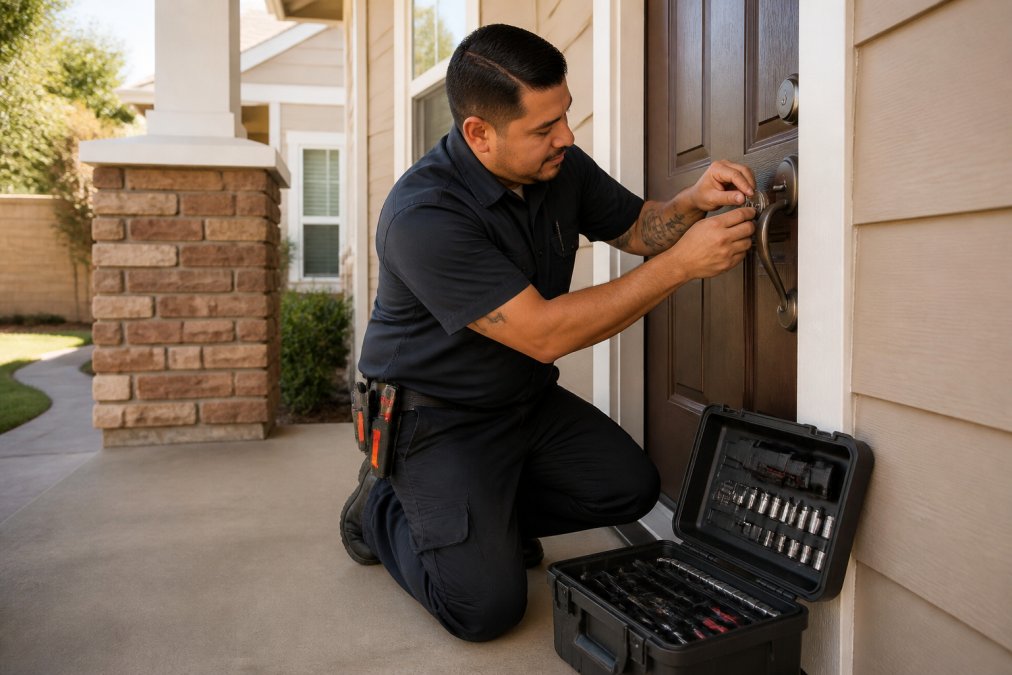
A single deadbolt is quick. A home with a knob lock and deadbolt on every exterior door takes longer because each cylinder has to be removed, repinned, tested, and reinstalled. Older or corroded locks add time, and a stuck cylinder can double the labor on that door.
Here is how the timing usually breaks down:
| Job Scope | Typical Time | Notes |
|---|---|---|
| Single deadbolt | 15-20 minutes | Simplest rekey |
| Knob lock + deadbolt | 25-40 minutes | Two cylinders per door |
| Whole home (4-6 doors) | 1-2 hours | Includes testing |
| Mixed or worn hardware | 2-3 hours | May need replacement parts |
If a lock is seized or the keyway is damaged, rekeying may not be possible at all, and replacement becomes the faster path.
Rekeying vs Replacing Door Locks: Which Makes Sense for Your Home?
Rekeying vs replacing door locks comes down to one question: is the lock mechanism itself still sound? If the hardware works and you only need old keys to stop working, rekeying is almost always the cheaper, faster choice.
Rekeying changes the internal pins so a new key operates the existing cylinder. The lock body, finish, and mounting stay the same. Replacing means removing the entire lock and installing new hardware.
Choose rekeying when:
- You moved into a new home and want old keys disabled
- A roommate, contractor, or ex-partner still has a key
- The locks are quality hardware in good condition
- You want to keep a consistent finish across doors
Choose replacement when:
- The cylinder is corroded, cracked, or jammed
- You want to upgrade to a higher security grade
- The existing locks are builder-grade and worn out
- You are switching to a smart lock
Rekeying a worn or damaged cylinder is a waste of money. The new pins will not fix a failing mechanism, and you will pay twice once it fails. Have the locksmith inspect each cylinder first.
Factors That Change Your Lock Rekeying Cost
Several variables move the final number up or down. Knowing them helps you budget accurately and question any quote that seems off. The list below is roughly ordered from the factors that swing price the most to the ones that nudge it.
Number of Locks and Cylinders
This is the single biggest driver. Locksmiths price per cylinder, not per door, and a door with both a knob lock and a deadbolt counts as two cylinders. A home with four exterior doors and knob-plus-deadbolt hardware has eight cylinders to repin, not four. Most providers apply a per-cylinder rate that drops slightly as the count rises, so the tenth cylinder usually costs less than the first. Ask for the per-cylinder rate and any volume break before you book.
Lock Type and Cylinder Complexity
Standard pin tumbler cylinders are the least expensive to rekey because they use common pins and tools. Costs climb with:
- Security pins, spool, serrated, and mushroom pins take longer to repin and test correctly
- Restricted keyways, keys that cannot be duplicated at a hardware store often require dealer-supplied blanks
- High-security cylinders, brands built around patented key control use proprietary pins and may require a certified technician
- Knob vs. deadbolt, a knob cylinder is usually simpler than a deadbolt, but the difference is small compared to keyway type
Key Quantity and Duplication
Rekeying includes a set number of new keys, commonly two per cylinder, and every additional key is a line item. Standard key blanks are inexpensive; restricted or high-security blanks can cost several times more and may need to be ordered. If you need keys for a family of five plus a spare hidden outside, say so upfront so the quote reflects it.
Hardware Condition and Accessibility
A cylinder that comes out cleanly repins in minutes. One that is corroded, painted over, or seized adds labor, and a stripped mounting screw or a door that will not close squarely adds more. Locks on storm doors, garage entry doors, and gates are often exposed to weather and take longer than interior-facing hardware. If a cylinder cannot be salvaged, the quote shifts from rekey to replacement.
Travel Distance and Service Area
A flat trip charge is common inside a core service area, but providers on the edge of their coverage or in rural areas often bill by mileage. Confirm whether the fee is fixed or distance-based before dispatch, this is one of the most common sources of on-site surprises.
After-Hours, Weekend, and Holiday Surcharges
Emergency locksmith service fees climb fast outside normal business hours. Nights, weekends, and holidays typically carry an after-hours surcharge on top of the standard rate. A lockout service call at 2 a.m. costs more than the same job at 2 p.m., and that premium is normal across the industry. If your situation is not urgent, scheduling during regular hours keeps the price down.
Bundling and Multi-Service Discounts
Many providers discount the per-cylinder rate when you rekey the whole house in one visit, and some waive the service call fee if you approve additional work on-site. Bundling a rekey with a deadbolt upgrade or a smart lock installation often costs less than booking those jobs separately, because the technician is already at your door.
When you compare quotes, ask each provider for the same three numbers: per-cylinder rate, service call fee, and included key count. Quotes that look cheaper on the total often hide a lower key count or a mileage charge.
Security Implications of Different Lock Grades
Most price guides ignore lock grades, but they matter more than the rekey price itself. Lock grade describes how much force a lock can withstand, and it directly affects your home security.
Locks are rated in three tiers. Grade 3 is builder-grade and the least resistant to forced entry. Grade 2 offers a middle ground for most homes. Grade 1 is the strongest and built for high-traffic or high-risk doors. Rekeying a Grade 3 lock makes old keys useless, but it does not make a flimsy lock strong.
If your home still has builder-grade hardware, spending a little more to upgrade the deadbolt while rekeying the rest is often the smarter long-term move. A professional locksmith can perform a security assessment and tell you which doors are worth upgrading.
Rekeying solves the key problem. It does not solve the strength problem. Check your lock grade before assuming a rekey is enough.
Smart Lock Rekeying Compatibility and Master Key System Costs
Most price guides stop at mechanical locks. Two modern categories, smart locks and master key systems, change the rekeying math in ways the standard advice does not cover.
Which Smart Locks Can Be Rekeyed
A smart lock is rekeyable only if it contains a traditional mechanical cylinder with a keyway. The electronics sit on top of that cylinder; they do not replace it. That splits the market into three groups:
- Rekeyable smart locks, models that keep a standard pin tumbler cylinder behind the keypad, such as the Schlage Encode and Camelot families and the Kwikset SmartCode and Obsidian lines with a physical keyway. These can be repinned like any mechanical lock, and on Kwikset’s SmartKey models the homeowner can even re-key the cylinder without removing it.
- Non-rekeyable smart locks, fully keyless deadbolts and retrofit units that replace the interior thumb turn with a motorized assembly. There is no pin tumbler to repin, so the only path is replacement or a firmware-level user reset that removes old access codes rather than old keys.
- Hybrid and retrofit models, devices that mount over an existing deadbolt and keep the original cylinder. These inherit whatever rekeyability the underlying lock has, so the answer depends on the hardware already on your door.
Before booking, identify the exact model. The brand name alone is not enough, Kwikset, Schlage, and Yale each sell both rekeyable and non-rekeyable products under the same family name. If the lock has a keyway, a locksmith can usually service it. If it does not, expect a replacement quote instead of a rekey quote.
What Rekeying a Smart Lock Costs Versus Replacing It
When a smart lock is rekeyable, the labor is close to a standard cylinder rekey because the mechanical work is the same. The variable is the key blank: restricted and high-security smart lock keyways often require dealer-supplied blanks, which cost more than a standard blank and may need to be ordered. When a smart lock is not rekeyable, the comparison shifts entirely, you are pricing a new lock plus installation rather than a repin, and the electronic features you are paying for have nothing to do with the key problem you were trying to solve.
Master Key System Costs for a Home
A master key opens every lock in a set while individual keys open only their own door. Setting up a master key system requires rekeying each cylinder to a specific pinning pattern, plus a planning step that maps which key opens which doors. That planning is the part most homeowners underestimate.
Cost drivers for a residential master key system:
- Number of cylinders in the hierarchy, every lock in the system has to be pinned to accept both its individual key and the master key
- Number of key levels, a simple master-plus-change-key setup is cheaper than a multi-level hierarchy with sub-masters
- Cylinder type, standard pin tumblers are the least expensive to pin into a hierarchy; high-security and restricted keyways add cost and may limit which locks can participate
- Key blanks and duplication, master keys and change keys both have to be cut, and restricted blanks cost more
- Ongoing key control, if you want the ability to add or revoke keys later without re-pinning everything, that has to be designed in from the start
Master key systems are common for rental properties, multi-unit homes, and small businesses, and the added complexity raises the price accordingly. For a single-family home with one household, a master key system is usually unnecessary, a standard rekey that puts every exterior door on the same key achieves most of the convenience at a fraction of the cost.
| System Type | Rekeyable? | Relative Cost |
|---|---|---|
| Standard pin tumbler | Yes | Lowest |
| High-security cylinder | Yes | Moderate |
| Rekeyable smart lock | Yes | Moderate |
| Master key system | Yes, planned | Higher |
| Non-rekeyable smart lock | No | Replacement |
If your door has a keyway, it can probably be rekeyed. If it does not, you are shopping for a replacement, not a rekey. Confirm the exact model before you accept a quote.
How to Verify Locksmith Credentials and Avoid Scams
Verification is the single best defense against overcharging, and it takes two minutes. A legitimate locksmith will confirm licensing, insurance, and a local address without hesitation.
Protect yourself with these steps:
- Ask for the license number and verify it with your state or local licensing authority
- Confirm the company carries liability insurance before work begins
- Request a written estimate covering the service call fee, labor, and parts
- Check that the business has a verifiable local address, not just a call center
- Refuse any quote that jumps dramatically once the technician is on-site
- Pay by card so you have a record of the transaction
The most common scam is the lowball phone quote that balloons on arrival. A locksmith who quotes a firm range and explains what could change it is the one worth hiring. BDS Locksmith is licensed, bonded, and insured, and provides free estimates.
You can also check consumer protection guidance from the Federal Trade Commission on avoiding service scams, which outlines red flags for home service fraud. For lock hardware standards, the American National Standards Institute publishes the grading criteria referenced above. Homeowners researching security upgrades can also review general safety recommendations from the U.S. Department of Homeland Security.
A service call fee, labor hours, and any hardware costs should all appear in writing before a technician starts. BDS Locksmith provides free estimates, same-day availability, and mobile service that comes to your door, with licensed, bonded, and insured technicians and a 5% military discount. Call (408) 300-4369 to get a clear quote and secure your home without the guesswork.
Frequently Asked Questions
How much should it cost to rekey a lock?
Residential lock rekeying services cost depends on the number of locks, lock type, and whether you need after-hours service. A standard pin tumbler cylinder rekey is usually the base service, and each additional lock adds to the total. Service call fees and trip charges also apply. BDS Locksmith provides free estimates so you know the full price before work begins, with no surprise charges when the technician arrives.
Is it cheaper to replace locks or rekey them?
Rekeying is almost always cheaper than replacing locks because you keep the existing hardware and only change the internal pins. Replacement makes sense when the lock is damaged, you want to upgrade to a higher security grade, or the hardware is builder-grade. If your deadbolts and knob locks are in good condition, rekeying is the cost-effective choice. BDS Locksmith can assess your hardware and recommend the option that fits your budget.
Does rekeying a lock change the key entirely?
Yes. Rekeying changes the internal pin configuration inside the lock cylinder so your old key no longer works. You receive brand-new keys cut to the new keyway. The lock mechanism and exterior hardware stay the same. This is why rekeying is the standard step after moving into a new home, ending a lease, or when a key is lost or stolen. It gives you full control over who can enter your residential property.
How long does it take a locksmith to rekey a house?
A single lock takes about 10 to 15 minutes for an experienced locksmith. A typical house with three to five exterior doors takes 30 to 60 minutes total. Complex locks, smart lock compatibility checks, or master key systems can extend the time. BDS Locksmith arrives with the right locksmith tools and rekey kits on the truck, so most residential jobs finish in one visit without a return trip.